
The Faroe Islands: Europe’s best-kept secret for big nature, quiet hikes and remote villages


Lauren Taylor traverses the Faroe Islands - the land of 10,000 waterfalls - and discovers Europe’s best kept secret for lovers of big nature, stunning trails, and exploring remote settlements.
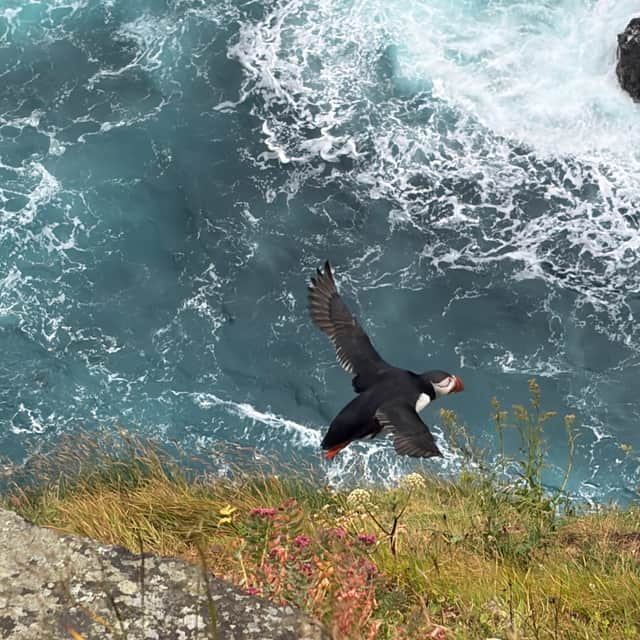
A group of puffins sit on the mouth of a waterfall that plummets 30 metres off the cliff edge into the sea, before taking off one by one into the breeze.
Behind, wood-panelled houses in red or black with green grass roofs (traditionally for insulation) cluster together to form the village of Gásadalur, on the Faroese island of Vagar.
Until 2004, when a tunnel and road were built, there was no way to get to or from this settlement unless by foot, with cliffs too steep to hoist much up from boats.
“The postman used to walk here,” says our Intrepid tour leader Amalie, as I look at the imposing mountain face, wondering how exactly. “Stoves, coffins, everything, they carried it over that mountain.
“The Faroese are very, very hardy people,” she adds.
Indeed. Conditions here can be harsh; there are some 300 days of rain a year and winds can reach up to 23 miles per hour on the 18 islands that make up this wild archipelago, midway between Iceland and Norway.

The self-governing body within the Kingdom of Denmark, may not be far from the UK (just two hours and fifteen minutes direct from London Gatwick and less from Edinburgh) but in many ways it feels like another world.
Each island comes with scenery as striking as the next, thanks to volcanic activity around 50 million years ago and glaciers of ice ages leaving vast fjords, sharp mountaintops, crags jutting dramatically into the sky and high-falling steeply into the sea.
There’s not a tree in sight (except for a couple of imported ‘tree farms’) on this incredible expanse of green-covered black rock, where waterfalls in their thousands weave their way through the cracks of the earth formed many centuries ago. It’s sometimes referred to as the “land of 10,000 waterfalls” which feels feasible although no official count has taken place.
Some 250km from its closest neighbour – the Scottish highlands – there’s a definite feeling of isolation here, where small villages perch on the edges of dramatic backdrops and resilient communities are deeply intertwined with nature.
At the moment, tourism is small-scale and the Faroese government seems to be fighting the effects of overtourism before it even happens – there have been temporary closures of the better-known hiking spots for conservational purposes, where the ground is given a break and footpaths are rebuilt.
And as a visitor, you can feel it – the quietness is palpable.
If there’s one image you might have seen from the Faroe Islands, it’s probably Sørvágsvatn on Vagar island, the largest lake in the country known as ‘the lake above the ocean’ due to its edge being close to the sea’s cliff and the optical illusion it creates.
My Intrepid tour group of nine – mostly adventurous solo travellers between their 30s and 70s – head out to do the 7km hike, with steep elevation to the cliff edge for the all-important view. Despite the changeable weather I’ve come to expect here in summer, the clouds part and blue sky emerges just as we reach the highest point – the lake stretching to the sea cliff’s edge, with not a person in sight.
While the most tourist-heavy trail I encounter – due to it being the filming location in the film No Time To Die where James Bond dies and someone’s bright idea to erect his tombstone – is the hike to the Kallur Lighthouse on Kalsoy Island. But it’s a spectacular walk along the top ridges, if you don’t mind some company.
Simply driving the winding roads also offers views at every turn, like the Drangarnir sea stacks – two spiky islets out at sea – that featured in the film How To Train Your Dragon.

We make a stop at the country’s only prison, a small, one-storey building on the islands of Streymoy surrounded by a fence without so much as a guard or high wall. It overlooks Mjørkadalur or ‘the valley of fog’, because for 300 days of a year that is what it’s covered in.
“It’s for offences of less than two years – any higher and you’re sent to Denmark,” says Amalie. Crime here is almost non-existent – the remote location making it pretty difficult to flee.
Most of the islands (14 out of 18) are now connected by an elaborate system of underwater tunnels, including the world’s only under-the-sea roundabout, 70 metres below the surface – and the whole country can be feasibly done via day trips with a base in the capital Torshavn, also on Streymoy.
It may be home to 40% of the 55,000-strong population but as capitals go, it has maintained a small-town feel; there’s a marina, coffee shops and a handful of boutique and second hand stores (the Faroes are famous for high-quality wool). The four-star Hotel Føroyar, as long as you don’t mind the 20-minute uphill slog from town, offers views over Nólsoy Fjord on clear days and an eco design that helps it blend into the countryside.
I’ve timed my first visit to the mysterious Faroe Islands with their national holiday – Ólavsøka – and in Torshavn that means everyone, and I mean everyone, wears their national dress, føroysk klæði. Among the items are hand-crafted long skirts, bodices and shawls for women, and embroidered wool waistcoats with traditional silver buttons for men, the designs based on what was everyday wear up until the mid 19th-century. It also means a city-wide street party, traditional chain dancing, dinner parties where strangers welcome each other in and thousands gathering in the town centre at midnight to sing together.
The Faroese have had to fight to keep their customs alive under Danish influence since 1814 (after being under Norwegian control since the 11th century). Until 1948, Danish was the official language (church services were only allowed to be in Danish until 1938) – now it’s Faroese, traditional music is preserved and celebrated, and folklore is told through stories and song.
An estimated 70,000 sheep outnumber the human population – apparently brought over by Irish monks between 500-600AD, but the sheep stayed after they went. Visitors are told it’s important to pick up wool we spot on our hikes so birds don’t get trapped in it.
For traditional Faroese cuisine of the homecooked kind, we head to meet fifth-generation sheep farmer Harriet and her husband John on their coastal farm in Heimablidni, who serve up a generous spread of lamb, creamed potatoes and lamb gravy.
Outside, the family’s pet ram Elias munches on grass, rare Faroese horses (four of the estimated 104 left in the world) roam, and the green of the land meets the blue of the sea.
There’s a simple rhythm and slow pace here that seems to encapsulate life on the Faroes perfectly.
How to book:
Intrepid offers a five-day trip to the Faroe Islands starting from £2,132pp. Price includes accommodation, on ground transport, selected meals and activities, and a local guide throughout. International flights cost extra. To book, visit intrepidtravel.com or call 0808 274 5111.
Comments
Want to join the conversation? Please or to comment on this article.