
When Scotland gave the All Blacks a scare in the dark with end of 35-year try drought

Keith Robertson reflects on an international debut to remember
It began in daylight, just about, but when the last whistle sounded the supporters stationed behind each set of posts at Murrayfield could barely make out what was happening at the other end of the pitch.
Amid the gloaming roamed Keith Robertson, one of four Scotland debutants that day. The nimble-footed Melrose man was making his international bow in the most testing of circumstances: against New Zealand.
Unsurprisingly, there were a few pre-matches nerves ahead of this 1978 meeting with the All Blacks on a dank December day in Edinburgh.


“It was my first game and I was up against Bryan Williams who was probably one of the best wingers in the world,” recalls Robertson, now a sprightly 70 and still immersed in the game as a board member of the Scottish Borders District Union where he champions sevens.
A first try against the All Blacks for 35 years
“I was worried. I mean I'd only played once on the wing for the South, against the Anglo-Scots. It was Lewis Dick who was the incumbent at the time. I'd played once there and then effectively got selected for the international.
“It was the thought of embarrassing yourself. Having never been at that level, you're thinking, ‘Christ, first game against the All Blacks, against this kind of player!’ Everybody was telling me, ‘look, you're going to get the ball put on top of you more or less straight away’. And that's exactly what they did.
“I was lucky. First of all, he dropped two balls on a wet night when he was going one-to-one with me so I never needed to really tackle him. And then I caught my first high ball which allowed me to settle in a wee bit.”
Robertson, who had played most of his rugby in the centre up to that point, found his groove and so too did the rest of the Scotland team, stunning the Grand Slam-chasing All Blacks by scoring the opening try through Bruce Hay after eight minutes.
This was very much not in the script; the first try conceded by New Zealand in over 800 minutes of rugby and, incredibly, Scotland’s first against the All Blacks since 1935.

Unfortunately, having been forced to wait 43 years for such an event, many Scotland supporters missed it. They were still streaming into Murrayfield when the ball rebounded to Hay and the Boroughmuir winger dived over to score.
Half-baked attempt to beat the darkness
In a slightly half-baked attempt to stave off the darkness, the kick-off had been brought forward - but only by five minutes. Many hadn’t got the memo, so when the game began at 2.10pm there were gaps on the terraces.
“Days gone by, different times,” laughs Robertson as he reflects on a Murrayfield before the installation of floodlights.
His own performance was bright enough. Winning his first cap alongside Gala men Bob Cunningham and Gordon Dickson, and Watsonians’ Ian Lambie who came on as a replacement for the injured David Leslie early in the second half, Robertson impressed the selectors and also The Scotsman’s correspondent, Harry Pincott.
“This confident young player never dropped a ball all day and twice sparked off moves from his own inventiveness,” wrote Pincott.
It was a memorable debut but, alas, not a winning one. A penalty from full-back Brian McKechnie brought New Zealand back into the game and then a fumble by Andy Irvine allowed All Blacks No 8 Gary Seear to drive over for a try, which McKechnie converted.
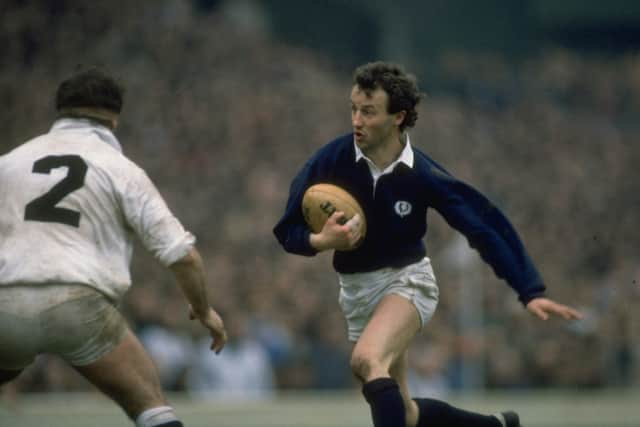
McKechnie’s second penalty moved New Zealand 12-6 ahead midway through the second half but Ian McGeechan, the Scotland captain and stand-off, set up a grandstand finish when his drop goal cut the lead to three points with 15 minutes remaining.
McGeechan charged down
By this point visibility had declined markedly and the lights almost went out on the All Blacks. From a scrum in front of the posts McGeechan had another drop-goal attempt which would have secured a draw. Unfortunately for the Scots, it was charged down and New Zealand hacked and chased the ball the length of the field for Bruce Robertson to score the decisive try. McKechnie converted to make it 18-9.
The margin was now too great but the Scots did fight back. Irvine hit the post with a penalty before New Zealand again counterattacked in the dying seconds. “Who it was nobody knew since by then it was so murky,” noted The Scotsman.
There was no more score and the tourists were able to celebrate a unique achievement. They had been the eighth All Black team to undertake a full tour but the first to achieve a Grand Slam by beating the national sides of Ireland, Wales, England and Scotland.
A celebratory shave
The match at Murrayfield was their 16th of the tour and they had won 15. The only loss had come against Munster at Thomond Park. They would go on to play two more games in Wales, against Bridgend and the Barbarians, and beat them both.
A couple of the All Blacks celebrated in an unconventional manner. Prop Billy Bush and centre Bill Osborne ceremoniously shaved off their moustaches and beards in Edinburgh on the Saturday night, fulfilling an early tour pledge that they would be clean shaven if the Grand Slam was won.
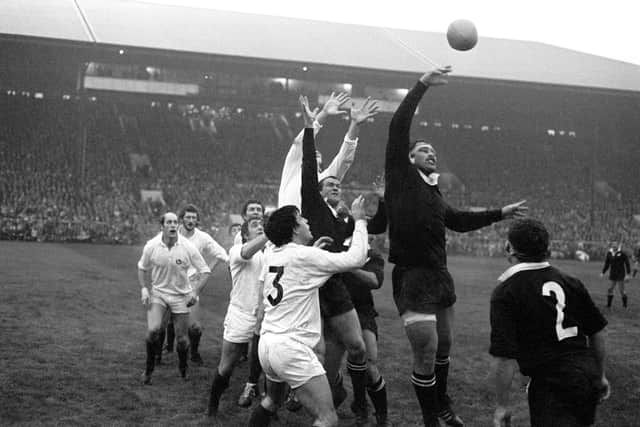
Graham Mourie, the New Zealand captain, felt Scotland had been their most difficult Test opponents of the tour. “They played with a spirit of adventure,” said Mourie.
Despite this, it was a seventh consecutive defeat for Scotland, although convenor of selectors Tom Pearson thought “the new caps did extremely well”.
For Robertson, the match was vindication that he belonged at this level. “Getting through it made you feel that maybe you do deserve to be here,” he said. “First game up, you might as well make it the hardest one.”
He would go on to win another 43 Scotland caps and be a key member of the 1984 Five Nations Grand Slam-winning side when he played both wing and centre.
Forty-seven years on, and Scotland are still seeking that first win over the All Blacks. The sides reconvene at Murrayfield this Saturday and Robertson rates the home team’s chances.
“I most certainly do,” he said. “Honestly, I do. I think in a one-off situation we can cope with anybody if we play our best rugby.”
Robertson adds the caveat that good conditions would help. And perhaps, too, some strong wattage in the Murrayfield lights.
Comments
Want to join the conversation? Please or to comment on this article.