
The blood-soaked past of stadium where Scotland will play Chile in tour match

Fixture provoked heated debate
Gregor Townsend’s team will this weekend become the first national side from Scotland to play Chile at the Estadio Nacional in Santiago since an infamous football fixture in 1977 which prompted heated debate in parliament.
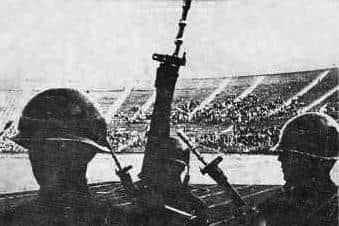
Ally MacLeod was the manager 47 years ago for what was dubbed the “match of shame”. MacLeod was taking Scotland on a tour of South America to get a feel for the continent in the hope and expectation that his team would qualify for the following year’s World Cup in Argentina. They played three fixtures, against Chile, Brazil and Argentina, but it was the opener which provoked a furore, coming as it did after the stadium had been used as a detention and torture centre during Augusto Pinochet’s military dictatorship.
Pinochet’s brutal hard-right regime had seized power four years earlier, overthrowing the democratically elected government of Salvador Allende. What followed in the months after were torture and murder on a staggering scale, with the military forcing the “disappearance” of thousands who had supported the left-wing Allende. The military imprisoned 40,000 political enemies in Chile’s national stadium whose changing rooms had blood on the walls.


“When I went into that stadium, I remember going into the dressing room and I remember seeing the bullet holes on the wall where they had lined up people and killed them,” said Alan Rough, the Scotland goalkeeper, years later.
Against this backdrop, a campaign sprang up in 1977 urging Scotland not to play in Chile. A petition bearing 30,000 signatures was sent to the Scottish Football Association and the secretary of state for Scotland was petitioned to intervene. The matter was debated in the House of Commons.
The SFA held firm, prompting Dennis Canavan, the MP for West Stirlingshire, to claim in the Commons that the game’s governing body was “using the threat of disciplinary action to force footballers to play in a stadium which has formerly been used as a concentration camp and which is stained with the blood of countless innocent victims”.
The game in Santiago went ahead, with Scotland winning 4-2 thanks to two goals from Lou Macari and one apiece from Kenny Dalglish and Asa Hartford. MacLeod’s side went on to draw 1-1 with Argentina in Buenos Aires before losing 2-0 to Brazil in Rio de Janeiro. They returned to South America for the World Cup a year later.
For Townsend, the match at the national stadium is an altogether more straightforward affair. No one is questioning this Scotland team’s right to be there and Townsend’s side are overwhelming favourites despite an experimental line-up.
The political climate in Chile is calm now. Pinochet lost a plebiscite in 1988 and power was transferred to a democratically elected president in 1990. But Chile’s turbulent past still casts a shadow. At least 2,115 were killed and 27,265 were tortured during Pinochet’s 17-year reign.
The stadium, which was renamed after the sports journalist Julio Martínez in 2008, now commemorates those who died there. A set of memorials was unveiled in 2010 which included the reopening of ‘Hatch No 8’, the door through which detainees were taken during the military dictatorship. In addition, the stadium’s north gallery houses a section which maintains the ground’s original appearance and bears the phrase: “A people without memory is a people without a future”.
Comments
Want to join the conversation? Please or to comment on this article.