
Scotland's biggest New Zealand obstacle can be traced to Murrayfield boardroom - Fraser Brown
To beat the best you need to play the best more regularly

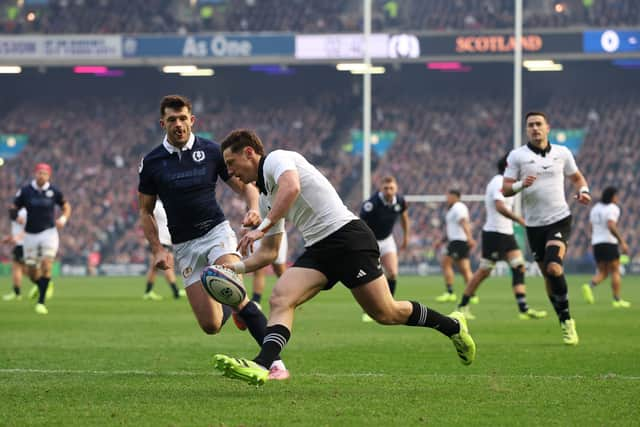
The manner of Saturday’s defeat by New Zealand was agonising, just as it was in 2022 when we last played the All Blacks. And it is that gap between games which is perhaps the biggest obstacle to Scotland’s hopes of winning this fixture.
I think we must be the only tier 1 nation that doesn't regularly play the top southern hemisphere sides. Even Wales, who are at their lowest ebb, had a two-Test tour of Australia last summer and a match against the Springboks at Twickenham before they left.
We just don't seem to get exposure to these types of games and that is a boardroom issue at Murrayfield. A strategic decision was made to play more games against so-called tier 2 nations. It has had its benefits. It has been good for growing the game across the globe and exposing the smaller rugby nations to more regular fixtures against top 8 teams. Its main benefit from a Scottish perspective has been to allow a greater number of players to experience Test match rugby and increase Scotland’s player depth. But it certainly hasn’t prepared Scotland to perform and win, consistently, against the best.


Of course, we all want to see nations like Fiji, Tonga and America develop but the reality is you can't beat the best until you are regularly playing against the best and you understand the level of intensity that's required to perform consistently at the very highest level. And that's been one of the biggest criticisms aimed at Scotland for goodness knows how long.
They can get up for one-off big games in the Six Nations, beat England home or away, France and Wales but then the next week it's a bit of a damp squib because they're just not able to sustain it. It's exactly the same playing New Zealand and South Africa and until we play them more regularly, we're not going to beat them.
Fortunately, that looks like it will start happening from next year when the new Nations Cup begins and the best sides from the northern hemisphere take on their counterparts from the south. The matches will be played in the summer and autumn windows and all the Six Nations teams look set to get a crack at New Zealand, South Africa, Australia, Argentina, Fiji and Japan.
Three games v All Blacks in eight years is root of problem
You can only learn from playing the top sides more regularly. Saturday’s game was our first against New Zealand for three years. Before that, there was a five-year gap between matches. And prior to that, you have to go back to 2014 for our last All Blacks game.
Contrast that with Ireland. Since they beat the All Blacks for the first time ever, in Chicago in 2016, they’ve played them a further 10 times, winning another four including a Test series in New Zealand.
The more consistently you play at a higher level of performance, the more consistent your high level of performance will be.
It's the same when we play South Africa. There's only one team in these fixtures who are used to dealing with the pressure of big games and it's certainly not Scotland.
I think the more you normalise these games, the easier they become. There are legitimate concerns that the Nations Cup could shut out tier 2 sides but I think taking the Test match schedule out of the control of individual nations can make for a more rounded fixture list.
Scotland don’t have long to recover from the pain of the New Zealand defeat. Argentina will pose a massive challenge at Murrayfield on Sunday and it is a similar situation to three years ago when we had to play the Pumas the weekend after being pipped by the All Blacks.
In 2022, we were winning against New Zealand until the 72nd minute but lost the match in those final moments, just like Scotland did last Saturday when Damian McKenzie scored the decisive try late on.
We bounced back to beat Argentina 52-29 and I think that's the challenge of Test rugby. You have to come in on a Monday morning and look forward. The All Blacks game is now five, six days old and a lot of people are still looking back but you can't afford to do that in sport. The best teams always look forward and we did that really well that week.
I think we had a good side and, to be honest, it's now a completely different type of Argentina that Scotland will face on Sunday. They’ve improved considerably since 2022 and I now believe they're one of the best in the world.
We'd had some great, great contests with Argentina in the four or five years leading up to that 2022 game. I remember one game in 2018 in Resistencia which was a really hostile fixture at a venue in the back-end of nowhere. But we won well.
There have been some tough autumn battles with Argentina at Murrayfield in recent years and it’s usually been pretty close. They were probably a little bit more forward-orientated back then whereas we had real talent in the backs.

Argentina are a proper rugby team
Now you look at them, from 1 to 15, and they just look like such a proper rugby team, no matter who's on the pitch. The forwards carry hard, are abrasive, have great footwork and the ability to offload. The backline have the skills and the pace. Every pass is in front and no-one checks their stride because the timing and cohesion is spot on.
They all look like they're on the same page and the play with a lot of intensity and pace.
Felipe Contepomi has gone in there and made a good team even better and you just need to look at their results for proof. Last year they beat South Africa, New Zealand and Australia in the Rugby Championship. This year, they’ve beaten New Zealand and Australia again and ran South Africa close.
I don't think Argentina played poor rugby under Michael Cheika but they've just gone to the next level since Contepomi took over, more cohesive and less reliant on moments from individuals.
And they have done this against a backdrop of turmoil and upheaval in their domestic game. They've got it harder than probably any other leading nation in terms of not having a professional domestic set-up.
They don’t have a team in Super Rugby any more and most of their squad are playing abroad. Yet they still have this brilliant talent pool coming through in their domestic game.
They don't look like a team of forwards and backs anymore - they just look like a team and that's the biggest compliment I can pay them.
The back three are particularly strong. They dominated the aerial contest against Wales last weekend, and I think that'll be a huge part of the match at Murrayfield.
It’s a facet of the game that Kyle Steyn has worked incredibly hard on and it’s a tactic that Glasgow utilise through the kicking of George Horne and Jamie Dobie. Those box-kicks off nine don't tend to have a lot of distance, or even much height, but they go about 20-22 metres, hang in the air four for around four seconds and give the wingers just enough time to chase and get up for them. And they are very good at recollecting their own kicks.

Make up of back three and bench will be crucial
It's something Glasgow practise a lot. Kyle Rowe and Dobie are also excellent in the air so it will be interesting to see whether either comes into the mix for selection this weekend.
Blair Kinghorn, who started at full-back against New Zealand, can be a mixed bag in terms of his aerial abilities. He’s such a big man and has a great leap but he’s not dominant in the air like, say, Freddie Steward or Hugo Keenan.
Darcy Graham can have good days in the air, but he’s obviously small and you wouldn’t say that’s his greatest strength. So it'll be really interesting to see what the make-up of the back three and the bench is this week, because that is such a key contest.
If you pick two out of the three who are good in the air and you have an obvious weakness, then Argentina will find that, and they'll target that all day and live off the scraps.
Argentina, like Scotland, are lethal on transition attack. Quick ball against an unstructured defence, both sides are extremely dangerous, both will see it as an avenue into the game and both I’m sure will look to control the arial battle at the weekend. Scotland will be confident they can generate quick ball and find holes in the Argentina defence if they can defuse the aerial bombardment and they will be confident that they can pressure Argentina at the set-piece after their second half showing against the All Blacks.
With no Tier 1 blockbuster fixture next week to round off the Autumn Series, the game against Argentina on Sunday is one Scotland simply can’t afford to lose.
Comments
Want to join the conversation? Please or to comment on this article.