
Rugby players need to learn to kick with both feet - as Finn Russell has shown
Lonely hours of practice can pay off
Rugby players are fitter and more skillful than ever before. As a generalism this is probably true. The ability of the best international and club sides to retain possession and go through phase after phase is remarkable. Likewise the ability to float passes the length of a cricket wicket. Game management, an expression never heard in the old days. When Ireland, or indeed Leinster or Munster, are in possession, you often wonder if the ball can be prised from them. Things used to be very different.
During the Covid shutdowns the BBC showed some videos of international matches in the amateur day. They were entertaining, a nostalgic pleasure for those of us old enough to remember how things used to be. Younger viewers might be entertained too, while being surprised by the frequency with which possession shifted from one side to the other, often because of a dropped pass. Nobody can deny that the modern professional game is more efficient now than it used to be, indeed than it was in the early years of professionalism.
This being so it's odd that in some respects things were better done in the old days. There are for instance few players today who kick equally well off either foot. Finn Russell's kicking off his left foot has improved in the last two or three years - and indeed I think he even attempted a left-foot drop goal last season, perhaps successfully - I don't remember. But for his first six or seven years in the Scotland team, his left foot was only for running on, not kicking, and indeed I think most international fly-halves, scrum-halves and centres were in the same boat. Indeed the only half who seems to kick equally happily with either foot is, not surprisingly, Antoine Dupont. While the last Scotland half-back whom I remember kicking with his left - that is, wrong - foot is Mike Blair.
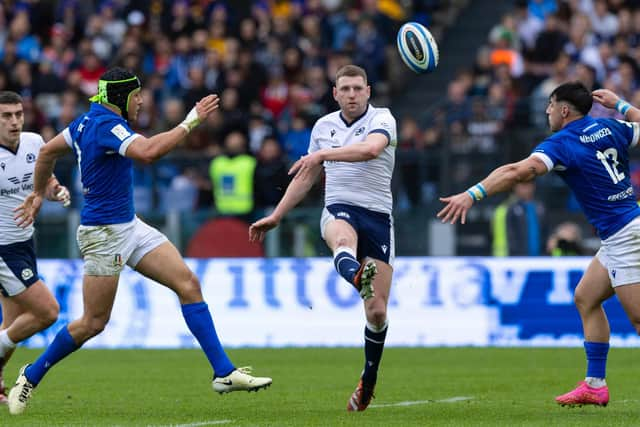

The curious thing is that this limitation, this inability to used either foot, seems common among footballers also. How often for instance, do you hear a commentator excuse a missed chance in the penalty area with the words "it came to his wrong foot"? Really? A professional who can't use either foot? Perhaps he hasn't practised enough.
I had an Irish friend at school with whom I used to talk a lot of rugby. Coming up to our last year he hadn't risen above the 3rd XI. Viewing hs next season's chances he decided that the most likely vacancy in the first XV was at full-back. He could use only his right foot, this at a time when full-backs were expected to field kicks and then boot the ball into touch. So Julian spent hours of the summer holidays training himself to kick just as well with his left foot as with the right one. He got his place in the XV and did well. Lonely hours of practice paid off.
I often wonder how much time professional rugby players now spend developing individual skills. Cricketers do, partly no doubt because cricket is an individual game in a team context. Geoffrey Boycott, with fewer natural gifts than some of his Yorkshire Colts team-mates, could never to the end of his long career get enough net practice. He worked at his game - excessively, some thought - but it made him the best England batsman of his generation.
The need for practice in order to develop your game is obviously almost always recognized in individual sports. But even in a team sport like rugby, there are specialist requirements in every position, and individual practice will surely improve any player. Back in my youth I was a great fan of a French prop called Alfred Roques. This was partly because he played no rugby till he was twenty-six or seven, was first capped by France aged thirty-three and held his place in the team till he was thirty-eight, but also because he was photographed practising scrumming against a Charolais bull - probably a bullock really. One liked to think that hours of scrumming against a big bull or bullock helped make him such a formidable prop. Not that I’m suggesting young props and hookers in the Glasgow and Edinburgh squads should be sent out to scrum against cattle. This would probably breach some safety laws or, alternatively, attract the attention of the League Against Cruel Sports, but the value of often lonely individual practice to develop individual skills is something that shouldn't be neglected. Rugby is a team game but, let's not forget, one that makes different demands on players from 15 to 1, therefore calling for hours of often solitary or one-to-one practice.
Comments
Want to join the conversation? Please or to comment on this article.