
‘Being trans isn't something you catch’ - cyclist Pippa York on her journey down from the mountains

Tour de France legend scaled the heights and suffered extraordinary lows but is now ‘95% content’
Dressing in girls’ clothes and sneaking out the door of his family’s 11th floor flat in a Pollokshaws high-rise was a risk the young Robert Millar was prepared to take.
The lift was too dangerous so Millar would take the back stairs. The future King of the Mountains would go on to become adept at perilous descents but this one presented unique hazards.
Millar had just got past the second level when he ran into a kid he knew from school going in the opposite direction.
“Howzitgoin?”
“Nae bad.”
Recognition then confusion clouded the eyes of the other child. Millar pressed on, worried. He got into the fresh Glasgow air only to be accosted by the kid, shouting from a second-floor window. “Aye, you’re goin’ out dressed as a wee girl?”


Millar is now Pippa York and their story is an extraordinary one. It has taken an extraordinary book to tell it. York has collaborated with the sportswriter David Walsh on The Escape: The Tour, the Cyclist and Me, an unflinching account which has been longlisted for the William Hill Sports Book of the Year Award and could be a late addition to the former cyclist’s already formidable palmarès.
Rode the Tour 11 times, and it wasn’t the female edition
As a professional road racer, Millar was a pioneer whose achievements put him in the pantheon of Scotland’s sporting greats. As York says on the back page blurb, “I rode the Tour de France 11 times, and it wasn’t the female edition”.
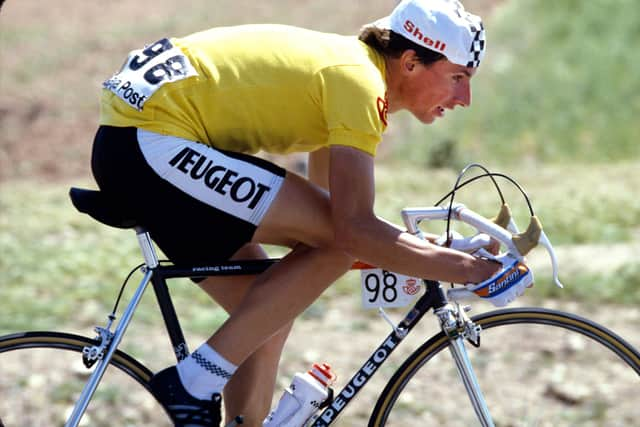
Millar won three individual stages and, most dazzlingly of all, in 1984, won the polka dot jersey awarded to the Tour’s top climber, ‘the King of the Mountains’, becoming the first English speaker to achieve this honour.
Millar was fourth overall, surpassing Tom Simpson's sixth place in 1962 as the best British finish at the time. And it was done in stellar company, as Walsh explains: “I think of what Robert Millar did in 1984. Polka dot jersey winner, and fourth behind [Laurent] Fignon, [Greg] LeMond and [Bernard] Hinault. Between them, these guys won the Tour de France ten times. There are good years and there are great years. Millar finished fourth in an outstanding year.”

How a boy from the Gorbals held his own against cycling’s aristocracy is remarkable enough material. The real story here, though, is about gender dysphoria and the long and terrifying road to becoming a woman, culminating in genital surgery and breast implants. “Where the journey ends,” writes York.
Robert Millar’s wee secret
She reckons she was five years old when she realised she wanted to be a girl. It is described in the book as “Robert Millar’s wee secret” and not something that can be aired in the playground of Abbotsford Primary School in Glasgow where he “has to support Rangers and he has to hide his weaknesses”.
The family moves from the Gorbals to Pollokshaws as part of a slum clearance and Millar’s first bike is a clunky three-wheeler. There’s an early, painful encounter with a lamppost but also a sense of exhilaration at speeding downhill in Pollok Park.
Millar’s sister Elizabeth is a year older and roughly the same size and when Millar is around nine or ten he starts to wear her clothes without her knowledge. This involves flitting between bedroom and bathroom and hoping not to be caught. Wearing a dress feels normal, makes the world feel better but he knows the risks.
Cycling and fashion co-exist in Millar’s young world and a paper round helps fund the two passions. Some of the money goes on bike parts, some on clothes. The book details trips into town to buy girls’ shoes, including a tricky return visit when Millar gets home to discover he’s been sold beige summer wedges of different sizes.
His first adventure out in girls’ clothes comes when he is 12 years old.
“Yeah, I remember most of those days,” York says now in an interview with The Scotsman. “I think it just shows that being trans isn't something you catch.
“It's one of those innate things, you know, like before it used to be, ‘oh, if I hang out with gay people, I'll end up being gay’. There's that kind of accusation. Whereas it shows that it's an innate thing.
‘I never thought of it as brave’
“And when it comes out when you're young, it kind of shows you that you haven't learned it from anywhere because you never see, you never have any kind of education or experiences of coming across anybody else like yourself. So it's kind of one of those things that nature's given you to deal with. I never thought of it as brave.
“I just thought this is kind of what I want to do and just get on with it. When you're young, you kind of process some of the consequences that become social ridicule and all that kind of stuff. But that didn't seem to stop me.
“And there was no one really to talk to about that during those childhood years. You know, it's pre-internet. The only knowledge you have is from books or people that you know.
“And I don't ever remember seeing any stories about trans people in the 1970s, other than sex workers or being laughed at in the media.”
It was a time of Dick Emery and Dame Edna Everage, when men played women for laughs on primetime. The reality for the young Millar was altogether more serious, particularly when his father returns home early from work one day and sees his son dressed as a girl.
Millar fears a showdown.
Dickie Davies is an unlikely inspiration
But Bill Millar is sympathetic and tries to understand which, if anything, is even more excruciating. It’s “just a thing that you’re going through…. puberty and all that…. I went through it”. Millar’s father says.
It leaves the child confused. Does that mean his father also dressed up as a girl when he was Millar’s age?
“How do you process that as a 12, 13-year-old?” says York. “You don't. It's just like, ‘what?’ Even more confusion.”
Despite the turbulence, Millar continues to ride and Dickie Davies proves an unlikely inspiration. The moustachioed anchorman of ITV’s World of Sport delivers summer Saturday bulletins from this exotic race across the Channel. Millar watches these brief clips of the Tour de France and in entranced. He sees a British rider called Barry Hoban win a stage and it’s a pivotal moment.

He realises he’s fast and fearless and his first race comes at 16. His training runs take him out the Crow Road - where a huge Millar mural is now displayed - to Lennoxtown and Fintry and the Campsie Fells.
Quits job to ride in Commonwealth Games
The teenage Millar wins the Scottish Junior Road Race Championship and the British title a couple of years later. He wants to turn pro and meets two men who are pivotal to this: Billy Bilsland, a well connected ex-pro rider, and Arthur Campbell of the Glasgow Wheelers club who has a role with the UCI, world cycling’s governing body.
Millar jacks in his job as an apprentice at a local factory, Weir Pumps, and goes to ride for Scotland at the 1978 Commonwealth Games in Canada.
The progress is rapid and Millar is able to bury the other part of his life. Dressing in female clothes goes from a twice-a-month habit to two or three times a year, then even less.
Millar wins the 1978 British National Amateur Championships, the first Scot to do so, and the following year moves to France to join the Athletic Club de Boulogne-Billancourt. The door has opened to the exotic world of top level cycling and though there is still a huge amount of work to do before the pro dream is realised, Millar is on his way. The Tour de France debut comes in 1983 and the following edition is his sunshine moment as he becomes the first Briton to win a major Tour de France classification. “I set standards that weren’t equalled for two decades,” writes York, with a nod to Bradley Wiggins, Chris Froome and Geraint Thomas.

Millar wore his hair long and sported an earring, brave enough in what York calls the “hyper masculine world of cycling”. But did Millar use cycling to suppress his true feelings?
“You would imagine so, but no,” York says now. “I kind of managed to separate both things into, ‘right, here's my career: I can't transition now because it'd just be too much of a scandal’.
“So then I made the decision sometime during my 20s that, yeah, right, we'll do the cycling part as well as I can. And then that gives me all the choices afterwards to deal with my issues.
“But I wasn't ever sure how far any kind of transition or the kind of medical process was going to go.”
Marriage break-up and depression
The end of Millar’s cycling career brought the toughest of challenges: the break-up of his first marriage and depression as he tried to come to terms with the gender issue. It was four years before Millar accepted that he needed professional help. “They were dreadful years,” writes York. “Just dreadful years. I ended up not in a good place at all with myself, relying on antidepressants. And it was just getting worse and worse, to the point where I thought. ‘There’s no choice here, I’m going to have to deal with this transition stuff’.”
What followed was psychotherapy and psychiatry and then hormone replacement. It’s a step by step process and York was unsure how far it would go. Four years later, in May 2003, sexual reassignment surgery took place. Six months earlier, Millar had changed names to Pippa York.
York describes herself now as “95 per cent content”.
Lived together for over 20 years
“I'm not as traumatised as some people think I might be,” she says. “I've always looked at my body as this tool to live my life with. So I think I approached it like that. It's like, ‘right, what do I need from my future?’ You know, what do I need? What do I want from this? And yeah, I took the experiences and knowledge of my sporting life and applied it to lots of parts of my transition. So it's not that difficult.”
She is still with Linda, her long-time partner.
“We've known each other since 1991 and we've lived together for over 20 years now.
“So yeah, she's still here. My son still talks to me. So I try and keep that part of my life fairly private because they're not used to media attention.
“But how each of them individually processed my transition, I can't know. I tried to make it as slow as possible so they would try and understand each step. But I can't know how that affected them.
“I can see their reactions, but you don't know.”
Despair at nastiness of the debate around trans
She despairs of how nasty the public discourse around trans has become.
“I don't know how it's come to this,” she says. “You know, if you think back 10 years… you would go through weeks without there even being a trans story. And then gradually they've got worse and worse. We've become this kind of danger.
“But I don't see that. And I think what's really disappointing about it is the fact that anywhere in the world, if a trans person does any kind of crime or has any kind of views which are controversial, that applies to everybody. So it's become really polarised and rather nasty to live amongst.

“I don't know why it's come to this. It's one of those kind of issues that certain factions want to press, and then you have the other factions which appear and they all shout to each other.
“And for most of us in the movie, we're just thinking, just leave me alone and let me get on with my life like I've been living, like I've lived for the last 20 odd years.
“So it's a shame that it's come to this. Yeah. I really do wonder when it is going to stop.”
Comments
Want to join the conversation? Please or to comment on this article.