
Scotland 1980s World Cup magic moment amid familiar feeling of regret
A ‘toe poke’ to savour but talented squads fell short in both 1982 and 1986

There aren’t many Scotland v England fixtures that are almost completely forgettable but the meeting in 1982 is one of them. Decided by a Paul Mariner goal, after Terry Butcher’s header struck the post, both teams seemed to have other things on their minds.
The World Cup, kicking off just a few weeks later in Spain, clearly dominated thoughts. England had missed out on the previous two tournaments. Scotland, meanwhile, were on a mission to atone for the chaos of Argentina. “Our fear is not our opponents, our fear is ourselves,” said manager Jock Stein on the eve of the tournament, encapsulating the feeling that Scotland were proving their own worst enemy on the big stage.
The fact that Brazil were in Scotland’s group for the second time in three World Cups was something else helping concentrate minds. The Brazilians are rarely anything other than scintillating, but this was a particularly potent blend, including the likes of Zico, Eder, Falcao and Socrates.


The backdrop to the tournament also caused concern. Britain was still at war with Argentina over the Falkland Islands. Graeme Souness was among those who suggested that Scotland, as well as England and Northern Ireland, who had also qualified, should withdraw if the fighting was still ongoing as the tournament prepared to kick off.
In the event Argentina surrendered the islands to Britain on 14 June, the day before Scotland began their latest World Cup mission against New Zealand in Malaga. In a scenario unlikely to ever be repeated at a World Cup, 14 Scottish-born players were on the pitch at the start – 11 for Scotland, three for New Zealand. Four years on from Scotland’s disastrous opening game against Peru in Argentina, it seemed ripe for a tragi-comic outcome: Scotland downed by a….Scot.
In the event, Steve Sumner and Steve Wooddin, two English-born New Zealand players, scored the goals that gave Scotland, who had taken a 3-0 lead, an almighty fright before two more goals secured a 5-2 win. It was the Scots giving the Brazilians a fright in the next game, perhaps unwisely in retrospect. “The carnival met the ceilidh,” wrote Mike Aitken in The Scotsman.
David Narey, deployed at right back, appeared as if from nowhere on the edge of the box to take advantage of a John Wark headed lay-off. He took a touch with his left foot before hitting a sweet ping with the outside of his right foot into the top corner of the net to stun those Brazilians in the crowd and most Scots too. It was Narey’s first goal for his country. BBC commentator Jimmy Hill never lived down referring to the strike as a “toe poke” although he later qualified this by saying it was the “best toe poke I have ever seen”.
Toe poke or otherwise, it only stirred the Brazilians, who equalised through a trademark Zico free-kick just after the half hour mark and then scored three further times after half time to leave Scotland scrambling to reach the second stage.
“We have a dream, if dreams come true…” sang John Gordon Sinclair in Scotland’s soaring 1982 World Cup song, which reached No 5 in the charts. The dream didn’t come true, perhaps predictably. Scotland drew 2-2 with the USSR in the final game when they desperately required someone to “score the winning goal”, as Gordon Sinclair had beseeched.
Calamity made its perhaps inevitable entrance in the form of Willie Miller and Alan Hansen colliding with each other to gift the Soviet Union their second goal.
Souness scored a fine late equaliser but it was too little, too late. The deep sense of regret may have been heightened by the contention from some that, despite the talent of the 1974 and 1978 squads, this might have been Scotland’s best-ever group of players at a World Cup.
No King Kenny in Mexico
It wasn’t a bad bunch four years later in Mexico either, although it didn’t include the then 35-year-old Kenny Dalglish, who pulled out two days before the squad departed due to a knee injury. Conspiracy theorists attributed the Liverpool player-manager’s late withdrawal to the fact Alan Hansen, his Anfield teammate and great pal, had been excluded from the 22-man squad. The biggest absence of all, however, was on the sidelines.
Jock Stein’s death after collapsing at the final whistle of the crunch qualifier with Wales in Cardiff nine months earlier still cast a pall. Alex Ferguson agreed to step in and helped navigate a testing home and away play-off against Australia with Scotland becoming the last of 24 countries to book their ticket. They were also the last to arrive in Mexico having spent time acclimatising in Santa Fe, New Mexico and Los Angeles.
“We had been drawn in the toughest imaginable group – bloody Denmark, West Germany and Uruguay,” is how Ferguson put it in his autobiography, Managing My Life. With little sensitivity given Scotland had lost their manager just a matter of months earlier, it was immediately branded the Group of Death following the draw in Mexico City in December 1985. The five-year-old grandson of the president of Mexico’s World Cup Organising Committee, chosen in an act of high nepotism to pick the teams out of a bowl, had done Scotland few favours.
Scotland scored just once in three games despite having strikers of the calibre of Charlie Nicholas, Frank McAvennie, Steve Archibald and Graeme Sharp to call upon. McAvennie ended a prolific season for West Ham United just behind Gary Lineker, then at Everton, in the goal charts, yet he made only two appearances as substitute. Archibald was a late replacement for Dalglish and played only one of the three games. Spoiled perhaps by choice, Ferguson seemed uncharacteristically unsure about his best team.
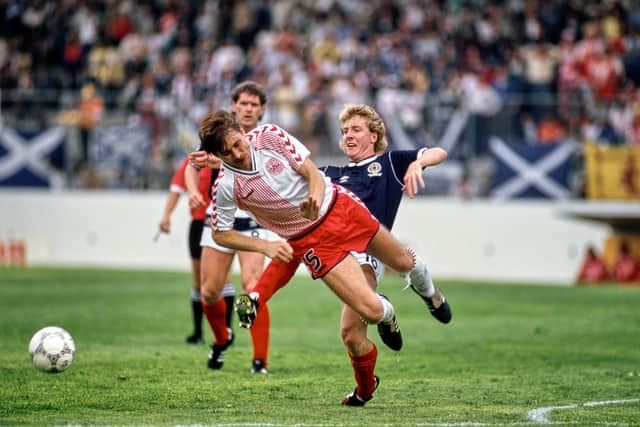
A narrow 1-0 loss in the tough opener against Denmark in Nezahualcoyotl was followed by another one defeat by a margin of one goal against West Germany, Gordon Strachan memorably putting Scotland ahead before Rudi Voeller equalised before the interval. The Germans struck again at the start of the second half and it finished 2-1.
Ferguson noted the “limitless cynicism” of Uruguay, Scotland’s opponents in the must-win third game. Surprisingly, however, he dropped Souness, Scotland’s go-to enforcer, because he felt the midfielder was drained following the first two games. He also plumped for Sharp in attack this time. Jose Batista was sent off in the first minute for a foul that left Strachan crumpled on the turf.
“It was horrendous,” Sharp recalled when speaking to The Scotsman in March. “I remember Fergie saying, whatever you do, I don’t want you to retaliate. It was disgusting. Spitting on you, putting their fingers where they should not be putting their fingers, and all that.
“Fergie stopped us exchanging shirts. It was awful, dreadful.” After not featuring in the first two games, it was a tough fixture for Sharp to make a World Cup debut. Were Uruguay the most cynical team he had ever encountered? “The worst, absolutely,” he says. “Dark arts was second nature to them. Fergie’s words were ringing in our ears, ‘Don’t retaliate!’ They were horrible.”
While this might have been the case, Uruguay employed all their wiles to advance to the next stage. However, FIFA fined them 25,000 Swiss Francs for their aggressive attitude - the South Americans had also had a player sent off against Denmark in the previous game.
Scotland spurned perhaps their best chance to reach the knockout rounds. Left to play against 10 men for 89 minutes, the bad tempered clash with Uruguay finished goalless. Steve Nicol wasted probably the best opportunity at the far post when he failed to put his foot through a shot, allowing the keeper to save on the line.
Similarly to the match against the Soviet Union four years earlier, a draw in the last game was not good enough. Ferguson returned to club football at Aberdeen before Manchester United appointed him manager later that year. Another reset was required.
Comments
Want to join the conversation? Please or to comment on this article.