
Sir Alex Ferguson selects his 21 greatest matches - and why missing Scotland cap mattered so much

Scottish legend chronicles memorable matches in excellent new book
It seems so very instructive that even after everything, including all the plaudits and all the glory, Alex Ferguson was still niggled by something missing: an international cap.
The irritation stemmed from the fact that he had played for Scotland; several times in fact. He remembers phoning Walter Smith and introducing himself as “four cap Fergie”. Smith doesn’t have a clue what his old pal is talking about, perhaps understandably.
Ferguson has used a fourth book about his life – ‘four book Fergie’ – to explain why being rewarded with a cap for his efforts during the summer of love in 1967 mattered so much. Retirement meant having time to devote to putting pressure on the Scottish Football Association to right an obvious wrong.


One picture in his handsomely illustrated new memoir, Games of My Life, shows Ferguson with a selection of Scotland team-mates from the strangely labelled “Far East” tour, which also took in North America and Israel. All the players are wearing blazers with an SFA crest on the top pocket. Why wouldn’t you think you had been called up by Scotland? Nine games took place across three continents, including v Israel, Australia and Canada. Yet the team went under the guise of a “Scotland XI”.
Admittedly, because of Celtic’s successful endeavours in the European Cup and Rangers so nearly going all the way in the Cup Winners’ Cup, the squad was a rump one. It lacked many of the mainstays who had featured for Scotland when they became unofficial world champions just a few weeks earlier, winning 3-2 against England at Wembley. Hence Ferguson and other fringe candidates being called up.
‘It was all about my Scottish pride’
It was a case of four goal Fergie – he scored four times, including three goals in two games against Australia. Ferguson petitioned the SFA to re-classify the games, which duly happened during Alan McRae’s time as president. Several of the matches, including four in which Ferguson appeared, were upgraded to full internationals. Alongside Alan Anderson and David Holt, Ferguson was presented with a treasured cap before Scotland’s 3-2 World Cup qualifying victory over Israel in 2021.
“When I stop and ask myself why was it so important for me to get that blue-and-gold hat with its bushy tassel, I suppose the answer is all about my Scottish pride,” he reflects.
Ferguson ponders that he has still lived for most of his life in Scotland, even if it’s now becoming a close-run thing. He left Aberdeen for Manchester when he was 44. Now 84 and mourning the loss of his wife Lady Cathy – whom he calls the boss of “Ferguson United” – he is dividing his time between Cheshire and Glasgow, his hometown. He has been in Scotland this week promoting his excellent new book.

It’s a footballing Desert Island Discs. Instead of the tracks of Ferguson’s years, it chronicles memorable games of his life. And there are a lot of games to choose from. He reckons he played or managed in more than 2,800 official fixtures, including at Govan High School. On top of that are all the games he watched – including the aforementioned clash between Scotland and Israel, one of 21 matches selected. Another making the cut is the “seminal” 1960 European Cup final between Real Madrid and Eintracht Frankfurt, which Ferguson watched from the schoolboy enclosure at Hampden having just signed for Queen’s Park.
Unexceptional draw makes cut for poignant reason
Now 84, Ferguson details how close his own final whistle came to blowing in 2018. It’s why another of the matches picked out is a seemingly unexceptional draw between Manchester United and Wolverhampton Wanderers from 22 September that same year. It was his first time back at Old Trafford following the brain haemorrhage that nearly killed him. Five patients with the same condition were operated on at Salford Royal Hospital on the same day as he was admitted. Ferguson was one of only two who survived.
Now he is hoping Manchester United get on with building their mooted new stadium so he can attend the opening. What might have happened had he flitted to Canada, as he once planned to do when his playing career refused to pan out the way he hoped it would. He even filled out the emigration papers.
He admits he lost focus. Vexed by Ferguson's less than professional attitude, his father stopped speaking to him for a spell. “I was very aware of the fact that Denis Law, Ian St John and Alan Gilzean were streets ahead of me,” Ferguson writes, with reference to his hopes of playing for Scotland. At the time he was stuck in the reserves for St Johnstone, which, he notes, “is in Perth – about a third of the way between Glasgow and Aberdeen”.
The book seems very aware it is catering for a worldwide audience. Even the spelling of words such as “organized” and “well-publicized” are Americanised, a mild irritation perhaps partly explained by the identity of the ghostwriter. Although Welsh, venture capitalist/author Michael Moritz has lived almost all his adult life in the United States. He has been recruited for a second time by Ferguson and is an expert chaperone as the Scot mines his endlessly fascinating back pages once more.
One claim that stands out is Ferguson’s contention that if Aberdeen had been able to retain the services of Steve Archibald, sold to Spurs in 1980, and paired him with Frank McDougall, bought from St Mirren in 1984, then Aberdeen could have won the European Cup. You wouldn’t put it past them. Aberdeen lost on away goals to IFK Gothenburg at the quarter-final stage in 1985-86, Ferguson’s last full season at Pittodrie.
There are many other fascinating bon mots, such as why Ferguson took up the habit of chewing gum throughout games. Apparently this was to stop him spitting on the ground. “Not a good look when shown on Sky TV,” he notes.
It’s a handsome tome. There’s no index, possibly because the picture credits at the end of the book take up so much space. One photograph of an off-duty Ferguson, thought to have been taken during his time at St Johnstone, stops you in your tracks. It is one of the few uncredited images for the simple reason no one knows where it’s from.
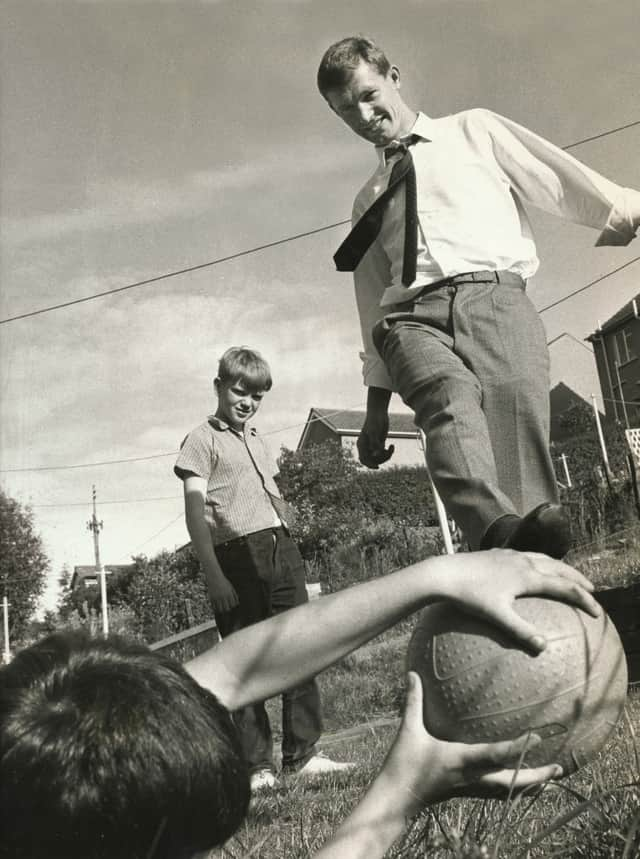
A twenty-something Ferguson is snapped, tie flapping, in a garden or public park from ground level – the photographer is clearly lying on the grass – taking a right-footed shot that has been saved by the outstretched hands of a young boy, identity unknown. It ought to be hanging in the Louvre, as they say.
Even the publishers, Macmillan, could not track down the photograph’s provenance. The detail is such that the ball’s dimples are plainly visible, which might well induce an involuntary wince in many readers who can remember the pain of being struck on the thigh on a cold day by such items.
The only other occasions tears are brought to the eye are because of the emotions stirred, including when Ferguson recounts his long rivalry with Arsene Wenger and concludes they were simply too alike – demanding fathers, working class background, same obsession for details. “To top it off, we both minded the pennies,” he writes.
This chapter, hinged on the classic 1999 FA Cup semi-final between Arsenal and Manchester United settled by Ryan Giggs’ wonder goal, reads like a paean to a better, vanished time.
Games of My Life by Alex Ferguson published on 8 October by Macmillan
Comments
Want to join the conversation? Please or to comment on this article.