
The Scottish football teamsheet that might be worth a pretty penny after historic night

Dundee United’s foreigner first in Europe is a far cry from the 1980s
At a boom time for football memorabilia, what price the slightly crumpled bit of paper lying on the desk in front of me? The Rangers jersey worn by Tommy McLean in the 1972 European Cup-Winners’ Cup final recently set a new record for a Scottish football shirt when it sold for £19,000.
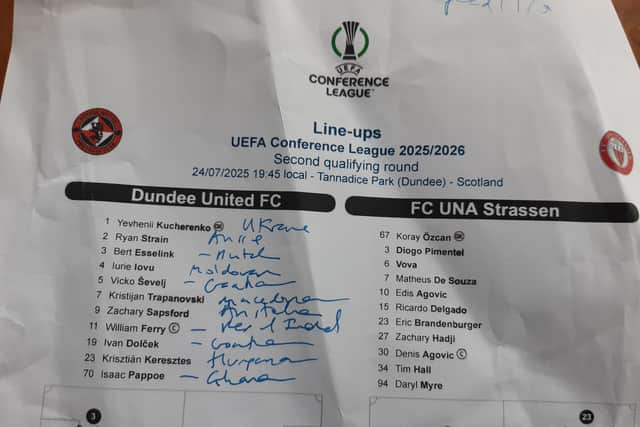
I’m thinking I should keep hold of my teamsheet from the first leg of Dundee United’s Conference League second qualifying round tie against FC UNA Strassen.
It is most definitely a collector’s item and now I am kicking myself for having spoiled it. Next to each United player’s name, I have scribbled the country for whom they are eligible to play international football. Not once did I have to write 'Scotland', which is why the teamsheet, albeit slightly defaced (my bad), could merit a place in a Scottish football museum in time.
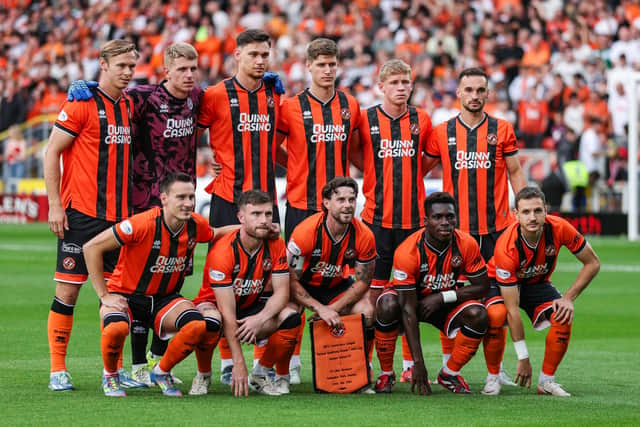

As you’ll be aware by now, for the first time in Dundee United’s proud history, a club that once provided five players for a Scotland World Cup squad and were regarded as the last word in developing young Scottish talent sent out a team without a single Scot in it on Thursday evening. I even heard it described as the saddest teamsheet in the club’s history – Steve Clarke, the current Scotland manager, might well agree.
It sparked plenty of comment across social media, understandably so, while calling to mind the wonderful photograph celebrating the achievement mentioned above when United players – namely Maurice Malpas, Eamonn Bannon, David Narey, Richard Gough and Paul Sturrock - made up roughly 22 per cent of the 1986 World Cup squad in Mexico.
The picture in question has the quintet sitting team photo style and includes Walter Smith, who had just joined Rangers from the United coaching staff.
Scotland’s new breed
This crop of talent – Bannon joined from Chelsea, the rest were home-grown and helped United claim their only Scottish league title in 1983 – was rivalled by a later wave including Duncan Ferguson, Christian Dailly and Ray McKinnon. The New Breed, they called themselves while testing Jim McLean’s mettle.
The current new breed is likewise young and ambitious. They just require a plane ticket. Manager Jim Goodwin flagged his intentions earlier this summer while observing that he’d had “considerable success” while at Aberdeen and St Mirren when exploring foreign markets. He certainly hit the jackpot in the case of Bojan Miovski, who earned Aberdeen several million quid last year.
All 11 United signings made so far this summer have been non-Scots. After skipper Ross Graham, perhaps the only native player assured of a starting berth, succumbed to an injury that could see him sidelined for up to three months, it was always likely United might line up the way they did on Thursday night at some point.
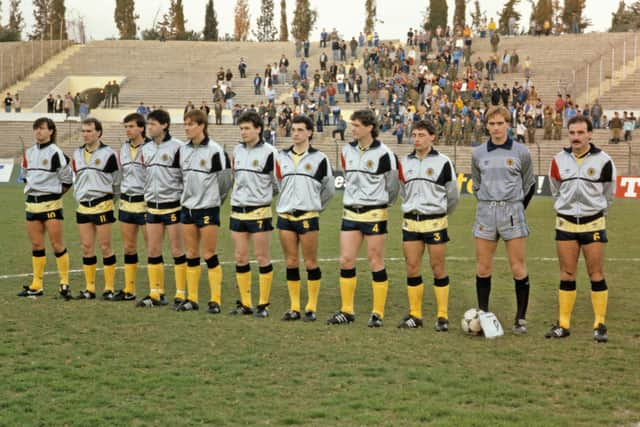
It felt particularly notable that they should do so in a European tie given United’s successes of old, such as the night(s) they humbled Barcelona in 1987 with 11 Scots. It ought to be noted that when they beat the same side home and away 21 years earlier in the Fairs Cup, they did so with a team including a Norwegian and two Swedes. United were pioneers when it came to exploring the Scandinavian market.
It’s also incumbent to note that two Scots did take the field on Thursday night in the shape of substitutes Craig Sibbald and Owen Stirton, the latter a more than promising product of the United Academy from far off Forfar.
Still, I wondered as I passed Club ’83 on St Salvador Street after Thursday’s game whether United’s first non-Scottish XI might be the main topic of discussion at the bar or would it be shrugged off as just what happens now. It’s modern football, innit?
Rangers’ team of 2000
Not even so modern. After all, it’s now over 25 years – March 2000 – since Rangers fielded a team without a Scot in it for the first time. Looking back at contemporary reports, this seemingly historic event barely rated a mention as the Ibrox side were held 0-0 at home by St Johnstone. Maybe, given Rangers had been accused of buying success since the Souness Revolution, it just felt like the logical next step.
Celtic, meanwhile, were behind the curve. It was not until 8 September 2001 in a 3-1 win over Dunfermline that they emulated Rangers on this score with a team including the likes of Dmitri Kharine (Russia) and Olivier Tebily (Ivory Coast).
One might imagine Tom Cairns, the Dundee United historian, having something to say on the seeming repudiation of the club’s proud past and he does in a way. “It’s quite blunt,” he answers. “The Dundee United Football Club of the last five years bears little resemblance to the club that I and many others grew up with.” He’s long understood the past is another country.
Remarkably, Cairns has only ever missed one home United European game – against Trabzonspor in 1997. He’s seen them joust with giants on the European arena with a team full of Scots and he’s now seen them beat a part-time side from Luxembourg 1-0 with a starting XI devoid of native talent.
As a historian, did it feel momentous? “No,” he replies, instantly dampening my excitement about the prospect of retiring with the proceeds from my teamsheet sale. “It was mooted the other week that it must be very close to that happening.
“At the end of the day, it’s like the new strip – do you like the strip or not? Well, I don’t care about the strip. I just want to know there are good players inside it.”
The finances don’t add up
It’s a further sign of the way football is going, he explains: “I am quite sure there are certain players they would like to have signed in Scotland but financially it’s beyond them.” As Goodwin has stressed, abroad simply represents better value.
Another reason we might just need to get used to vanishingly few Scots playing for our favourite teams is the recent phenomenon of highly rated players being sold to big English sides by clubs like Dundee United before they’ve barely had the chance to kick a ball for the first team, most recently Brandon Forbes.
Nevertheless, one felt compelled to swing by the Jim McLean statue upon leaving Tannadice late on Thursday night just to check it had not crumpled into a heap. The spotlights were still illuminating the great man, perhaps a little less brightly than before, but they were still shining.
Comments
Want to join the conversation? Please or to comment on this article.