
SFA chief and a 20-year Rangers lesson he's taking to Hampden as next Scotland manager process proves constant

The former Rangers figure has entered a key role within the Scottish FA.
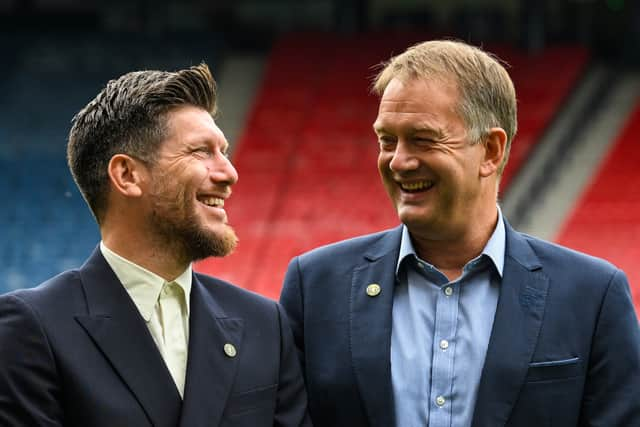
The bright-eyed, engaging Craig Mulholland does not seem like the kind of person who would ever take a closed-minded approach to things. However, during his time as academy director at Rangers, he admits there had to be an element of selfishness in how he operated.
The relevance? Now, in his role as chief football officer for the Scottish Football Association, he understands the suspicion within clubs when anyone starts prattling on about applying blue-sky thinking to curing Scottish football’s ills. He empathises with the ‘aye, but what’s in it for us?’ reaction. Why? Because he was once firmly in that camp.
The 56-year-old has called a summit of Scotland’s 42 league clubs. However, heaven help anyone who suggests anyone is being summoned to St Andrews a week on Friday for this powwow about the future of the game in this country. “We’ve not ‘summoned’ anyone anywhere,” Mulholland stresses. Invited, then. Whatever the semantics, Friday 4 September is another red-letter day for Scottish football, more than 15 years after former first minister Henry McLeish’s two-part independent review into the state of the game was published. Let's go round again.
What is Scottish football summit about?
Evolve or die might be putting it too strongly. However, Mulholland is keen to implement a new era of the SFA working “incredibly closely” with clubs to get to grips with issues such as the chronic shortage of Scots playing top-level football and the unhelpful recent trend of promising young Scots being subsumed into the academies of big clubs in England.
Even Celtic and Rangers are not immune to this. As recently as Friday, it was confirmed that Fulham had signed 16-year-old Celtic striker Erskine Rennie. The Parkhead club can look forward to receiving roughly £80,000 in ‘compensation’. Another way of looking at it is: would Rennie have been given the chance at first-team level with Celtic?
“We need to put mechanisms in place that encourage opportunities for young players to play,” Mulholland says. “We are one of the few countries in Europe that doesn’t have any rules or incentives or anything like that.”
He expects resistance. He knows the mindset from his time with Rangers. “I’ve sat on the other side of these conversations for one of the biggest clubs in the country for years,” he says. “If we’re going to get this game better then we need to get the Scottish FA and clubs working hand in hand – and the Press, the public…”
Club versus country is a long-established battle line, especially where the Old Firm are concerned. Mulholland’s ties to one of them might be helpful. Or else the connection could be a hindrance. It remains to be seen. All he knows is that he wants to reach some kind of accommodation regarding the way forward.
“We can’t be sitting bottom of the tables across Europe for giving young players minutes and think that’s okay,” he stressed. “We need to be aware of the reality of the problem.
“I was 20 years with Rangers, so I’m not sitting here preaching to anyone,” he continues. “I was then part of that problem. We were all part of it. But now we need to be brave enough to say, 'Right, we’re at a bit of a crossroads'.”
Mulholland had been expecting to work with Steve Clarke when he clocked on in his new role last month. Although well regarded at Nottingham Forest, where he was head of football development and talent management, one of his main credentials for moving back north of the Border was knowing he could get on with Clarke. They shared broadly the same vision. This was all rendered redundant at the end of June, when Scotland suddenly found themselves looking for a new manager. Suddenly Mulholland’s in-tray looked a lot different. Finding a new manager became his first task.

Why are Scotland continuing their next manager processes?
He is thrilled with who has emerged from the pack, the “exciting” – and young - Sebastien Pocognoli, who turned 39 earlier this month. Mulholland came into the process imagining the ideal candidate was an experienced manager with plenty of international games under their belt. Then sporting intelligence company Twenty First Group got involved, at the SFA’s behest.
“It turns out people doing the international job for the first time are more successful than those doing it for the second time,” Mullholland explains. “It is probably logical; you only get the second job if you’ve done well in the first one.
“Age? There is no correlation between being over 50 or under 50 in terms of success in the job. Then I thought about nationality. It turns out there is no correlation between being from that country or not being from that country.”
Sixty per cent of countries at this summer’s World Cup had non-native head coaches. But then it’s also true that a country has never won a World Cup with a foreign coach. Since Scotland’s principal ambition is simply qualifying for the second stage of a major finals for the first time, that ought not to be a problem. It’s small steps.
Mulholland thinks we’ve won a watch with Pocognoli, although he would think that. A lot of work has clearly gone into identifying the Belgian as The One. Mulholland and Ian Maxwell, the SFA chief executive, got to know each other a whole lot better. They visited four countries in five days at one stage of the 50-day process. “We had to be put the hours in, we had to put the work in,” says Mulholland. “We had to be connected to the agents in the markets.”
Mulholland has some interesting ideas. He is already thinking about the appointment after Pocognoli. “We want to have a live league table of managers on the go all the time,” he reveals. “If a manager does leave, then you immediately know who your three or four top candidates are you can go to.”
Part of the reason for coming back – he mentions another Premier League side were interested in hiring him – is that he wants to leave a legacy in his home country. His ears pricked up when he heard president Mike Mulraney tell him that the SFA are more open to change than they ever have been.
“That excited me,” he says. “Because let me tell you, I could have made a hell of a lot more money staying in England.”
Comments
Want to join the conversation? Please or to comment on this article.