
Scottish football's iconic half-time scoreline remembered as club marks 30 years since famous night

New book charts adventures of unlikely heroes in Europe
It may seem peculiar for any football club to celebrate a defeat as one of their greatest ever moments.
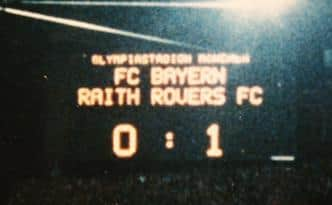
But that is exactly what October 31, 1995 represents to Raith Rovers - and understandably so - when one of the most enduring and iconic images in Scottish football history was captured on a giant Munich scoreboard.
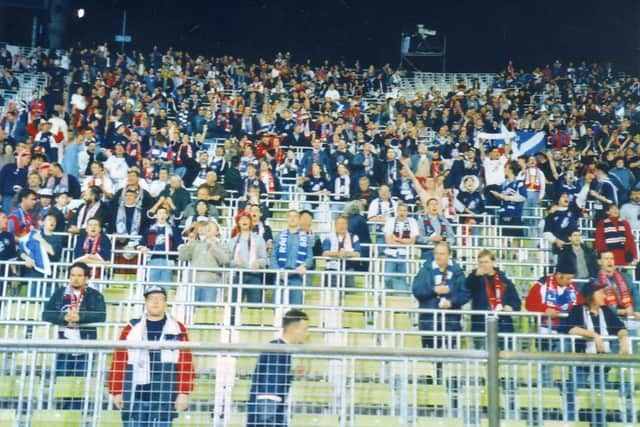
Underneath the words ‘Olympiastadion’ read the half-time scoreline that rippled across Europe and forever sticks in the mind of the 1,200 away supporters who witnessed it... FC Bayern 0:1 Raith Rovers FC.
Yes, this was the Halloween of 30 years ago when a small town Scottish club, who were part-time up until only four years earlier, spooked one of the giants of the game in the third round of the UEFA Cup. It was the night Kirkcaldy - formerly famous for being the linoleum capital of the world - was suddenly placed on the football map.

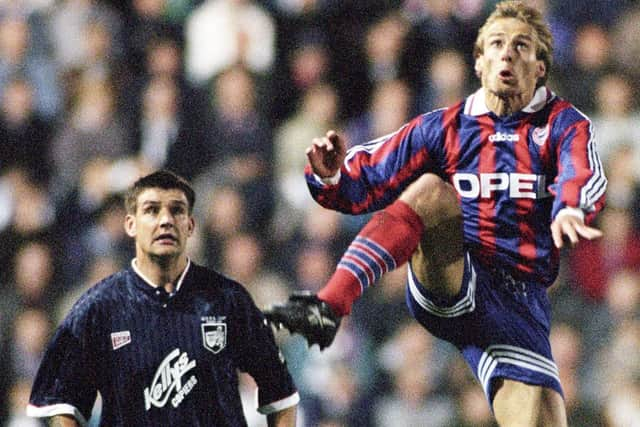
Trailing 2-0 to a Jurgen Klinsmann double from the first leg at Easter Road - the Fifers brought European football to Leith in a decade where Hibs managed it only once after the match was switched from Stark's Park - most expected Raith to be lambs to the slaughter in the away leg, particularly when Munich manager Otto Rehhagel lined up with his full compliment of superstars.
But when French striker Jean-Pierre Papin fired an early penalty over the bar, and Raith started to gain a foothold in the game, it was clear there was something in the Munich air. Then, in a dreamlike moment when time stood still, Danny Lennon's free-kick on the stroke of half-time was deflected past wrong-footed goalkeeper Oliver Kahn by Andreas Herzog - two international icons in a team packed full of them. The net bulged and, after a moment’s disbelief, the celebrations began.
"I can still play that from the minute," recounts Lennon in a new book, We Led in Munich, authored by Raith supporter Steven Lawther, charting the club’s remarkable European journey which took them to the Faroe Islands, Iceland and ultimately, Germany. "The exact place on the pitch. How the free kick happened. The wall. The reaction of the Bayern Munich manager. They are all etched in my mind. I got a little bit of luck along the way, but scoring in the game against Bayern in the Olympic Stadium still puts a smile on my face. It is a reminder that dreams can become a reality, with hard work and belief."
Rovers ultimately went down to a 2-1 defeat on the night, 4-1 on aggregate, with KIinsmann and Markus Babbel rescuing the hosts with goals after the break, but not before Raith winger Tony Rougier had blasted a presentable chance to level the tie into the side-netting. Two lapses in concentration had cost Rovers a famous result, but they were far from played off the park.
Competing in Europe for the first and only time in their history was Rovers' reward for their fairytale League Cup final penalty shoot-out triumph over Celtic the previous season when manager Jimmy Nicholl and his players secured their status as club legends. They thought that night at Ibrox could never be toppled, but Munich came close.
First stop: the Faroe Islands
Avoiding being knocked out by a team you couldn't pronounce was Nicholl's one wish for the European adventure. The first round draw against Faroese minnows Gotu Itrottarfelag presented precisely such a hurdle to overcome.
A 4-0 first leg win at Stark's Park, with Jason Dair having the honour of netting Raith's first goal in Europe, meant there was never any danger of such a fate befalling them. A 2-2 draw in Toftir, following a bumpy flight through the mountains that, according to teammate Robbie Raeside, drew “the loudest scream I have ever heard from big Ally Graham” as it landed, ensured safe passage.
It is worth noting that Lawther's book - the third he has written on his beloved Raith - contains an interview with John Petersen, the current Faroese women’s national team manager, who played in both Gotu games and also scored twice against Scotland in the 2-2 draw seven years later which saw Berti Vogts sacked. It also features a foreword by Raith fan and former Prime Minister, Gordon Brown, as well as contributions from many of the Rovers heroes of the time, and stories told by the fans who travelled to all three ties, Lawther himself among them.

The second round draw presented a far tougher challenge in the form of Icelandic champions Akranes, featuring formidable twins Arnar and Bjarki Gunnlaugsson. The type of opponent that Scottish clubs of greater stature and resources have failed to negotiate countless times over the years - indeed Motherwell were eliminated by MyPa-47 of Finland in the first round that year leaving Raith as the country's only remaining representatives in the UEFA Cup.
Against a team who knocked six goals past Shelbourne in the previous round, and peppered with seasoned Icelandic internationalists, Raith did not look favourites, but thanks to a brilliant Lennon double in the first leg at Stark's Park, and a crucial late Barry Wilson strike, they took a 3-1 lead to Akranes. With away goals still a factor back then, a 2-0 defeat in Iceland would have sent Raith crashing out so the objective was to defend what they had.
Bizarre double sweeper system
In an attempt to do so, Nicholl sent his team out in a formation that had never been seen before or since. "It can best be described as a 6-3-1," writes Lawther, "but it was the inclusion of the two sweepers behind the back four that made it unusual."
The bizarre double sweeper system worked in that Raith escaped with a 1-0 defeat and progressed to the third round meeting with Bayern. Asked in the book whether he would repeat the formation, Nicholl laughs. "No, no never. We hadn't worked on it and, in the end, I was over-cautious." Regardless, Raith were through and the rest is history.
To put their efforts against the Bayern into perspective, Raith's aggregate defeat of 4-1 was bettered only by losing semi-finalists Barcelona (4-3) as their third round conquerers went on to lift the trophy. Nottingham Forest were hammered 7-2 in the quarter-finals while Bordeaux were crushed 5-1 in the final, also played over two legs. Rehhagel would later admit that the two legs against the Fifers were the toughest the Bundesliga side had endured in the competition.
Yes, Raith were beaten in the end, but they will never forget their 15 minutes of fame - or 23 minutes to be precise including the half-time break between Lennon's opener and Klinsmann's leveller when the impossible seemed possible.
"The UEFA Cup campaign was everything I wanted it to be for the club," Nicholl reflects in the book. "We were never going to win the trophy, but we had a wee run, and it was great to go out on such a memorable occasion."
We led in Munich - the unlikely adventures of Raith Rovers in Europe, by Steven Lawther, Pitch Publishing, £18.99.
Comments
Want to join the conversation? Please or to comment on this article.