
Exclusive:Sir David Murray: I know the truth as he addresses Rangers critics, raw reaction and revisiting Ibrox
In a big interview with The Scotsman, former Rangers chairman insists he’s given honest account

Ahead of a vital Champions League qualifier, such as the one awaiting Rangers next week against Panathinaikos, it once seemed almost mandatory to beat a path to David Murray’s door.
Once inside his well-appointed Charlotte Square office in Edinburgh, just along from Bute House, the sportswriter in question would busily jot down inevitably entertaining rattle about the Ibrox club’s ambitions on the European stage. There would perhaps be some further toffee in the form of a signing target to chew over.
In 1997, it was Ronaldo, or so it was widely reported. Rangers were apparently ready to rewrite the record books with a financial package worth almost £40 million for the then world footballer of the year, who was at Barcelona at the time.
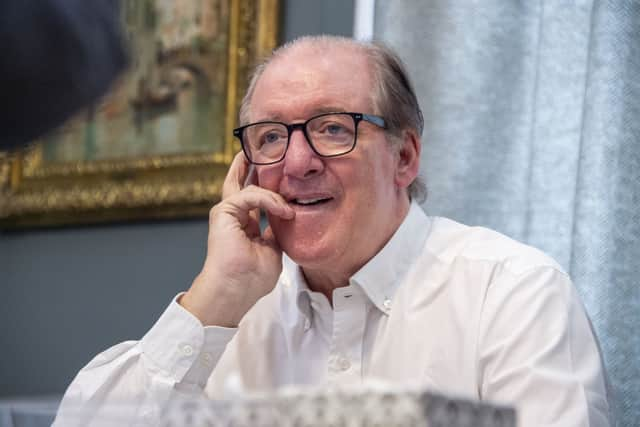

Although there's plenty on the likes of Paul Gascoigne, bought 30 years ago this summer, and Tore Andre Flo, a £12 million signing 25 years ago, the Ronaldo tale does not make Murray’s new book, probably because, he claims, it wasn't true. “That’s folklore,” he says. “We tried to get and did get some pretty big names, that’s not one.”
It did appear plausible at the time, though, which perhaps says everything. Things are of course very different now; for Rangers, for Scottish football and for Murray.
For a start, his office has shifted a few hundred yards to a still salubrious street in the city’s west end, next to a building with a plaque dedicated to a “John Brown”. While it might amuse visitors with serviceable knowledge of Scottish football, the sign is not paying tribute to the Rangers nine-in-a-row legend.
It is instead denoting where the Edinburgh writer Dr John Brown, author of Rab and His Friends, a sentimental tale about a dog, lived in the late 1800s.
‘There are people who make a living from being critics’
Legacy is, of course, a very pertinent issue when it comes to Murray, whose name was once attached to the Rangers training academy until it very quietly wasn’t. There were also calls to strip him of the knighthood he was awarded in 2007 for the way, critics claimed, he ran Rangers into the ground, with Craig Whyte, the convenient idiot who controversially bought the club for £1, applying the coup de grace.
As you’ll be aware by now, Murray’s newly released autobiography has stoked the embers somewhat. It’s been over two weeks since official publication day and he says he enjoyed the cut and thrust of re-engaging with the football media. “I couldn’t do it every day though,” he notes.
And it’s probably best that he steers clear from various Rangers fans’ forums, where it’s fair to say the majority have rejected out of hand Murray's apology, issued through the book, for selling the club to Whyte and for failing to steer Rangers, already laden with debt and being pursued by HMRC for tax avoidance schemes relating to player and staff payments, through the global economic crisis.
“These are the same fans who were criticising when we were winning doubles and trebles,” he says. “I have gone to Rangers agms and been questioned after winning a treble. There are people who make a living from being critics. That’s what they do. I know the truth."

He knows not everyone has been convinced or even moved by his mea culpa but then concerns might have been put into perspective by the recent shocking news from Spain, where Digo Jota, the 28-year-old Liverpool footballer, and his younger brother Andre Silva were killed in a car crash following what police suspect was a tyre blow out.
It’s easy to imagine these details bringing it all back home in chilling fashion for Murray. His new book’s prologue deals with the violent car crash following a tyre blow out that left him a bi-lateral amputee when he was just 24. It was a miracle he survived.
“If it had been a steel car, I’d have been stuck in it,” he explains with reference to the purple Lotus Elite that he was driving after playing stand-off for Dalkeith at North Berwick. “Because it was fibreglass, I got out.” He was also lucky he wasn’t wearing a seatbelt.
“But then again, I was unlucky,” he continues. "Because on that stretch, there’s a mile of open field and then half a mile of oat fields and a clump of trees about 25 yards along, and I go into those. So I was lucky to come out of it but unlucky to hit it.”
‘I never used it as an excuse’
It’s a tribute to Murray that his disability seems one of the least remarkable things about him these days. So much else has happened to make the extraordinary appear somehow ordinary. However, it still stops you in your tracks to watch the elaborate, physically punishing process involved when he wants to simply hoist himself up from his chair.
“I never used it as an excuse,” he says, and he hasn’t. The same applies to the life-threatening aortic aneurysm diagnosis that is among the revelations in his autobiography and which he says accounts for him looking “terrible” in the photograph of him signing over Rangers to Whyte in 2011.
“If anyone criticises the book, they are being unfair,” he continues. “It is open and it is honest. It lets people know what I have gone through in my life, what I have done. I like to think I have integrity. People might say different. I have done my best. I don’t go around to shaft people, or do them down.”
It’s true. There’s little score settling often found in such books. Donald Findlay, who Murray considered a friend and who was once his vice-chair at Ibrox, gave his old compadre a torrid time in court when acting for Whyte at the latter’s fraud trial in Glasgow. He barely rates a mention other than a paragraph in which Murray wonders why he was permitted to act as a defence counsel, given his status as a former prominent season ticket holder, shareholder and club director (jurors with similar credentials were barred).
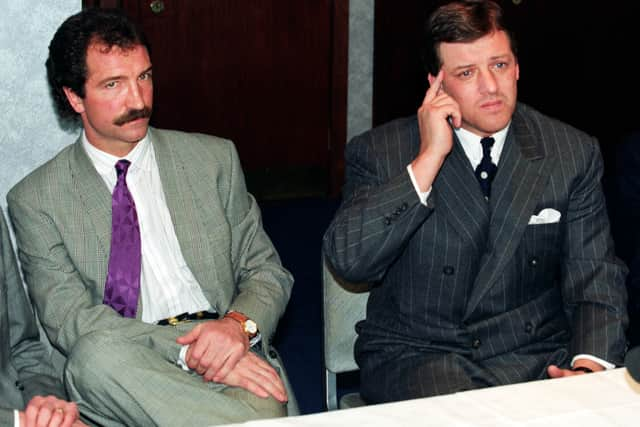
“I was disappointed. He thought he was doing his job,” Murray reflects now, with reference to Findlay’s aggressive tone in court. “I think it was not hard to win his case when you consider the jury was pre-selected. And Lady Stacey said, ‘Anyone with a Rangers connection, a season ticket, please leave’. Er, hello. As good as Donald thinks he is, it was only ever going to go one way.”
Have they spoken since the court case in 2017, which ended in success for Findlay when Whyte was acquitted of all charges? “No,” he says.
As for former chairman David Holmes, whose own recent book depicts Murray in an unflattering light, there’s again scant mention. “David was kept on (as chairman) and was treated properly,” he says. “I wouldn’t use the word bitterness but he seemed annoyed he wasn’t invited back. He could have come back anytime!” Although he thinks Holmes was a bit unfair to him, he has resisted any urge to respond in print and, indeed, chooses “invaluable” to describe his initial support.
“In the book, I have not criticised anyone,” points out Murray. There are, though, some deliciously gossipy anecdotes, including the story about Murray taking Sean Connery in to meet the Rangers players before a Champions League qualifying clash in Copenhagen. Having clocked Connery, Ronald de Boer makes the baffling decision to inform him that his last film, The League of Extraordinary Gentlemen, “was shit”.
Murray enters the dugout
Murray was mortified. “It was nerves,” he says, generously providing some mitigation on De Boer’s behalf. “It was a big game. We needed to win that game. We needed money.”
Before the same match, Barry Ferguson, he notes, was more interested in collaring him to discuss bonuses, which he felt would be better left for afterwards. The midfielder was sold shortly afterwards to Blackburn Rovers in any case. “He was gone the next day. And he was arguing about a bonus!”
But then everyone is a critic, Murray included, judging by an amusing story he tells against himself that isn’t included in the book.
Rangers were in Edinburgh for a game against Hibs although when Walter Smith, the manager, phoned to find out if his chairman was coming to the game, Murray said he wasn’t. “I went to Mather’s Bar after work, met a pal and had two pints,” he recalls. “Then I thought, ‘Ach why not?’ I jumped in the taxi, got to Easter Road and I couldn’t be bothered climbing up the steps. I got in the dugout, didn’t I?”
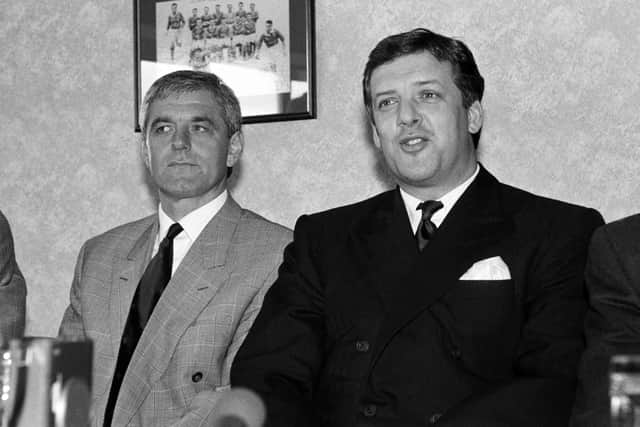
Emboldened by a couple of pints, he suddenly finds himself shouting ‘Get Spackman off!’, much to the displeasure of the referee and one imagines Smith. “The next week a memo was circulated: ‘no directors will be allowed in the dugout’,” he notes.
It's all good knockabout stuff until it becomes something a bit more sinister, which is what some of the comments online come across as being with regards to Murray and Rangers, although anger is understandable. Whoever was principally to blame, Rangers went bust. They ended up in a league with the likes of Peterhead and Montrose.
Time doesn’t heal anything, as one of the taglines for the recent film 28 Years Later has it. “I was in France when the book promotion stuff all opened up, someone on one of these websites was saying 'I saw him driving around the west end, number plate MUR 1, who does he think he is?’ I was out of the country for a month! People write what they want. Why is there no policing of that?”
He worries about the extent to which AI will affect daily life. "Two people have ‘written’ books on the Amazon site and are selling them about me. Up beside mine there’s two other books written artificially. It is scary.”
‘There was more effort, more spirit...’
Actually, having checked, there’s now at least four bearing Murray’s name. Although quick to embrace change in business life, he’s a man of his time although there’s little in his office to identify him as the owner of Rangers for nearly 23 years. He does still use a leather desk blotter gifted to him by Bernard Tapie, the controversial former Marseille president who was welcomed to Ibrox for an epic Champions League tie in 1992. Those were the days.
“I was talking to Graeme Souness about it yesterday,” he says. “The 1980s and the 90s were great years to be alive and be young. There was more effort, more spirit...”
Not that Murray has lost much of his vim, despite everything. The variety of poses The Scotsman’s photographer Lisa would like him to strike are restricted not only because of Murray’s need for crutches, but also by a back crick sustained on the quad bike he has just acquired to ride around his Perthshire estate.
Then there’s the relationship with Sarah, his girlfriend from the late 1990s, which has been resuscitated in recent years (the account of the death of his first wife Louise, mother of his two boys, from cancer, aged just 39, is one of the most affecting parts of the book).
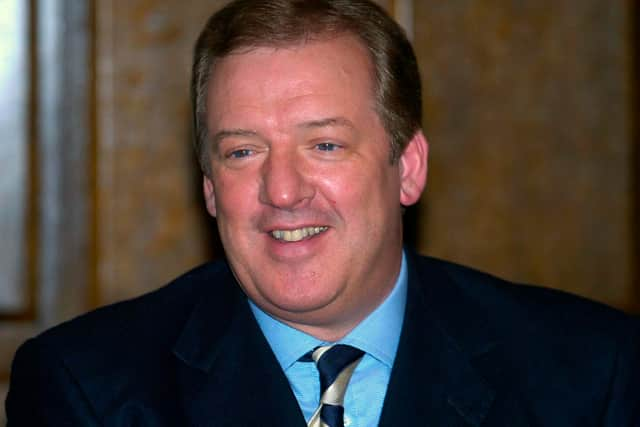
He’s recently sold his house in Juan-Les-Pins but a vineyard north of Marseille, Chateau Routas, is still going strong under the watchful eye of Keith, Murray’s youngest son.
Murray is also just back from seeing ELO in Manchester with his other son David, now managing director of Murray Group, which was timely, since it’s probably turned out to be frontman Jeff Lynne’s last ever performance.
Given the way he’s built back his businesses - he says he has just completed one of his biggest ever property deals - it’s not difficult to reach the conclusion that life is currently good for Murray, now 73, hence the book. He isn’t going away even if it felt like he had post-Rangers following what seemed like his total disappearance from public life.
“Be under no illusion,” he says. “I have made a lot of sacrifices in my life. For Rangers, my business and my family, which is a pleasure in the latter case. People need to understand if you want to climb the greasy pole, there’s a price to pay. Less and less people want to make the effort.”
His book is climbing the charts
He laments the current state of the Scottish economy, the lack of incentive for entrepreneurs coming through and the tax pressures on family businesses.
The gospel according to David Murray is never less than interesting, though it won’t be everyone’s cup of tea – and not everyone will go out of their way to hear it.
----------------
Enough people have, however, purchased his book for it to enter the Sunday Times top ten list last week. For Scottish football fans of a certain age consulting this chart, it felt completely surreal.
Among books such as The Greatest Story Ever Told, a retelling of the life of Jesus Christ using eyewitness accounts of the era, and The Last Days of Marilyn Monroe, can be found, at number 5, Big Dunc, an autobiography of the “larger than life” former Rangers footballer Duncan Ferguson. Meanwhile Murray’s book Mettle: Tragedy, Courage and Titles, written with former tabloid editor Bruce Waddell with all proceeds going to the Erskine veterans’ charity, was sitting at 10.
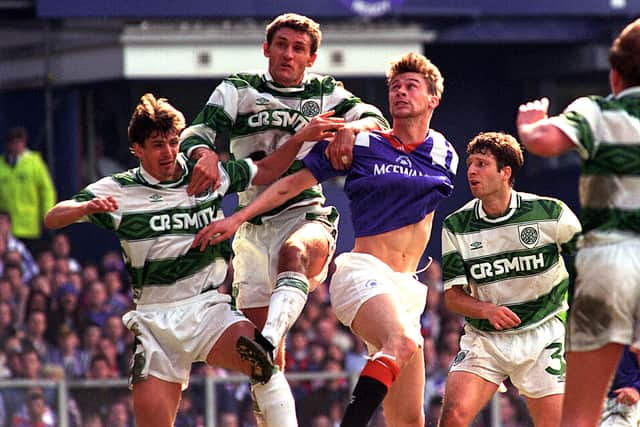
Perhaps not appreciated by the wider literary crowd, there’s a crossover between the two titles – Murray, of course, sanctioned signing Ferguson for a biggest ever British fee 32 years ago this month.
There’s a further connection between the two books: Barlinnie. Ferguson was sent there, famously, in 1995 after being convicted of an on-field assault on Raith Rovers player Jock McStay.
Less well known is that Murray’s own father, Ian, spent time in the notorious prison before being transferred to an open prison near Newton Stewart after being convicted of a “minor fraud”. Somehow these details have remained out of the public domain. An inveterate gambler and latterly prodigious drinker, he passed away at the age of just 50.
Murray writes that his father never recovered from his prison experience but pays tribute to him for instilling in him a lifelong love of sport, including taking him to watch Scotland for the first time when they beat England in 1964 courtesy of an Alan Gilzean header.
Still keeping tabs on Scottish football
His mother, Roma, whose maiden name was McMahon, kept the family going. “She was Roman Catholic!” he points out, which might be an odd thing to say but then this is Scotland, and Murray is happy not having to cope with the seemingly never-ending sectarian problem afflicting Rangers.
He has offered counsel to current chief executive Patrick Stewart on a variety of matters, this issue surely among them. It reared its head most recently when fans unveiled an eye-catching tifo before a game against Celtic. Murray is vaguely aware of the details.
“The Souness with the gun thing?” he checks. He does keep up to speed with Scottish football to the extent that he recently acted as a talent scout for St Johnstone.
“I had a young German boy over,” he says. “I was in the south of France, at a big wedding a couple of years ago and met this young boy, David, who wants to be a footballer. I said, 'Come over to Scotland'. This was the summer before last. So I brought him up to St Johnstone with Steven MacLean. He was pretty average (as a player) but was sitting down at dinner one night with the family and he said, 'Do you think there’s an anti-German feeling from the British because of the war?' I said, 'Not at all'. But in Northern Ireland they are still going on about 1690. Britain and Germany have moved on. Unfortunately that stuff has not really moved on, has it?”
‘I’d rather go to ELO with David’
Life has moved on in other ways, though. It’s a different landscape now, with Celtic way out in front and Rangers struggling to make up ground. Russell Martin’s side face a huge game in the context of their European ambitions on Tuesday night.
Murray will be watching at home. He hasn’t been back at a Rangers game either at Ibrox or elsewhere since he sold the club. It’s not realistic to imagine that situation changing now.
“I would go back if I wanted to go back,” he says bullishly but one wonders if that is truly possible given the enduring bitterness. “That part of my life has moved on now. I would rather have my grandchildren to stay. I’d rather go to ELO with David or go to a cricket match or go to the vineyard.”
When he asks what reason is there to go back, I venture: “Watch a game?” He suggests that he’s seen enough, over 1200.
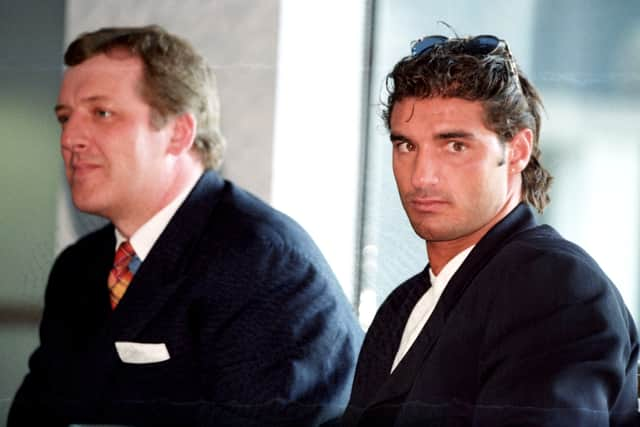
This number would be significantly lower had he sold the club in 2005 when given the chance to do so, another recent revelation. Jack Petchey, the former Watford owner who died last year, was Murray’s signature away from taking control of the club in a £40m deal.
With his Mont Blanc pen hovering over the paperwork, Murray writes that he “endeavoured to renegotiate an additional sum” before realising he just couldn’t sign it and left the room, amid “despairing groans”.
There were some concerns about Petchey’s plans to reconstruct the Copland Road stand to include flats. Murray contends that he had done “the best thing for the club but not for me, personally” which jarred slightly when reading the book, since it seemed that a big part of the struggle to let go was an unwillingness to lose something that had become him. There was a selfish element there.
“It was probably a bit of both,” he accepts.
Walter Smith’s message
Whatever it might have meant for Rangers in the long run, he can’t bring himself to regret staying, because the subsequent years included the return of Walter Smith and another eight trophies in five years as well as a European final, an arguably better achievement than their first spell together given the severe financial squeeze. Reuniting with the legendary manager meant everything, both professionally and personally.
He has kept his final message, sent shortly after Smith missed Murray’s 70th birthday celebration due to illness. “He sent me a message, he was about to die, ‘sorry I missed your party’. Typical Walter.”
And on this subject, even his harshest critic amongst the Rangers fans cannot doubt his sincerity. “All the people that mattered at Rangers are still friends with me,” he continues, with Graeme Souness having contributed one of two forewords in the book.
“We are in a joint business venture with Brian Laudrup (they recently launched a rosé wine, bearing his name). (Ally) McCoist is friends with the family. Archie Knox, he sent me a nice text about the book. The people that mattered I remain friends with.”
Comments
Want to join the conversation? Please or to comment on this article.