
Rangers hero opens up on Hearts dislike, proving Ibrox worth, career-ending injury and battle with cancer

Scorer of famous Rangers goal bears all in searingly-honest autobiography
Anyone who has been a professional footballer knows what it’s like to work on Christmas Day. Scott Nisbet would never dream of complaining.
He will be doing so in the sun for one thing. And if this time of the year is all about children, he is guaranteed to be around plenty of them. Around 30 boys and girls attend the coaching school he co-runs each day from a hotel in Lanzarote, with Christmas Day being no exception.
But more than anything, he’s just happy to be anywhere having been diagnosed with stage 4 cancer five years ago. He’s also had a couple of new hips fitted in the interim, the further cost of a football career that was cut cruelly short by a pelvic injury. It’s little consolation to know that medical advances since 1993 mean that it’s highly likely he could have recovered were he playing now.


Back then, however, he was advised to quit the game aged 25 after feeling something “go” in his hip against Celtic at Parkhead of all places.
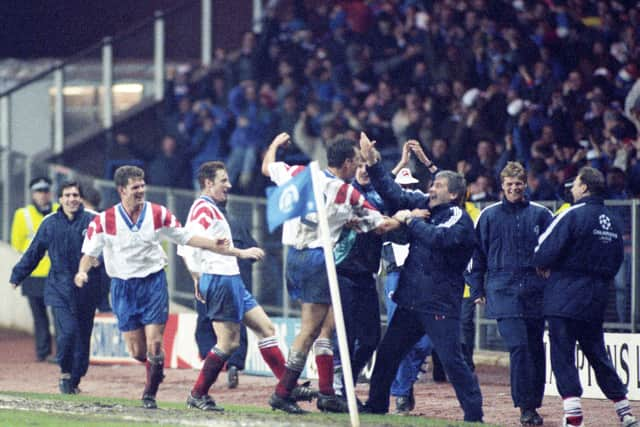
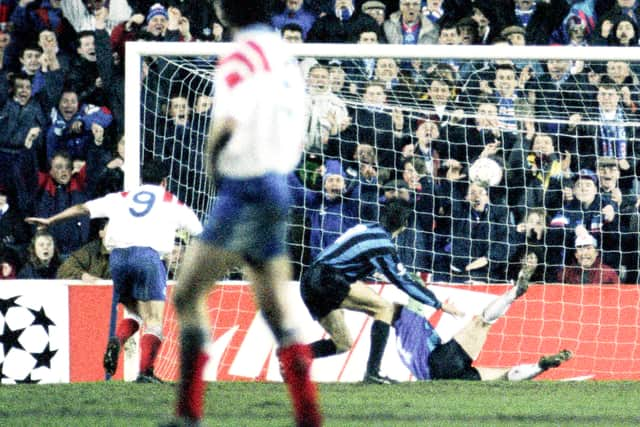
It was just days after he scored the memorable winning goal against Club Brugge that kept Rangers on course for the inaugural Champions League final, although they fell just short.
At half time of the first leg of the Champions League qualifier against the same Belgian side in August, it looked like he might remain the last Rangers player to score against them. The Ibrox side were 3-0 down at home. Danilo scored in the second half but it was the first of two chastening nights.
Nisbet watched both legs of the Champions League qualifier in his local in Playa Blanca. “I watched them here - through my fingers! I was speaking to the punters, then I had to apologise to the punters or the performance of some of the players.”
Rangers lost the tie 9-1 on aggregate. What infuriated Nisbet most was the meekness of the Ibrox side. Robbed of such a large chunk of his career, he’d have done anything to be out there, giving his all, like he used to do. The same applies to this weekend’s game with table-topping Hearts, a team the Edinburgh-raised Nisbet says he never liked and always relished beating.
There was only one Hearts player I liked
“I used to go out in Edinburgh,” he recalls. “They’d be in the same bars. They thought they were it. They’d turn up in their Hearts blazers, I’d go home and get changed and then go out. What p****d them off is that I pulled more birds than them! The only one I liked was wee John Robertson, he would always come up to me before the game and say, ‘Hey Nissy, all the best’. And he would wink at me at the halfway line. One time we played at Tynecastle and I had him out wide and I was saying to him, ‘Run me, run me!’ He said: 'f*ck that', turned round and passed the ball back. He knew I would outrun him. What he was good at was in the box. He was lethal in the box. Give him half a yard, he would punish you.”
It's good to be able to catch up again with Nisbet in the weeks after the publication of his autobiography, Red White and True. It has few rivals for the title of most searingly honest sports book of the year. It’s also among the most entertaining. Having been approached by author Alistair Aird, Nisbet agreed to cooperate on a book about his life but on one condition.
“I said, 'Alistair, if you're going to do a book. I want to do a book about everything. Everything. Not just football.'” It’s why we learn so much about Nisbet’s divorce from wife Anna, which led to him having to sell all his medals to fund the seemingly never-ending custody cases involving their three children, TJ, Indya and Chad.
It’s a harrowing read at times. There are a couple of death-bed scenes. “Son, that’s me f**ked now,” his dad David tell him as his organs started shutting down one by one, a few years after he’d already had a leg amputated due to a blood clot. There were the last words he ever said to his youngest child. The eldest, Debra, Nisbet’s sister, died two years later following a botched operation to remove her kidney after being diagnosed with cancer. A coroner’s report eventually confirmed the hospital in Milton Keynes had been negligent on several occasions. “I was also terrified that I would suffer a similar fate to Debra when I went in for the operation to remove my kidney,” Nisbet says.
Cancer-free and a walking miracle
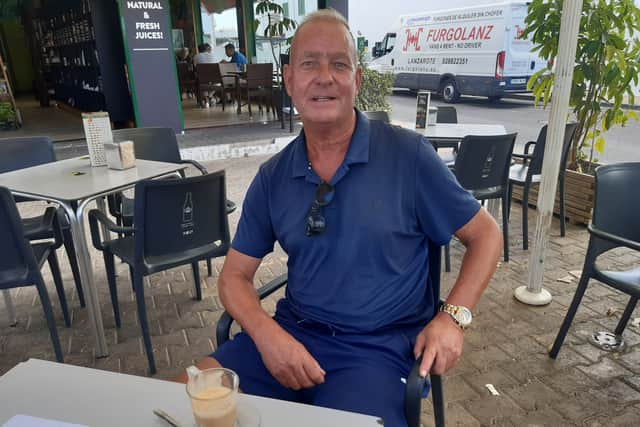
We last met just over a year ago in Lanzarote and given his health situation, there was always an element of doubt about whether there would be a next time.
Now 57, it’s no exaggeration to call him a walking miracle. “I’m cancer-free at the moment,” is how he describes it, careful to avoid jinxing anything. He has taken his oncologist’s advice to just enjoy life. He has a bucket list trip booked to play golf at Sawgrass in Florida in March but was frustrated at missing Sir Chris Hoy’s Tour de 4 ride from Glasgow to Edinburgh in September, which aimed to demonstrate that those given such a seemingly dire diagnosis as stage 4 cancer can still lead fulfilling lives.
The event clashed with the annual European Rangers’ Supporters Association bash which was held in Majorca this year. Next year’s venue is even more handy: Lanzarote. It includes a catamaran day. The mind boggles.
“It gives me something to aim for,” says Nisbet. “Everything feels good. I have my feelings back. My stomach area. My hips are feeling great. The body took a big kicking. The tumour in my chest has really shrunk. Touch wood, so far so good.
"I will be honest with you, when I was diagnosed with stage 4 cancer in my kidney, lymph nodes, abdomen and trachea, I did not think I would be sitting here now talking to you. I would not think I would have written a book. And I have not missed a single day of my soccer school. When I got my hips done, I coached with my crutches.”
Even before cancer hit, writing a book about his life hadn’t seemed on the cards. He is dyslexic for one thing and was given what he described as a “free transfer” from Craigroyston High School - expelled in other words. However, he was fortunate that an inspirational head teacher by the name of Terry Christie learned of his plight. Christie set many pupils on the right path though he had a special interest in those who could also kick a ball, and Nisbet could certainly do that. He invited him to enrol at Ainslie Park High School. “There was a condition,” he recalls. “I had to play in the school team.” He was already training with Rangers but Nisbet readily agreed.
Christie was one of the best-known and most respected managerial figures in Scottish football during the 1980s and 90s. He remained part-time with Meadowbank and later Stenhousemuir to allow him to continue working in education. Nisbet’s football ambitions took him in a different, loftier direction than teams like Meadowbank (his brother, David, played for them). Although he grew up in the same Muirhouse district of Edinburgh that produced Irvine Welsh, he was not drawn to Hibs or even Hearts. Always a Rangers man, on account of his father, Nisbet lived the dream by signing a professional contract with the club.
Complicated Souness relationship
Having done the hard part, he wasn’t going to be bullied out of Ibrox - not even by Graeme Souness. When the player manager told him with a wink, following David Murray’s successful takeover, that “the Edinburgh boys are in charge now”, it wasn’t a comment designed to provide Nisbet with comfort. Despite their shared background in the Scottish capital, the pair hadn’t hit it off following Souness’ arrival at Ibrox in 1986.
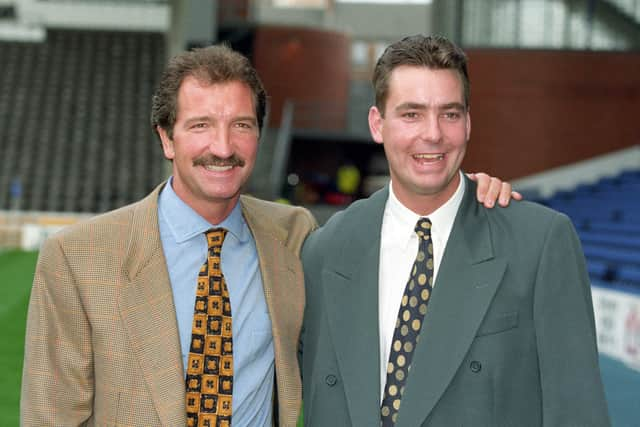
Souness ordered him to sign for Dundee, who were after both Nisbet and Ian McCall in a £500,000. Rangers needed the money to sign Nigel Spackman. That wasn’t Nisbet’s problem, and neither was it McCall’s. They didn’t want to go to Dundee and refused.
“I got kicked out of the first-team changing room,” recalls Nisbet. “I was dropped and everything. And then a couple of weeks later Souness calls me back into the office and asked me if I had been tapped!? He said: ‘I have just had (Spurs manager) Terry Venables on the phone wanting to buy you. I told him you’re not for sale!’ I was like, ‘Wait a minute, one minute you’re trying to sell me to Dundee….’
“That was Souness all over. But I’ve no regrets. I did the best thing, I wanted to prove myself.” He certainly did that while going on to make 151 appearances for Rangers. To be fair to Souness, he transformed Nisbet’s football life by turning him from a striker into a defender.
He went on to win title-winning medals in the first three seasons of nine-in-a-row and has been hailed as a Rangers great for the way he filled-in in a variety of positions. He scored one if the most memorable goals of the last 40 years at Ibrox, the aforementioned strike from near the touchline on a muddy, rain swept night against Brugge. Eat your heart out, Kenny McLean. In the very next game against Celtic he sustained the injury that forced him to quit. He didn’t play at the very top level again.
In his book, he suggests Souness was partly to blame. “The genesis of the injury that brought my career to a premature conclusion came a couple of years earlier,” he writes. According to Nisbet, Souness had brought “in a couple of Dutch guys” to fix the thigh problems he was having at the time. They manipulated the muscles with their elbows. The pain was excruciating and made things worse, with the problems progressing to the top of his thigh and into his groin. He doesn’t hold any grudges and there were no studs-up challenges when he and Souness ran into each other at an airport about 15 years later.
“I am not bitter,” he says. “I fulfilled my dreams, even if I had my battles with him.” The airport reunion meant a lot. “He was manager of Newcastle at the time. I was going to Majorca to coach. I was looking at him, he was looking at me. He said: 'Awright Nissy!?’ He waited for me once we had gone through security.”
Souness introduced Nisbet to the Newcastle players then asked him to come to the pharmacy with him, “because he needed help reading the label on his tablets for his heart! He then shook my hand, gave me a hug and wished me all the best. I have not seen him since.”
If relations are mended there, it seems they might never be with his current – yes, current – business partner. Nisbet’s book goes into extraordinary detail about a spat with Gary Sperry, with whom he runs his soccer school business and now refers to as ‘Sperry The Rat’. They have been working together for 20 years but Nisbet dismantles Sperry’s claim to be a former Leicester City player. He writes that, according to a club historian, “no one by the name of Gary Sperry played for their first team or reserves, not even in the wartime regional leagues”. Nisbet concedes Sperry played some form of football: “For Isle of Wight v Orkney, I think!”
Although they are perfectly cordial with one another when the children are around, they don’t speak outwith sessions. The main problem stems from a bar in Playa Blanca they jointly bought, with Sperry later informing Nisbet he was putting the business in his wife’s name. That wasn’t the agreement. “I can’t stand his wife,” Nisbet writes.
One of many consequences of this souring relationship is that the pair, once firm friends, no longer have anything to do with each other outside the soccer school business they run so successfully. Nisbet is particularly sore that all this was happening while he was battling cancer, with the suspicion being that Sperry had been hoping the co-owner might not be around for too much longer. If so, he clearly hadn’t factored in his former pal’s appetite for the challenge.
Red, White and True, containing an afterword by Ally McCoist, is published by Pitch Publishing, £25.00
Comments
Want to join the conversation? Please or to comment on this article.