
Exclusive:Sepp Blatter: Scotland's 'pure' football, World Cup verdict and Gianni Infantino won't talk to me
Controversial former FIFA chief speaks to Alan Pattullo ahead of biggest-ever tournament’s kick-off

Already warned to prepare for the full force of Sepp Blatter’s seductive charm, it takes all of about five seconds to be exposed to a wave of twinkle-eyed charisma. It envelops you like a Swiss mist.
One is aware of this sensation almost as soon as Thomas, Mr Blatter’s helpful Italian press officer, shifts round his laptop so that it faces the former Fifa chief, who is sitting next to him though out of camera shot initially.
Before he does, I notice a crucifix on the wall of the Zurich apartment. And then suddenly, there in front of me is Mr Blatter. Now 90, he’s looking exceptionally well despite a recent period of ill health delaying this interview by a few days. He remains sharp and is as nimble as ever in the art of flattery.


“Looking at you, I remember that once upon a time we met,” he says. “We walked together…” Indeed we did, all of 25 years ago, down Princes Street in Edinburgh. And while it was his 65th birthday, which he spent in Scotland attending an IFAB meeting, little else about the day merits being recalled over two and a half decades later, certainly not a brief interview with The Scotsman after he was doorstepped at the Balmoral Hotel by a young, floppy-fringed sports reporter tasked with tracking down the visiting VIP.
A far older, greyer face is staring back at Mr Blatter now, but I appreciate the sentiment even though I knew I had mentioned this impromptu rendezvous in my missives back and forth with Thomas while arranging the current interview. While memorable for me - walking down Edinburgh’s historic main street with the most powerful man in football at the time tends to stick in the memory, particularly when he stops to tip a busking bagpiper – let’s just say it’s unlikely it stayed in Blatter’s mind much longer than the time it took to return to his well-appointed room in the five star hotel to prepare for dinner. A banquet was being held that night for all the football dignitaries. “Perhaps they will propose a toast to me!” Blatter had wondered as we walked.
Few people are now proposing toasts to someone whose name is rarely mentioned without terms such as “disgraced” affixed to it, although the shame might now be shifting - more of which later.
He certainly looks better than just over a year ago, when he was photographed after an appeals court hearing had fully cleared both Blatter and Michel Platini of corruption charges. They were initially acquitted of fraud offences in 2022 and then by an appeals court last year in a case relating to a £1.6 million payment Blatter made to Platini in 2011.
Such a sum of money transferred between the two most powerful men in football at the time was bound to raise eyebrows. Blatter described it as an “oral agreement” for work carried out during Platini’s time as a football agent-advisor between 1998 and 2002.
But two acquittals and the more recent withdrawal by the Office of the Attorney General of Switzerland, which had wanted to impose sentences of 20 months on the pair, mean the long-running corruption legal case is now closed. Just in time for another World Cup, which Blatter says he will watch on his television at home in Zurich.
‘I have the best TV set in Switzerland’
“I have the best television set in all of Switzerland,” he smiles. “And I will follow everything now. I follow not only the big games. Football is my life. Now as I have more time at my disposal and I am not any longer in a position of duty to have to do things, I have my freedom of expression. I have my freedom to do what I want. But I cannot abandon football.”
He certainly cannot abandon the World Cup. He does, however, have some deep reservations about the upcoming tournament, a tournament with which he was once so synonymous.
It’s hard not to be distracted by his hands as the expressive Blatter makes another point. These are the same hands that have placed the World Cup trophy into the eager clutches of footballing royalty. The erstwhile president performed this duty for the last time at Maracana in 2014 at the end of a World Cup that, despite controversies about white elephant stadiums and protest marches against the cost of hosting the tournament, was generally considered a triumph.
Blatter and the Brazilian president Dilma Rousseff jointly handed the trophy over to Philip Lahm, the German captain following the 1-0 win over Argentina. By the time Hugo Lloris was lifting it aloft as the heavens opened four years later in Russia, a drenched Gianni Infantino was placing the trophy in the France ’keeper’s hands while a less drenched President Putin – an umbrella was hastily found for him – was standing by alongside. It will likely be a drier though no less nauseating scene in New Jersey at next month’s final as President Trump muscles in on the action. Is it too soon – or too late? – to say, come back Sepp, all is forgiven?
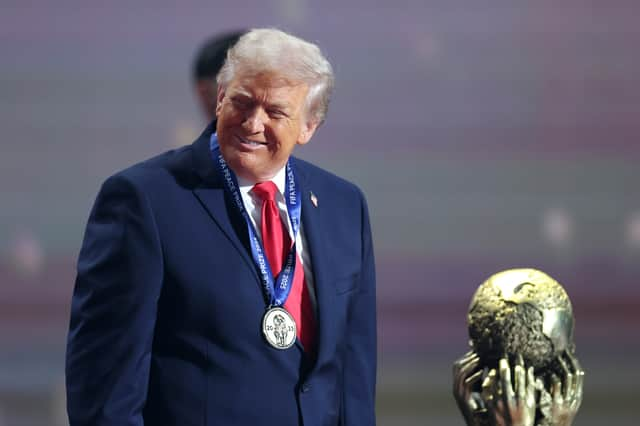
On the subject of Trump, Blatter is unequivocal. The so-called peace award given to the President of the United States shortly before bombs started raining down on Iran is he calls “a shame for football”. He squarely places the blame on Infantino, his successor.
“It has never been our idea to create a special prize,” he says, the use of ‘our’ identifying someone still finding it very difficult to accept being on the outside looking in. “This has only been an idea that came with the new president and without any authorisation from any organisation or FIFA, but here we are...” Citing Saudi Arabia’s underwriting of the Club World Cup, he says “football now depends on politics and politicians, and this is totally wrong”.
The Iran debacle particularly offends him. Days before the World Cup begins, their players are holed up in Mexico even though they are playing all three group games in America. They have authorisation to travel across the Border only on the mornings of matches. “It is such a nonsense!” exclaims Blatter. “And I cannot understand that inside the Fifa organisation there is not one objection – not one! Not one single big association, be it Scotland, England, France, Germany, Italy – nobody has said, ‘Hey! Hey! Pay attention, something is wrong!’
“They have just accepted it. Everything is accepted. I think the game will be played. But the spirit of the competition and the World Cup, it is the highest and more recognised competition in all of sport. Fifa’s World Cup every four years in one country. And now football is still the most popular sport with Formula One, both of them are over two billion followers. It (football) is still popular but the organisation now….I can only express my surprise. I doubt a little bit about the outcome. Once a ball is kicked perhaps the spirit will come back, I don’t know.”
Blatter worries a lot about the spirit of football. “There are questions about this World Cup,” he says. “In three countries, with all the travelling around, the World Cup will lose its regional spirit that occurs when it is played in one country, with the exception that we had with Japan and South Korea. But otherwise it is in one country and the spirit must be there for football. Now the spirit is not in one country, it is in a continent! In three big, big countries. How can you then produce the famous spirit that’s been in the game and in the World Cup? But let’s wait and see. I am not a prophet, so I don’t know.”
He is not a judge either, he says. “But something is wrong,” he continues. Prior to this interview, his most public recent pronouncement was a brief post on his X account informing his 1.3 million followers that he agreed with Swiss-based legal professor Mark Pieth’s contention that fans should stay away from this World Cup amid concerns about security and heavy-handed policing. It was an extraordinary intervention from someone who was once the tournament’s great protector. “It is not up to me to stop the World Cup,” he says. “But I can say ‘don’t go there’.”
Whatever one thinks of Blatter, his devotion to football isn't up for debate. “If there is nothing to do in the region here on a Sunday morning, I go to a small field where young players are playing,” he says, and you don’t doubt it. He was involved in football administration for over 50 years, initially as a secretary of a club in the canton of Valais in southwest Switzerland where he grew up. He was then promoted to the regional football committee and put in charge of refereeing. “This marked me with the laws of the game, definitely,” he says. He is no fan of VAR. “What we wanted to have and we did it is for goal-line technology to see if the ball is inside or outside (the goal),” he says. “That was done. What VAR is doing is to put into question various offside or no offside (decisions) - impossible! Even tracing the line on the television proves nothing. You would need to have a line every centimetre to be sure. So offside is not good. What happens in the six-and 18-yard box, the referee (alone) should decide. And the referee has a right to make a mistake. And now there is a worldwide study on what is handball – let the referee decide. Let us go back to the rules and don’t complicate everything.”
‘This is a nonsense’
He is also concerned about overkill, which is admittedly rich from someone who once proposed having a World Cup every two years. “Those in charge of the direction of football have to think there is a limit somewhere,” he says now. “They already speak about the next World Cup with 64 teams. Why not 128 like Grand Slams in tennis! That is a nonsense, a total nonsense. There should be opposition by the national associations. They must say no, this is a nonsense. It does not enhance the quality of the game if there are so many.”
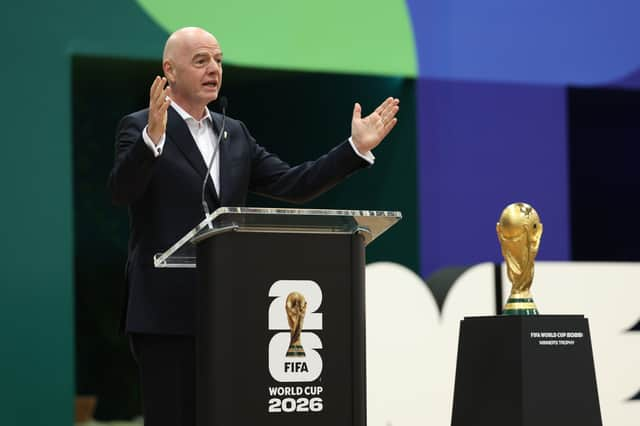
There was a time when they walked the corridors of power in Zurich but Blatter seems barely to have noticed Infantino, who was once an underling at Uefa. A Swiss national of Italian extraction, Infantino rose without trace until suddenly he had undercut his old ally Platini, mired in corruption charges, to take the very top job. Some insight into how he’s regarded by fans as opposed to football associations, whose support he has courted with promises of generous development grants, was gleaned during Saturday night’s Scotland v Bolivia friendly in Harrison, New Jersey. “Infantino’s a fanny!” one banner proclaimed. Whether the American meaning of the word or otherwise, it wasn’t intended as a compliment. I wonder if Blatter has been able to raise his fears for football, and specifically the World Cup, with Infantino?
“He will not speak with me, I have been writing to him and some people around have always said we should meet,” he says. “But he considers me as non-existent. But in his mind, he knows that I am here.”
Blatter recalls Infantino’s coronation, with the Fifa HQ resembling a “crime movie” – Blatter’s own description - amidst the wreckage of his own reign. Dossiers were being confiscated by police, offices were being cordoned off. Something Blatter remains proud of are the TV deals which were struck in his time, with Infantino enjoying the benefits.
“We had television contracts that are still valid until 2030,” he notes. “He (Infantino) could say, ‘Thank you Sepp for what you have done’. But instead he is trying to bring me into tribunals. But it is over, last year. All this criminal law was ended. Now he still tries a little bit to bother me. Why I do not know. I said come and sit and speak with me, but he said no. It is sad.”
One wonders who does come to speak with Blatter now. There is Thomas, his loyal aide, and a daughter Corinne, the product of one of three Blatter marriages. She has always spoken in defence of her father, especially during what he himself has described as his “breakdown” in 2015. Days after he was re-elected to serve another term as president, the walls of Blatter’s world came crashing in following a United States Justice Department-led investigation.
He was reported to have resigned although when I ask what he would do now about football’s direction of travel were he still president, he suggests he was never officially divested of his duties. He only relinquished his mandate. Infantino stepped in to finish Blatter’s term of office before winning two subsequent elections unopposed. He recently confirmed he will run again in 2027, which means Infantino's reign is likely to extend to 15 years – three more than the statutory limit of 12 (his first three ‘Blatter years’ don’t count, apparently).
The 56-year-old seems even more adept at empire building than any of his predecessors, including Blatter. Meanwhile in Switzerland, an old man might be said to exist in a state of Lear-like delusion. “My time as president, perhaps if we go into the statutes and regulations is not finished,” says Blatter. “Because I have never been taken off, I put my mandate at disposal.”
It’s tempting to imagine a delicious scene where Blatter materialises out of nowhere on the podium ahead of the trophy presentation at the - mouthful alert - New York/New Jersey Stadium and barges Infantino aside. It’s a measure of where we are that such a development would likely be applauded.
As for Blatter, our slot is nearly up. We must say farewell, almost certainly for the last time. “You should not thank me for my time, I should thank you for your time,” he says with one last gentle blast of Alpine bonhomie. “Because we have shared the time.”
Before we click off our call, he has some warm words for Scottish football. “It is pure football,” he explains. He says he feels emotional just thinking about it. He expresses his hope Steve Clarke’s side can finally qualify for the second stage of a World Cup. If they do, rest assured he will be watching - on the biggest TV screen in Switzerland.
Comments
Want to join the conversation? Please or to comment on this article.