
Inside rise of Morocco as former SPL star lifts lid on what Scotland will face at World Cup
They were still talking about Kachloul long after he left Livingston

He might have been just a face in the crowd the last time Morocco played Scotland, but Hassan Kachloul’s association with the country he watched bow out of France 98 at the hands of his homeland is secure.
Seven years later, someone who still holds the record for most appearances – and goals - by a Moroccan in the English Premier League played his last ever game of professional football in Livingston, of all places. “For me, I had been playing professional football for 13-14 years,” he reflects. “It was enough”.
From Agadir to Almondvale via Southampton and Birmingham, where he now lives, Kachloul certainly made his mark. They were still talking about him long after he left Livingston, for example.


His name was cited in court documents in the summer of 2005 as Dunfermline and Dundee sought to hand themselves a relegation lifeline. Both had dropped to the second tier while Livingston were saved thanks largely to the talented Kachloul’s contribution over eight appearances.
The Moroccan’s goals, including one in a game-changing 3-0 win over Hibs at Easter Road, helped Richard Gough’s side survive in the top flight following a final day 1-1 draw against Dundee. Controversy had already arisen regarding Kachloul's status. Signed outwith the transfer window, Livingston announced he was joining as an amateur although he was paid a salary for a nebulous role as a “business development officer”. The SPL, as it was then, ruled that such chicanery was unnecessary since he could have been signed as a salaried player in any case because he was unattached, having already been released by Aston Villa. Livingston were fined £15,000 for a breach of transfer regulations but were not docked points because they had not benefited from an untoward sporting advantage.
How Livingston could have used Kachloul this season as they disappeared through the trapdoor. The Moroccan was sad to hear of their fate and has only good memories of Scotland and Edinburgh, where he stayed. “My kids and my wife enjoyed it as well. It’s a good feeling. When I speak about Scotland, I always have a smile on my face.”
It’s hard to imagine Kachloul without a smile. Now 53 and based in Birmingham, he is a charming and cheerful interviewee. Having played for Morocco between 1993 and 2000, it’s no surprise he has been recruited by BBC Sport to complement their team of World Cup pundits. The reason we have arranged to speak is to assess upwardly mobile Morocco’s standing ahead of a pivotal return match with Scotland, when both countries’ second stage qualification prospects will be very much on the line in Foxborough.
Kachloul was in the Moroccan squad when the United States last hosted the World Cup. He didn’t play as his team finished last in their group with zero points. He was left out of the squad by Henri Michel in France four years later having moved on loan to Saint-Etienne, then in Ligue 2, from Metz. Slightly cruelly, Morocco’s last game was in Saint-Etienne against Scotland, so he couldn’t avoid it even if he wanted to. “I still had an apartment there, just five minutes from the stadium,” he recalls.
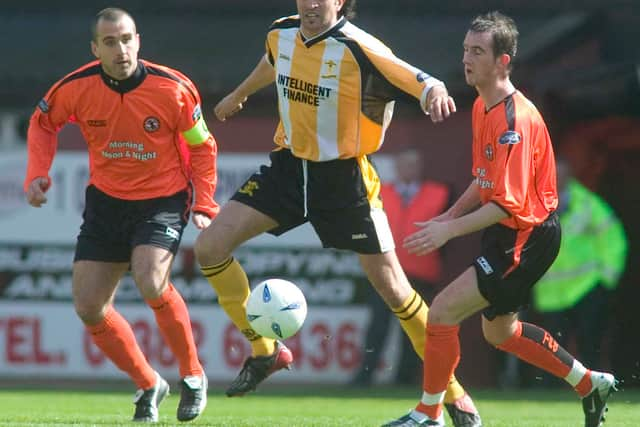
Although happier in midfield, he was deployed as a striker by Saint-Etienne. “They already had plenty of strikers at the time, so I was not called up as one of the 22,” he says. “All the players were my friends and teammates, I still went to support them.” One of them, Mustapha Hadji, ripped Scotland apart.
Why are Morocco so good?
Kachloul remembers the streets teeming with people in kilts and then Scotland coming a cropper. But there was a sting in the tail for Morocco too when their emphatic 3-0 win was rendered futile due to Norway beating Brazil against all odds. Both Scotland and Morocco were eliminated and then endured long nuclear winters. The Scots’ 28-year exile is well documented, but Morocco missed out on four tournaments before returning for Russia in 2018 and then reaching the last four in Qatar four years ago. They are currently ranked eighth in the world.
To paraphrase a certain Scottish TV personality, now with TalkSport, why are Morocco so good? "It has been a very long project that His Majesty of Morocco, King Mohammed VI, has been at the head of,” explains Kachloul. “It has been a total reorganisation. It has not just been focused on the first team. It has been reorganising the way they view football from youth, from the academies. They have given themselves all the tools to work well – great facilities and academies. Every club that plays in the top league needs to have an academy, which is itself very rare in Africa.
“This work has been going on for more than a decade,” he adds. “We came to the World Cup in Qatar, where the team did fantastically well, beating some of the best teams in the tournament. At the same time, it was something that we knew was coming.”
Morocco are the current Under-23 World Cup champions, their B – or it’s even been said C team – won the Arab Cup last year while their Under-17 side reached the last-eight of that age group’s World Cup in November. Meanwhile, everyone knows what happened at the AFCON final in January, when Senegal walked off the pitch following a disputed penalty award to Morocco before being persuaded to come back and play on.
Brahim Diaz chipped into the ‘keeper’s arms after a 17-minutes delay and Senegal went onto win in extra time. Kachloul was a sober and compelling analyst for Channel 4 while some of the most dramatic scenes ever seen in international football played out.
Although Everton forward Iliman Ndiaye is among those still claiming Senegal are bona fide champions, the Confederation of African Football appeals board awarded the title to Morocco in March.

“Being a footballer, it is bittersweet to win it like this five weeks later,” says Kachloul. “It’s not really enjoyable.
“Nobody has celebrated. When you win a tournament, it is about celebration with your teammates and the people of the country. I just think, more than the final, which will be forgotten, it’s more about the football in Africa. It shows that there are a lot more problems needing to be resolved.
“There are rules that have to be applied. If those rules are not respected, nobody can play football anymore. It’s shameful that at the top level we can end up here. Nobody enjoyed it, whether the Senegalese or the Moroccans.”
Manager departure ‘hard to comprehend’
While hardly desirable circumstances, few can argue about Morocco’s quality or question whether they are worthy of being crowned kings of Africa. Last year saw them clinch a world record 19th consecutive win. Now that they have been awarded a 3-0 win in the AFCON final, The Atlas Lions are unbeaten in their last 27 matches, including Tuesday’s 5-0 World Cup warm-up win over Burundi.
It made parting company with manager Walid Regragui earlier this year all the more baffling, although the decision was made before Morocco were declared to have ‘won’ the AFCON title. He was replaced by Under-23s coach Mohamed Ouahbi, who has been rewarded for leading his side to the world title last year. “For me as well it was hard to comprehend,” says Kachloul. “After they lost the final against Senegal, the criticism was a bit harsh towards him from journalists in Morocco. Being at home, they wanted to win the tournament so much. They lost on the pitch at the time and I think he felt the pressure. It was a mutual agreement that it was maybe better to move away.
“They appointed Mohamed Ouahbi, who is a great motivator, great with young players. I hope he carries on what Walid has done. But yes, it is a bit surprising that three months before a World Cup, a team that is so successful change their manager…”
The squad is still brimming with talent, including Paris Saint-Germain right-back and African Player of the Year Achraf Hakimi and Manchester United’s Noussair Mazraoui, who has deputised for Hakimi in the past but can also play on the other side. Chadi Riad, who won the Conference League with Crystal Palace in midweek, is an option at centre-half in a formidable defensive unit.
Kachloul identifies Real Betis winger Adbe Ezzalzouli as a potential match winner on the left. Having thanked him for his generous insight, perhaps all that’s left is to ask for a prediction when Scotland and Morocco go head-to-head again at the Boston Stadium. “It will be tough for Morocco,” he says. “If Scotland walk on the pitch on 19 June having won their first game (v Haiti), it will boost the morale. The approach is completely different then. If Morocco lose against Brazil in their first match, they walk on the pitch and it’s already a match that you’ve got to win, not even draw, you must win….The pressure will be different.
“I’d like to say 1-0 to Morocco, because Morocco do not score a lot of goals. It will be a tight game.” Like any good pundit, he reserves the right to change his mind before the big match.
Comments
Want to join the conversation? Please or to comment on this article.