
Sir Tom Farmer's Hibs legacy and the final interview that brought tears and talk of Easter Road memorial

Former owner remembered as man who staved off Hearts merger
It was his last interview as far as I am aware, certainly in terms of a football context. Having written a column speculating on Sir Tom Farmer’s future intentions with regards to Hibernian, he rang me and invited me to his office in the Blackhall area of Edinburgh.
It was his 79th birthday. And yet here he was at work, which said everything. He had just severed his Hibs ties after selling his shares to new owner Ron Gordon. In my piece, I’d suggested a parting of ways might be imminent and Farmer would be careful to transfer the club into the right hands.
It was now a week into his ‘post Hibs life’ but then, by Farmer’s own admission, his post-Hibs life did not look very different to his Hibs life. He was always an absent landlord, but without the negative connotations usually implied by that description. Distance was by design and well understood from day one. He had Kwik Fit, the auto repairs service he later sold for close to £1 billion, to think about.


At a news conference on 27 June 1991, having secured a controlling interest in the club, the then 49-year-old told reporters he had only ever attended five football matches and, once the deal was completed, he would have no further involvement in the club. Farmer joked that he intended spending his Saturday afternoons counting cars entering his depots.
Although he did slowly increase his attendance at games, it rarely reached double-figures in a season. I can remember once speaking to him at a social event in Glasgow. Despite the fact Hibs had been playing in the city that afternoon against Celtic, he hadn’t been there and wasn’t aware of the score (or so he claimed – I have my doubts).
His length of service with Hibs actually ended up exceeding his association with Kwik Fit, the company he set up in 1971. He bought Hibs for around £3m and although they won the League Cup soon afterwards, it was not all sweetness and light. Two relegations, in 1998 and 2014, cast long shadows. He was far from everyone’s cup of tea.
When we met in July 2019, I had expected some guardedness. For example, he refused point blank to reveal the names of his two children. What I hadn’t expected were the tears. They came while Sir Tom – he was knighted in 1997 - was recalling being surprised by the wetness of his eyes after Hibs finally laid one of the football’s most infamous hoodoos by winning the Scottish Cup in 2016.

The wetness returned as he recounted being at Hampden that afternoon for what felt like the delivery of a promise to the people of Leith. He’d already made good on that in truth, when he stepped in and ultimately warded off the very real possibility that Hibs might be subsumed by Hearts.
The Tynecastle club’s owner Wallace Mercer made a move that continues to hold its charge. Next month, there will be features written on the time, 35 years ago, when the unthinkable almost happened.
If Mercer hadn’t spotted what he described as a “once-in-a-lifetime achievement” to merge the capital’s two major clubs then he would not have created the dire circumstances in which Farmer resolved to ride to the rescue, having heeded the pleas of fans, not all of whom were bedecked in green and white. Many Hearts supporters were firmly against Mercer’s plans. The drama drew Farmer somewhat reluctantly into football’s orbit.
Although a proud Leither, he had been doing well enough, thank you very much, without having Hibs in his life. Unlike many successful business people, it did not automatically follow that he wanted to buy his local football team. It wasn’t a case of him not liking football, he simply hadn’t given the game the chance to insert its hook. “I worked every Saturday since I was 14,” Sir Tom told me, with his mother having answered an advert for a stores boy with a company called Tyres Scotland. "I worked after school, I worked on a Saturday job, and when I left school I worked on Saturdays and Sundays.”
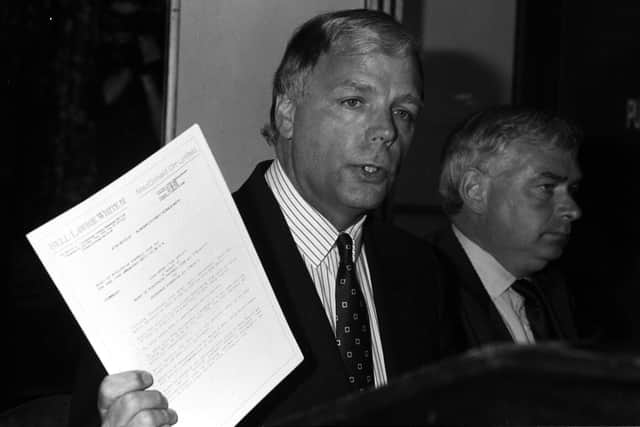
Staving off Hearts merger
Hibs had reason to be grateful he ignored them and concentrated on creating a tyres and car accessories supplies service, originally operating out of premises on Buccleuch Street in Edinburgh’s southside. It led to him creating Kwik Fit – following a short shot at retirement in San Francisco – which in turn helped generate the funds with which he purchased Hibs. He bought an initial tranche of shares to help stave off Mercer’s buy-out bid before taking outright control in 1991, with receivers close to being called in.
He reserved most of his disdain for those in the Hibs boardroom who had allowed it to get to this point as opposed to Mercer, whose chutzpah, as a fellow businessman with the eye for a main chance, he seemed to genuinely admire. “He believed in what he was trying to do,” he told me. “He genuinely believed the way forward for Scottish football and the teams in Edinburgh was to have one, strong team. That was his view. It did not bank on the emotion involved.”
It was also personal to the extent that Farmer felt a calling from a distant past. His grandfather and great uncle had helped save the club from bankruptcy in the late 1800s.
No one is pretending Sunshine on Leith has anything to do with Farmer. The song was written before the businessman got involved for a start. Secondly, its creators The Proclaimers have not always seen eye-to-eye with Farmer, who it must be noted was a divisive figure for much of the near 30-year period he owned the club.
But lines in the opening verse of what’s become the club anthem can, if desired, be interpreted as paying tribute to his football legacy: “You saw it/You claimed it/You touched it/You saved it.”

Farmer’s legacy
It’s hard to argue with the portrayal of Farmer as Hibs’ saviour, which is how many tributes described him over the weekend, including one published on the club’s own website.
He delivered the club debt free into different hands and while it’s not always been a smooth ride, Hibs are still here. Indeed, they are on course to finish as the third best team in Scotland this season.
When Farmer took full control in the summer of 1991, Hibs had just finished ninth in the ten-team Premier Division and were playing to an average attendance of just over 9,000. They were training at a succession of public parks, including Wardie playing fields. Now they are playing to crowds regularly exceeding 16,000 at a completely renovated, modern stadium and have a well-appointed training ground near Ormiston.
This won’t all be written on Sir Tom’s gravestone but it might as well be carved into stone since it’s undeniable. There’s something else that can stand as a memorial and it’s already in place. The west stand at Easter Road was built in 2001 to replace the old main stand and has never had a name attached to it.
When I asked Sir Tom about the possibility of stand, main stand or otherwise, being named after him, he was lost for words for a moment. “It’s a… nice thought,” he eventually replied.
Businessman to the end, the fact a thriving company bearing his name, Farmer Autocare, continues to open new garages around the country was likely the source of greater satisfaction. But identifying one of three currently nameless stands at Easter Road to honour the former owner in perpetuity is something Hibs must surely be considering.
Comments
Want to join the conversation? Please or to comment on this article.