
Inside Hibs' finances: The plan to break even, new investment, player sales plus Celtic and Rangers tickets

Easter Road chief Barnett speaks for first time on how to make accounts better
For all Hibs’ success on the pitch over the past year, there is still the spectre of some gloomy accounts off it.
While the latest set of financial results were healthier than previously, a £5.84 million loss is nothing to write home about, even if it was better than £7.17m from 12 months ago. The fact of the matter is Hibs require the Gordon family, who own the club, to write off such figures.
Everyone at Easter Road accepts that such a situation is unsustainable in the long term. Hibs’ accounts will look stronger next year because they will factor in European football from this season, where the team made the play-off qualifiers of the Conference League, and the £6m windfall of selling Kieron Bowie to Hellas Verona.
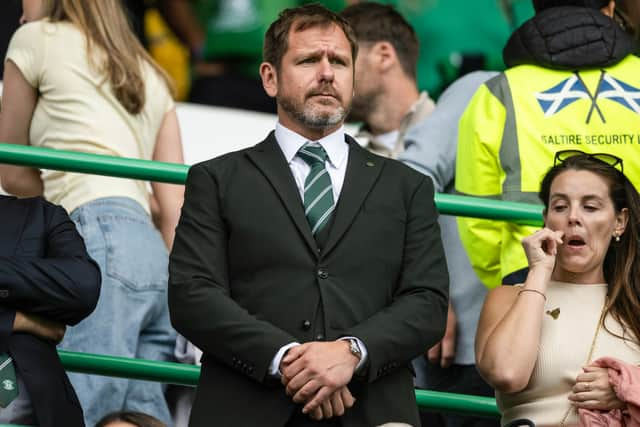

Chief executive Dan Barnett joined Hibs at the start of August and is largely tasked with putting the club on a sounder footing. He addressed the financials at Thursday’s annual general meeting in front of shareholders and for first time since his appointment, he spoke publicly on commercial matters at the club on Friday.
“I think the trajectory is heading in the right direction,” Barnett said of the accounts. “As some of you have seen, I think it was circa nine [million], then seven, then five-and-a-half this year. And it'll be lower again next year.
“I think there's a few key ways to do that on the business side. And I mentioned this at the agm, it is growing the revenue, growing the turnover. You grow your revenue, you grow the club. We believe there's a lot more revenue to be made at the football club on the business side.
“And the second key piece to it is the player trading plan, such that you kind of have that influx of players where you find the young diamonds and you build them up. They have a good couple of years with you. And then like most clubs, you then maximise the value of them. So we definitely have a plan and we can see how we'll be financially sustainable for the long term. So there's no concerns there for us.”
The deep pockets of executive chairman Ian Gordon and his mother Kit have helped Hibs greatly in trying to ride out their losses, but there would be immense satisfaction from within the Hibs board room and beyond if the club could stand on its own two feet.
“To be honest, that's what we are planning to track to,” admitted Barnett, whose previous role was at Leicester City. “The Gordon family is incredibly generous and they have a long-term commitment to this football club. Malky [Mackay, sporting director], myself, our finance director Philippa [Lombardi] and Ian speak every single day. So there would be no surprises in one day in going to him and saying that.
“But through the revenue streams and the models we've been talking about, that is the intention. We fully plan to make the club long-term, sustainable. And you'll see from the trajectory of the accounts and also next year's accounts and the plans we have that that is the intention.”
The sale of Bowie was seen as a major success story for Hibs given that they brought in the Scotland internationalist for a little more than £400,000. There are other sellable assets, such as midfielders Josh Mulligan and Miguel Chaiwa. Put to him that there may be a commercial pressure to sell a player this summer for big money, Barnett was emphatic. “No, there's not,” he said.
Hibs fresh investment and Black Knight
Another way of bringing extra cash to the club is to find an investment partner. Hibs did this with Bill Foley’s Black Knight group, generating £6m in return for a 25 per cent shareholding of the club in back in February 2024. However, the partnership with the Bournemouth owner ended “amicably” last year, with the Gordons buying the shares back. It is understood there was a difference in strategies. Since then, there has been speculation that other parties are keen to get involved at Easter Road - including Midtjylland owner Anders Hoch Povlsen.
Barnett confirmed there has been interest from outside the confines of Easter Road, but intimated Hibs are against being a feeder club and wary of getting involved in a multi-club model again - especially with tighter regulations from UEFA surrounding ownership. The demotion of Crystal Palace to the Conference League from the Europa League this season because of businessman John Textor’s involvement in both them at Lyon has served as a lesson to many.
“That was actually an amicable difference of opinion in terms of the vision going forward,” Barnett said on the Black Knight relationship coming to an end. “Black Knight wanted certain things from their multi-group ownership, whereas I think we had a vision. Ian, the board, the executive committee had a vision that we did not want to be part of a system like that.
“And that our priority first and foremost always has to be win football games, as many as possible, be competitive at the highest level on the pitch and make the fans proud.
“The family gets a lot of inbound interest for a minority interest. A lot. And so really he's in no rush to do anything. In fact, he doesn't need to do anything at all in order for us to execute on a long-term strategy. But if somebody comes in with a proposition that will enhance the club and our ability to get where we want to go, he would always be open to that.
“I can't really go into any details of who it is. I mean, it's just not appropriate given the confidential nature of the conversations, but that is always on the cards.
“I do think it's fair to say that the multi-club ownership model is a sensitive topic with UEFA right now. And so I think that would form part of our assessment if a group did come in where that may be potentially an issue. Because the last thing we ever want to do is jeopardise the club's ability to play in European football, which is a huge plan for us year-on-year.”

Asked what an ideal business partner looks like for Hibs, Barnett added: “So we've had conversations on that. And I think particularly given what we're seeing around the UEFA sensitivities on the MCO [multi-club ownership] model, I don't think it would be a silent partner.
“I think it would be somebody can come in and they can come with ideas and challenges. You know, we're always talking about accountability. We have healthy challenges of each other all the time.
“You know, that could even be someone who's driving us forward commercially or somebody who is helping us unlock the brand equity that comes with telling people about the magic of Hibs. And so I think we want someone who could help us meaningfully drive the club forward.”
In the world of Scottish football, every penny counts - and that includes away fans. Hibs have cut in half the allocations to Celtic and Rangers this season and they are keen to stay loyal to their own supporters. However, it could cost the club up to £200,000 if half the seats in the South Stand stay empty.
“It's a very good question,” he said on what can be a thorny topic. “And to be honest, we've raised that with the fan forum. We've been very open and honest about kind of what we want to do in principle versus what the impact is from a revenue perspective. And so really, we're working with the fans to make that decision together as to the position we adopt and whether it's worth doing it that way.
“It equates to around between £150,000 and £200,000 a year if our fans do not take up the allocation that's not allocated to the opposition.”
Hibs have kept season ticket prices the same for next season and Barnett wanted to do so out of “loyalty” to his customer base.
“We've also made the decision to freeze season ticket prices for next season,” he said. “You know, which could have been an incremental revenue driver for us, but we feel strongly that we want to keep football accessible for everybody. And then in fact, we want to reward that loyalty. And so far, it's paying off.
“We're actually, we broke our records for season tickets last year, and we're tracking well ahead of that for this season. So I think that will ultimately pay off. And in my mind, my preference would be to drive incremental revenues other ways rather than through our season ticket holders. That doesn't feel necessarily the right thing to do.”
Comments
Want to join the conversation? Please or to comment on this article.