
Exclusive:I didn't want to leave without my Hibs-Hearts story being told - and I want Easter Road return
Ex-Hibs chairman Duff speaks on his tell-all book and desire to have one final moment


As a Leith-born former chairman of Hibs who can claim to have saved the Easter Road club, it ought to be puzzling that David Duff is able to roam the streets of Edinburgh without being recognised.
That isn’t to say he can do so unnoticed. On the day we meet, in a central Edinburgh bar, he arrives on a mobility scooter, scattering pedestrians on the pavement outside.
He is further distinguished by a big white beard and white hair in preparation for his annual turn as Father Christmas in London’s Mayfair district (he even has a 'Father Christmas' agent for securing these gigs). Later, over lunch, he will take a call confirming a cameo role in the forthcoming ITV drama series, Tommy and Tuppence. Blink and you might have missed his appearance as a barman in Quiz, the mini-series from 2020 about the former British Army major accused of cheating on Who Wants to be a Millionaire? He started auditioning for such parts with a former partner "for some fun" although it quickly became a bit heavy.

“One of my first roles was in London Road with Tom Hardy about the Ipswich rapist,” he says. “I had to have a fight with a policeman outside the court as Tom Hardy was going in.” Acting has always been around him, he explains. English actress Lesley Manville, for example, is an old friend.
It’s fair to say he’s lived a life, and this is only the half of it. While his parts in dramas might be cameos nowadays, this wasn’t always the case. Hibs are currently celebrating 150 years of history. That they have reached such an impressive anniversary has a lot to do with Duff, who stood strong in those febrile days when Hearts owner Wallace Mercer sought to buy the Easter Road club.
The Evening News described the story as “the biggest to hit Edinburgh since World War Two”. As chairman of Hibs at the time, Duff was at the centre of the storm. He acknowledges having helped create it to a certain extent when, with majority shareholder David Rowland’s support, he listed the club on the stock exchange and left them vulnerable to a hostile takeover bid. The corporate entity known as Edinburgh Hibernian PLC was born in 1988. Hibs were the first team in Scotland to float and just the second in Britain after Spurs.
Rowland ‘was part of the Hibs-Hearts plot’
Duff was regularly on the front as well as back pages of newspapers, hence why it’s surprising a bigger fuss isn’t made when he returns to the city of his birth. “I sat with Andy Goram on George Street in an outside bar, we sat there for two or three hours," he says. "Around 20 people at least came up and went up to Andy Goram, all of them were Rangers fans. No one once said, 'Who are you?' Or mentioned Hibs. I was just a bloke with Andy Goram. He would say, 'Are you not going to say hello to my Chairman? I would not have done anything without my Chairman.' I have a tee shirt signed by him, ‘thank you for giving me my chance’.”
The reason he was meeting Goram, who died over three years ago from cancer aged just 58, was in connection with a memoir he has written. Sunset on Hibs: The Plot to Destroy Hibernian is a breathless read. As the title suggests, it concentrates on said plot although not at the expense of other interesting episodes. And why plot? "It wasn't a takeover, it was a destruction," Duff says. "It was a plot and it would have destroyed Hibs. Someone must have introduced Wallace (Mercer) to Rowland because Rowland would not have hunted out Wallace. They didn’t meet by accident. Rowland was part of the plot. Mercer was part of the plot. Were there other people? I don’t know…”
With the action shifting from Kyiv to the West Country and including such figures as a former British ambassador to Moscow and legendary Russian footballers, the book reads like a John Le Carré novel in places.
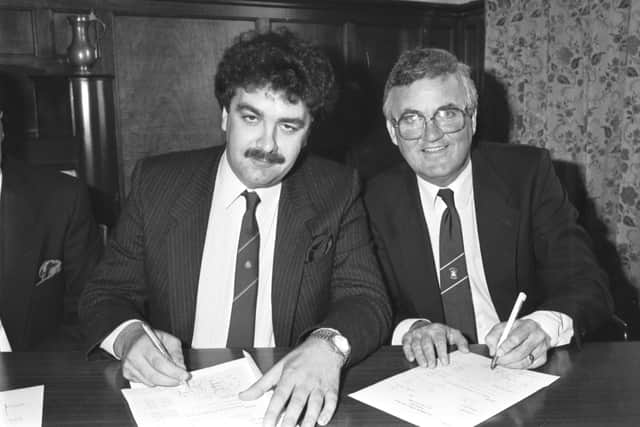
Although delayed for several years, publication this week has been perfectly timed in view of this weekend’s Edinburgh’s derby. It is the continuation of a century and a half old story that nearly had a big fat full stop inserted in the summer of 1990. Each derby since has been a bonus as well as a testimony to the strength of will of people like Duff and also John Robertson, the legendary Hearts striker who defied Mercer, his own chairman, by appearing at a Hands Off Hibs rally in the Usher Hall. “Whether he wants to be or not, he is a Hibs Hero,” writes Duff, whose own part was pivotal even if his subsequent problems have meant this hasn’t always been acknowledged.
Other fascinating tales, not associated with the merger, are covered, including one extraordinary revelation about Goram. Duff received permission to include the story about Goram and teammate Pat McGinlay tricking drug testers following a Uefa Cup game against Royal Football Club de Liège in 1989.
Goram was taking weight-reducing tablets, which he knew would likely feature on the proscribed list. He relayed his fears to McGinlay out of the ear shot of Duff, who was in the room along with the players keeping them company. By sneaking his own urine into Goram’s test tube while the testers’ backs were turned, McGinlay might well have kept his teammate on a trajectory towards becoming one of Scotland’s greatest-ever goalkeepers. They later faced up against each other in Old Firm derbies.
The incredible Andy Goram tale
“I sometimes wonder, was there a time when Pat McGinlay was bounding down on the Rangers goal for Celtic ready to score a goal and there he was face to face with Andy, and Andy had to decide what to do’ this man saved my career, I’ll let this one in!’’ reflects Duff, who was chairman when Goram signed for Hibs for a club record fee of £325,000 from Oldham Athletic.
“I don’t think there’s time to do that but we as fans have to think, did that happen? I hope it comes out in the book that I had a great deal of time for Andy. He was a model human being. If there’s a heaven, he’s in it. He had an instinctive desire to help people….”
Flawed but lovable, which is how Duff might be described as well. He met his match in some of the characters populating Scottish football at the time. Tom Farmer, for example, was a wiry, self-made businessman with an eye for the main chance and who was prepared to leave some blood on the boardroom floor. “You’re just a big teddy bear, son,” he told Duff at one of their last meetings – it wasn’t designed to be a compliment.

Duff is an even larger teddy bear now, hence the mobility scooter. He admits he is completely unrecognisable to the dark haired, moustachioed city slicker of his youth, perhaps in outlook as well as appearance. “Commercially, the young solicitor in London was definitely a Thatcher yuppie,” he says. “But I was always left of centre.”
Duff and Jim Gray, the Hibs managing director, might well have been brothers. Both sported the same moustache and the same dark hair. They were in fact brothers-in-law – at the time at least. Although the so-called merger plan, which amounted to an “Edinburgh United” team playing initially at least at Tynecastle in maroon jerseys, was repelled, things fell apart, most obviously in Duff’s life. He was later given a two-year sentence and spent a year in an open jail for a mortgage fraud conviction unrelated to his time at Hibs.
His marriage broke up and the family home was repossessed. His part in Hibs’ salvation also became obscured somewhat after Farmer’s arrival on the scene, more of which later. A major hint about the inclusion of some controversial detail is the publisher’s note at the beginning of the book explaining that the text, which was submitted in 2021, was only now seeing the light of day because Sir Tom requested that all references to him were excised. This became a redundant issue when the former Hibs owner died in May.
‘I am not a bitter person’
Others, still alive, distanced themselves from the book, which underlines the enduring potency of some of the matters addressed. Even Gray wanted no part.
“I haven’t seen him for a while, but I have no animosity,” says Duff. “He read the book and though it brought back incredible memories and made him cry, he didn’t want to be involved in it.”
Duff pushed on. Now 71, it’s clearly been a cathartic process although it’s not been about settling any scores. “If I were a bitter person, I wouldn’t find it difficult to be bitter about this,” he says. “But I am not.
“I don’t want to leave my mortal coil without my story being told. I feel compelled, because when I die it dies with me. There it is. It is in your hands. Is it the whole truth and nothing but the truth? It is how I remember it. Of course, I might have got things wrong. But I will pass any lie detector test because it is exactly how I remember it.”

Aged just 33, Duff resolved to buy Hibs while sitting at a game v St Mirren watching a relegation threatened team in a crumbling stadium. Duff was a practising solicitor based in Wiltshire. Most of the £800,000 capital was provided by David Rowland, a City financier and one of Duff’s clients. Perhaps now better known for being one of Prince Andrew’s financial advisors, it was Rowland’s involvement that sowed the seeds of Hibs’ dark destiny.
Unlike Duff, who watched Hibs as a boy and was a member of the Carlton Hibs supporters’ club, Rowland had no emotional attachment to the club other than Sheila, the mother of his children, being parachuted onto the board. Even then, she was his ex-wife.
Rowland was also instrumental in tying Hibs up with a chain of doomed bars, clubs and restaurants based in the south-west of England that loaded the football club with debt. Armed with a 66 per cent shareholding, what Rowland wanted to happen tended to happen. It meant that, when he agreed to sell this stake to Mercer, Hibs, Duff tells me, were “already 5-1 down”. The Hearts owner required just 75 per cent to comply with the Takeover Code of the UK Companies Act.
Mercer ‘had scored an own goal’
When I remind him that, in his book, he describes the scenario as an even more hopeless 0-5, he sticks with the revised scoreline. “Ah, but they had scored an own goal,” he replies. “They thought I would be there the next morning.” This is with reference to the infamous press conference called by Mercer at the Caledonian Hotel, when the deal, a fait accompli in their eyes, would be announced. Duff owned a 13.5 per cent stake and had been expected to roll over for a personal gain of nearly £1 million. Who wouldn’t? Well, Duff it turns out, at huge financial and personal cost.
Although instructed by Rowland to attend the press conference and hold up an “Edinburgh United” scarf, Duff instead headed for Easter Road to form a battle plan. The game was afoot. One of the most impressive fan action group efforts ever seen in British football, either before or afterwards, was mobilised.
Led by the late Kenny McLean Senior, they carried a message delivered by Duff while standing on a chair in the car park outside the main stand and with financial advisors fretting inside about transgressing stock exchange rules. They had given him a script. He ripped it up. "I wanted to talk to them (the fans) from the soul, not the pavement," he says. With the Bank of Scotland providing much of Mercer's funding, those supporters who were customers were urged to start closing bank accounts to ramp up pressure.

It was all very different to the summer that had been planned for Hibs. Duff reveals that, as part of the new convivial relationship forming between Margaret Thatcher and President Gorbachev, a grand exhibition promoting Britain in Kyiv was being organised. Forming the centrepiece of the occasion was a proposed football match between storied club side Dynamo Kyiv and a British team. These opponents were earmarked to be Hibs. Although they revel in the status of British football's European pioneers, it was for no greater reason than Duff had studied law with the daughter of Sir Curtis Keeble, the former British ambassador to the Soviet Union.
“Keeble did not know anything about football," recalls Duff. "Jane, his daughter, phoned me up and said ring my dad, he wants to talk to you. He asked me, ‘Would you like to serve your country?' I was thinking, is he trying to get me to sign up for MI5 or something? I told him I needed a bit more information about what was required. 'Bring your team out to play football,' he said.”
Duff and Gray went out on a reconnaissance mission. "I met the wonderful Lev Yashin," reports Duff, with reference to someone regarded by some as the greatest-ever goalkeeper. "He was a big name when I was growing up. Unfortunately, he was a very sick man with cancer when we met. He only had one leg. He died very shortly afterwards though is still the most impressive person I met in football."
The famous meeting at Farmer’s house
Instead of being involved in a ‘festival of Britain’ in the former Soviet Union, Hibs were left fighting for their own independence a full year before Ukraine gained theirs. The showpiece game in Kyiv was off. Duff sets up the drama well in his book’s prologue. Who is the absolute worst person you can think of to buy Hibs he is asked, having been summoned to a London hotel room one Sunday night in June 1990.
Duff’s reply of “Robert Maxwell” firmly dates the drama and underlines how far from anyone’s mind the worst person in question was. Mercer buying the club was an unimaginable scenario. That Farmer backed him, one of the revelations in the book, seems equally inconceivable.
Duff recalls being invited to the tyre entrepreneur’s house, where he was strongly urged to accept Mercer’s proposal. Why? “I believe Tom Farmer had formed the view before that meeting that we couldn’t win the battle,” he says. “Therefore he was trying to save something out of Hibs. He thought it would be better for everyone if it was all cleaned up and he took away the name and the memorabilia and started again, as his ancestors had done in the past. He did not really understand the nature of football, that the history was the club and the fans would all rally round.”

With Mercer, he believes, literally waiting in the wings of Farmer’s house, Duff refused to countenance selling his shares and walked out. “It wasn’t game over,” he says, which proved accurate. In the book, he writes: “I never once met Tom Farmer without afterwards feeling dumbfounded.”
But his beef isn’t with Farmer or even Mercer. He feels let down by Rowland, on the other hand. He blames him for the miserable experience of leaving his beloved Hibs through the back door following the liquidation of Edinburgh Hibernian PLC, the club's parent company, nearly a year after the merger attempt and with Farmer now lord of the manor.
Incredibly, Duff has only been back at Easter Road on two occasions since. Both times were funeral wakes. The first was for Peter Cormack, assistant manager to Alex Miller’s during Duff’s tenure. And the second, only last month, was following the funeral of Duff’s much-loved younger cousin, Victoria. He has never returned for a match.
‘That would be my redemption’
Time is of the essence. It hasn't been a good time to be a Hibs office bearer, erstwhile or otherwise. As well as Farmer, the club lost owner Ron Gordon in 2023 at the age of 68. Rod Petrie, former chief executive and Farmer’s right-hand man, passed away in August. Duff wants to donate John Collins’ first international shirt to the club. It was worn against Saudi Arabia and later gifted to him by the player. He wants to walk back in through the front door before it’s too late. It’s already becoming a physical struggle to walk anywhere.
“It’s time they asked one of their few former living chairmen to come back,” says Duff. “That would be my redemption. But I have to come back welcomed. I am not coming back as a thief in the night. I could go tomorrow, no one is going to recognise me. But I want my chest held out. This is the club I loved. I made terrible mistakes, but it is an enduring story. And with a little bit of luck, a little more direction, Hibs could have changed Scottish football in those days.”
He contends, with more than a little hubris, that if his plan to sell Easter Road and move to a new stadium at Straiton on the outskirts of the city had materialised, “not every league title since 1985 would have gone to Glasgow”. In addition to being champions of Scotland, Duff believes it would not have taken Hibs so long to lift the Scottish Cup, the crowning glory of Farmer’s reign.
“It didn’t work out like that. I accept that,” he says. “And I accept my part in putting them in danger. But we could have (changed Scottish football). And we were not that far away from it. A team with Collins, (Steve) Archibald, Goram….? We were in the right direction.”
Comments
Want to join the conversation? Please or to comment on this article.