
Polytunnels with extra strength: Shetland shelters offer a super strong weatherproof cover for growing veg
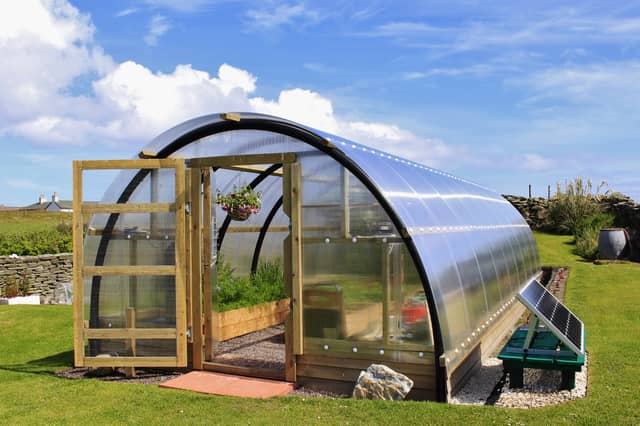

They say necessity is the mother of invention – and for this Shetland community it has led to a whole new business venture with global reach.
What began as a way to make a Shetland-proof, wind and weather-proof polytunnel led to Polycrub, a versatile structure used for things as diverse as hen-houses, nightclubs and hot-tub shelters!
Now, almost two decades on from the idea being born, there are hundreds of Polycrubs across Shetland and thousands globally, with distribution centres in the Highlands, Lewis and Cheshire.
They give people access to fresh fruit and veg, the opportunity to learn a new skill, a sense of wellbeing – and help reduce food miles!

How did the Polycrub come about?
When you live in the Shetland, things other people take for granted are not so straight-forward; shopping for fresh fruit and veg for example.
When a delivery vehicle has journeyed to the north of Scotland and taken a 14 hour ferry trip to deliver fruit and veg, it’s not always in the best condition. Growing your own is a common solution, but with the cold, the wet, the wind and the dark days anything more exotic than potatoes, cabbage and carrots wasn’t always an option for most islanders.
But islanders are not most people! Renowned for their resilience and ingenuity the locals set about finding a solution.
Cue Nortenergy – the Polycrub Company, a social enterprise set up by the Northmavine Community Development Company (NCDC), which began work on building sheltered growing spaces.
“We couldn’t find anything to use that was going to survive the Shetland weather, so we decided to come up with our own,” said Maree Hay, the managing director of Polycrub.
Using recycled pipe from the commercial fish farming industry, thick polycarbonate sheets and a robust frame concreted into the ground, you have a shelter that should withstand winds of up to 120mph.
Local and international success
Following the success of the first prototypes in 2007, there are now a range of options – ideal for growing a much wider variety of fruit and veg, as well as offering super-strong buildings for a host of other activities.
The design is a mix of the traditional polytunnel and the historic Shetland “plantiecrub”, a small, circular dry-stone enclosure used for centuries by crofters for growing kale.
“We built 12 Polycrubs in our community, each shared by four people, and that was to be the end of it,” Mrs Hay said. “But then other folk were saying ‘yon’s what we need, where can we buy one?’”
She said islanders had battled with standard polytunnels blowing away or greenhouses being smashed by flying objects due to extreme climactic changes and high winds – even in summer gusts of up to 50mph to 60mph are not uncommon.
And then as more Polycrubs were erected, more people saw them. Visitors from other ‘wild and windy’ parts of Scotland the UK started making enquiries.
So then we started selling them sooth and it just grew,” says Mrs Hay.
They can now be seen not only across Shetland and the wilder parts of the UK, but all over the world from The Falklands to Greenland.
There is a fondness for the Polycrub among locals, and a pride – and there is also a sound economic and community benefit.
In the small community of Northmavine alone, which had little in the way of jobs, Polycrub has gone from employing one person to five full-time staff. Profits from the business are fed back into the NCDC for community projects.
“Polycrubs capture people’s hearts,” Mrs Hay said. “A common comment from Polycrubbers is ‘the Polycrub is my happy place’.
“Caring for the Polycrub, tending the plants, or simply enjoying the space — even sitting inside with a cup of tea and a book while it’s blowing a hoolie like today — does wonders for your wellbeing.”
Not only does it make people happy, there’s a health benefit too, thanks to a variety of freshly grown fruit and veg.
Mrs Hay had never grown fruit or vegetables until she invested in one herself. Now her crops include cherries, nectarines and tomatoes.
Who would have thought we would be able to say we’ve grown our own lemons and limes in Shetland?
“There are a lot of people in Shetland who never grew anything, but are now growing their own food that’s fresh. It’s something they can also enjoy with their bairns and encourage them to eat fresh fruit and vegetables.”
Get your own Polycrub
Whether you want a strong, sheltered place in which to grow your own fruit and veg; a home for your hens; a shelter for your hobbies, or somewhere to escape and relax whatever the weather – then take a look at the Polycrub options.
They come in two ranges – 3 or 4 metre wide- with a variety of lengths available and prices start from £2,960 including VAT. The website here gives lots of information and inspiration for home Polycrubs and Polycrubs for communities, education and business.