
How podiatry innovation is changing lives one step at a time


As demand grows for healthcare professionals who can help people stay mobile, active and independent, Derek Santos, Professor of Podiatry at Queen Margaret University, Edinburgh, explains how a pioneering foot-drop project demonstrates podiatry's contribution to healthcare innovation and why the profession deserves greater recognition.
When most people think about healthcare innovation, they often imagine cutting-edge medicines, robotic surgery or artificial intelligence. Rarely do they think about footwear.
Yet for hundreds of thousands of people living with foot-drop, something as seemingly simple as a well-designed shoe could be life-changing.
For the past several years, I have been part of an interdisciplinary team of researchers working to develop an innovative footwear solution for people living with foot-drop, a condition commonly associated with stroke, multiple sclerosis, motor neurone disease, cerebral palsy and other neurological conditions. Foot-drop makes it difficult to lift the front of the foot while walking, increasing the risk of trips and falls and affecting confidence, independence and quality of life.

As a podiatrist, I have spent more than three decades helping people maintain their mobility. Time and again, I have seen how foot and ankle problems can affect every aspect of life. When walking becomes difficult, people often lose confidence, become less active and struggle to do the things they enjoy.
That is why developing effective solutions for foot-drop matters so much. While podiatrists and other allied health professionals all have an important role in supporting people with the condition, this project also highlights something broader: podiatry's contribution to healthcare innovation.
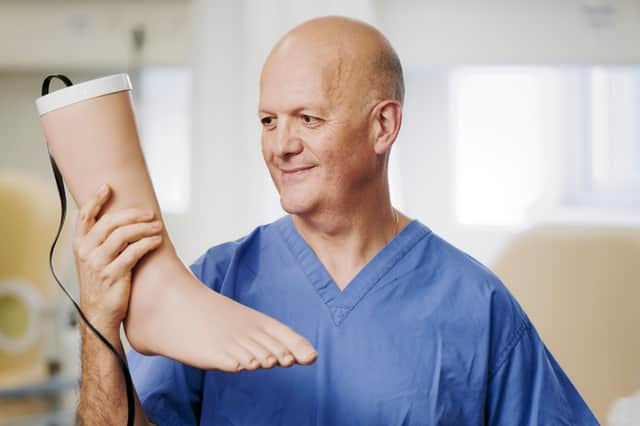
Podiatrists are experts in the mechanics of human movement. We understand how small changes in footwear or orthotic design can transform walking ability, and projects like this showcase the profession's growing role in research, innovation and rehabilitation.
A new approach at QMU
Working with an interdisciplinary team of podiatrists and physiotherapists through the Health Design Collective at Queen Margaret University, we took a different approach to solving the problem. Rather than asking patients to wear additional devices, braces or electrical stimulation systems, we explored whether the solution could be built directly into the footwear itself.
The goal was to create something affordable, comfortable, discreet and practical enough for everyday life.
What followed was years of design, testing and collaboration, with people living with foot-drop placed at the centre of the research. As podiatrists, we contributed expertise in orthotic and footwear design, gait analysis and understanding how the foot interacts with footwear and the environment during walking.
That evidence-based approach helped shape a product that not only addresses a clinical challenge but also reflects the realities of everyday life. It has been exceptionally rewarding to witness the transformational impact the footwear can have on people's confidence, mobility and quality of life. We are now working towards bringing the footwear to market, with the ambition of making it accessible to the many people who could benefit from it.
More than many people realise
The foot-drop project is just one example of the diverse work undertaken by modern podiatrists.
One of the challenges facing the profession is that public understanding of podiatry has not always kept pace with how it has evolved. While podiatrists continue to provide essential foot and lower limb care, many also work in musculoskeletal rehabilitation, sports injury management, wound care, orthopaedics and research.
Treatments such as shockwave therapy, steroid injections, custom 3D-printed orthoses, rehabilitation exercise programmes and gait analysis are increasingly part of contemporary practice. In my own work, including my role as an Honorary Podiatrist within Orthopaedics at NHS Lothian, I see first-hand how podiatrists help a wide range of people recover from injury and pain, return to activity, and improve their long-term mobility and performance.
As healthcare services support a growing older population while also responding to increasing demand for musculoskeletal and sports injury care, the role of podiatry has never been more important.
Some of the most effective healthcare innovations do not emerge from expensive laboratories alone. They come from clinicians who understand people's everyday challenges and are determined to find better solutions. Whether developing new footwear technologies, creating custom 3D-printed orthoses, advancing rehabilitation techniques or improving wound care, podiatrists are increasingly contributing to innovations that can transform patient care.
It is also a reminder not to underestimate the opportunities a career in podiatry can offer. Despite the significant impact podiatrists make on people's lives, the general public still have only a limited understanding of the profession.
A varied and rewarding career
My own career has taken me from clinical practice to teaching future podiatrists, leading international research and helping to develop innovative technologies that could improve lives around the world.
Modern podiatry offers a remarkable breadth of career opportunities. Today, the profession spans clinical practice, sports rehabilitation, research, education, surgery and innovation.
Many people are surprised by the breadth of modern podiatry. Above all, it is a profession with purpose, helping people recover from injury, maintain mobility and live life to the fullest.
Discover more
To find out more about studying podiatry at Queen Margaret University, Edinburgh, take a look at the Master of Podiatry/BSc (Hons) Podiatry
See the transformational impact of the foot-drop research project on Jeanette Russell, a former nurse with MS, and watch the moving film of Andy McKenna, a professional cyclist with MS, as he finds hope in a new pair of shoes.