
What funds raised in Scotland have achieved in troublespots and disaster zones across the world in 2025


Huw Owen from the Disasters Emergency Committee in Scotland gives an overview of the major humanitarian crises in 2025 and how Scottish based charities with have helped.
It has been another year where the news has been dominated by continuing violent conflicts with inevitable consequence for the lives of tens of millions of people, often the most vulnerable, who desperately need medical care and are acutely short of food, clean water and somewhere safe they can call home.
Most of our attention remains on the ongoing war in Ukraine and despite the Autumn ceasefire agreement, huge hardship for close to two million people in Gaza, where famine was declared earlier this year and where hundreds of thousands have been facing Winter storms and floods without a proper roof over their heads.
OCHA, the UN body that coordinates humanitarian response around the world has recently published its outlook for 2026 and once again it makes difficult reading. Its report describes the humanitarian community as over-stretched, under-funded and under attack, facing widespread brutality, impunity and indifference.
Following deep cuts to the US aid budget and significant reductions in overseas development assistance here in the UK too, the overall global humanitarian budget is at its lowest level for a decade. Spending has to be prioritised on the most acute crises where lives are being lost daily, but that means millions more won’t get any support at all in 2026.
Despite that bleak backdrop, public backing for humanitarian action has once again been inspiring here in Scotland. Millions of pounds have been raised to support the Disasters Emergency Committee’s 15 member charities and their incredible local partners to deliver aid in the most challenging of circumstances in Gaza and the wider Middle East as well as the now largely overlooked earthquake response in Myanmar.
As well as leading UK fundraising for the most high-profile crises, the DEC supports the work of the Scottish Government’s Humanitarian Emergency Fund which also provides funding to help in crises which rarely make the headlines. During this past year, that includes fresh funding for ongoing work to help millions of people still caught up in the violent conflict in Sudan but also responses in the Democratic Republic of Congo, Kenya and over the Christmas period to help communities reeling from another earthquake in Afghanistan
Here is a short overview of how the Scottish public and Scottish government have made a difference in getting life saving aid to the most vulnerable people and communities whose lives have been shattered in 2025.
Gaza/Middle East
Since the October ceasefire agreement in October, DEC charities and their local partners have been able to scale up their work thanks to continuing donations. Just last week, the Scottish fundraising total in Scotland passed £5 million, with more than £59 million now raised across the UK. We are hugely grateful for each and every donation. Access for supplies at the scale required is still elusive but with more trucks now entering the territory malnutrition rates are finally decreasing and just last week the UN hunger watchdog, the IPC, lifted its famine status but is still describing food shortages as critical.
Overall needs remain huge, with recent storms and flash flooding making life even more unbearable for families who have been forced to move many times for safety and are literally hanging on, soaked wet in flimsy tents of other makeshift shelters, with children having to spend nights without warm clothes or blankets.

Through the fierce security and logistical challenges of this crisis, local humanitarian workers have still been able to save lives and protect many more. A key intervention has been the repair of damaged water supplies and delivery of clean water to help with hygiene and reduce the risk of disease.

Funds have also been used to keep community kitchens running with small scale farmers given seeds and tools to grow vegetables, even in the limited space between tents or amidst tons of rubble.
Rania (name changed) is eight months and badly malnourished. Her mother, Noura (name changed), was nearly killed by a shrapnel injury soon after Rania was born and was told to stop breastfeeding due to possible health complications. As a result, Rania* became severely malnourished and needed instant specialist help. At a DEC supported Save theChildren health care centre, Rania was given peanut paste, medicine and other supplements. Noura*also received support on how best to feed Rania*.

Sudan
The scale and the intensity of the civil war in Sudan is staggering. Around 150,000 people have been killed. Nearly 25 million people - close to five times the entire population of Scotland - are acutely short of food, with famine declared in Darfur, where there has been brutal, indiscriminate mass killing of civilians, particularly during the recent capture of the strategic city of El Fasher by the rebel Rapid Reactionary Forces.
Within and beyond Sudan’s borders, millions of people have been forced to flee their homes. The limited response of the international community has been significantly weakened by the massive cuts to US Agency for International Development Aid (US AID), decimating the supply of both longer-term development aid and more immediate life-saving humanitarian support.
Against this bleak backdrop, every bit of help is vital, so it has been really heartening that the Scottish Government has activated its Humanitarian Emergency Fund three times since the conflict erupted in 2023 to support responses from Scottish charities and their local partners.
As well as providing funds for Islamic Relief and the British Red Cross in Sudan itself, Oxfam and Christian Aid have been supported to help refugees fleeing across the southern border to South Sudan. Tearfund has also helped refugees fleeing west to neighbouring Chad with recent project funding targeted at the epicentre of humanitarian need in Darfur.
Tearfund helped more than 4,500 people families on the brink of starvation in East Darfur with emergency cash payments to help feed their children and buy other essential goods to stabilise their households. The most vulnerable people in communities, those with disabilities or survivors of sexual violence were also given protection, including legal assistance and psychosocial care.
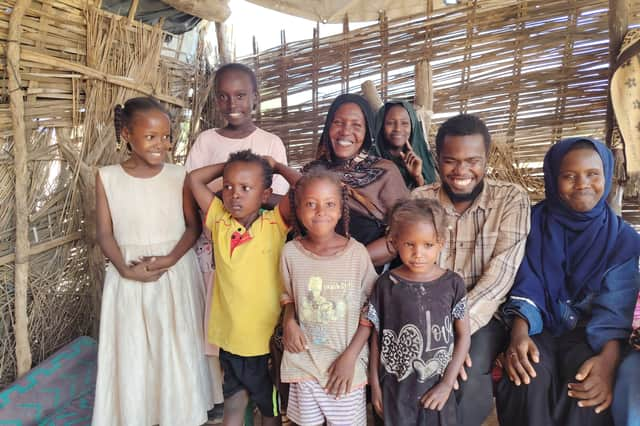
Ahmed, 42, lives in Al Guba, East Darfur, with his wife Fatima and their eight surviving children. Three of the children are blind, one has multiple disabilities, and the family is grieving the recent death of their son. With no stable income and rising for food and safe water, daily survival has become a struggle.
Before the crisis, Ahmed farmed millet and groundnuts and worked as a daily labourer. As conditions worsened, Fatima began selling tea to help the family survive, while their eldest daughter was forced to leave school to care for her blind siblings. The family now lives in a fragile shelter that offers little protection from heat or cold.
When support from the Scottish Government arrived via Tearfund’s partner, it came at a critical moment. “For two years, we survived on one meal a day – and sometimes not even that,” Ahmed said. With the cash assistance he received from Tearfund, he was able to buy basic food supplies and protect his children during the ongoing crisis. “I cannot find the words to fully express my gratitude. Your assistance has brought us relief and hope in the midst of unimaginable hardship.”
Myanmar
In Myanmar - formerly Burma - more than 17 million people were affected by the devastating earthquake back in March. Whilst attracting only limited media interest since the early days, the DEC Myanmar appeal has still managed to raise £2.4 million here in Scotland with the UK appeal total now past £27 million. DEC member charities, again working with expert Myanmar based partners have been working closely with the most badly affected communities to help them rebuild their lives. In the beautiful Inle Lake area, many families have been helped by a DEC cash assistance project. DEC charities have replaced traditional bamboo homes in more sustainable ways, working with women in particular to ensure their thoughts have informed the project designs. Women have also been working together to support the construction of new floating farms on the lake to grow tomatoes and other produce for food and to sell. In the historic city of Mandalay, close to the earthquakes’ epicentre, traditional fabric weavers have been given a lifeline with a new DEC funded water tank and children terrified by the quakes and frequent aftershocks have been given psychosocial support to help them heal after so much trauma.

One of DEC’s 15 UK members, Age International has been providing cash assistance to older people in the Inle Lake region, as well as psychosocial support to help them process what they have been through. Daw Than Yin, 69, lives with her daughter in a village by the lake.
Their house was damaged when the earthquake happened, and they had to borrow money to pay for the repairs.

“I was struggling to repay the loan I took for fixing the house. Thanks to this cash, I was able to pay back all the debts. I feel so thankful”
Like so many disasters a key part of every DEC response is the distribution of cash payments or vouchers. They allow people to spend money quickly, making their own decisions about what their biggest needs are, and giving people flexibility in their spending to help them regain a sense of independence.
During the first three months of the DEC funded response more than 100,000 people received cash or vouchers to help buy whatever they need, whether it’s supplies to repair their homes, medical expenses or goods from the local markets.
DRC -Democratic Republic of Congo
Tearfund and Oxfam were also given Scottish Government funding to respond to another vast and protracted crisis in the Democratic Republic of Congo. Here again, millions of lives are threatened by long running intercommunal violence close to the eastern border with Rwanda. A cholera crisis had been exacerbated by persistent conflict, displacement, and insecurity, restricting access to health care. Climate shocks of heavy rain and flooding have damaged water and sanitation systems, already under strain from rapid urbanization, which further threaten hygiene and make it easier for diseases to spread.
Millions of people are in also in acute hunger, their lives on the brink when faced with these multiple challenges.
Working with their local partner, SOPROP, over a four-month period, Oxfam were able to give cash assistance to 500 families returning home after fighting stopped in their area, helping them to rebuild their lives step by step and begin regaining control over their futures.
Dr. Manenji Mangundu, Oxfam’s Country Director in DRC, said: “Behind every cash transfer, there is a story of resilience, a mother who dares to dream again, a man who finds purpose, a child who returns to school. This project did more than provide assistance. It restored people’s ability to act, to choose, and to believe again.”
When Uwineza fled the fighting, she carried nothing but fear and exhaustion. Arriving in Humule, she had to start from scratch. Thanks to around £130 she received in two instalments; she was able to rent a small plot of land and return to farming. “Before, I depended entirely on others. Now, I farm to feed my children. And if one falls ill, I can take care of them without fear. That money was more than aid; it was a second chance,” she said.

A few kilometres away, Claudine, a member of the Women’s Forum in Humule, has become a strong voice for women’s rights. Trained through the project, she now leads awareness sessions on gender-based violence (GBV), early marriage, and women’s legal rights.
“Here, at just 13 years old, girls already dream of marriage,” she explains. “We want them to dream of school, of their future, of freedom.”
Through training and the creation of community and women’s protection plans, Claudine and other women have become leaders of change in their communities. The project also supported the establishment of a referral mechanism for survivors of gender-based violence and the distribution of cash for protection to the most vulnerable.
“Before, we spoke without being heard. Now, we speak with knowledge, with facts, with confidence. And people listen differently. This support didn’t just change situations, it saved lives and restored hope”, adds Claudine.
While Scotland’s contribution remains relatively small amidst the surging shortfall in global humanitarian funding, the life-saving impact of these projects is clear. Oxfam Scotland is urging every political party to commit to significantly increasing the value of Scotland’s Humanitarian Emergency Fund in the first year of the next Parliament.
Conclusion
Despite the huge loss and trauma endured by millions of people in these conflicts alone, we hope it is clear that what can be achieved when charities come together and receive generous support, not only from people across Scotland but by a range of Scottish business partners and the Scottish Government.
We are particularly grateful that the Scottish Government not only supports DEC Appeals for high profile disasters such as the conflicts in Gaza and the wider region but also lower profile crises still affecting tens of millions of people. We hope these acts of solidarity and global citizenship will continue after the forthcoming Holyrood elections so that we can ensure we can continue to save, protect and rebuild lives and keep hope alive too.
UK Aid Match: Right now, if you are able to donate to our Middle East Humanitarian Appeal for Gaza and the wider region, your support will effectively be doubled by a promise of extra
Aid Match funding from the UK Government. Up to a total of £3 million, for every pound you are able to donate, the sum reaching us will be doubled to support our continuing live saving work. Please donate now at dec.org.uk
Comments
Want to join the conversation? Please or to comment on this article.