
Wildfires are burning now: Scotland needs a dedicated aerial response


‘Uncomfortable questions have been raised about whether Scotland is properly equipped for the wildfire era that is now clearly upon us’
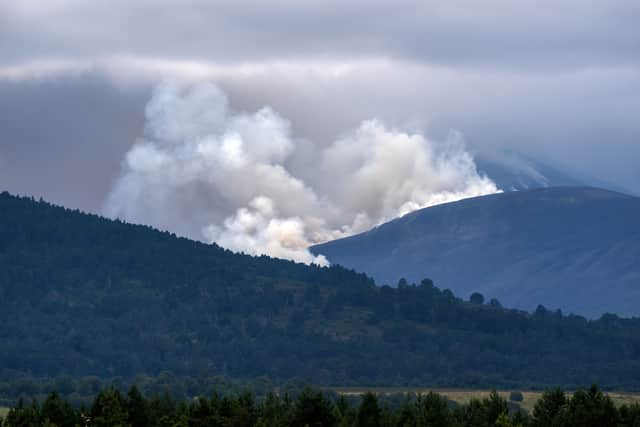
Just months after the publication of the Scottish Government’s new Strategic Action Plan on Wildfire, a major wildfire is burning in the Cairngorms.
There could hardly be a more powerful illustration of why this issue can no longer be treated as a future challenge. While policymakers discuss resilience, an army of firefighters, gamekeepers, estate staff and emergency responders have been battling flames in the Strathnethy area of the Cairngorms National Park.
Homes and businesses have been evacuated, campsites closed, roads shut and access to large parts of one of Scotland's most treasured landscapes restricted. More than 50 firefighters, specialist wildfire units and extensive multi-agency resources have been committed to an incident the Scottish Fire and Rescue Service (SFRS) has described as both "complex" and "protracted".
The wildfire has already consumed significant areas of moorland and woodland within the national park, prompting the evacuation of properties and tourism facilities in the Glenmore area. Helicopters have been dropping water onto the blaze while firefighters have pumped water from Loch Morlich and worked alongside land managers to create firebreaks and prevent further spread.
Everyone involved in the response deserves enormous credit. But the uncomfortable question raised by this incident is whether Scotland is properly equipped for the wildfire era that is now clearly upon us.
The current fire has again highlighted the importance of aerial firefighting capability. SFRS commanders have openly acknowledged that helicopters provide a critical operational advantage in difficult terrain and inaccessible locations. That should surprise nobody. The Cairngorms contain precisely the sort of landscape where aerial assets are most valuable: extensive forests, remote moorland, peat-rich ground and vast areas that can be difficult to access quickly by vehicle.
Yet despite years of warnings about increasing wildfire risk, Scotland still lacks a dedicated aerial wildfire capability available and controlled by the SFRS. That gap matters because large wildfires are often won or lost during the earliest stages of an incident. The private helicopter companies relied upon currently have a broad range of commitments and contracts, and it is not always possible to guarantee their support when it is required.
Once fire becomes established in remote terrain, options narrow rapidly. Small ignitions become major incidents. Every additional hour allows flames to spread further through vegetation, woodland and peat. Every additional kilometre of fire front increases the pressure on firefighters and land managers alike.
The current wildfire demonstrates this challenge. Helicopters are now playing an important role in limiting the spread of the fire, but their effectiveness only reinforces the wider question of whether Scotland should possess a dedicated capability, operated by the SFRS, that can be mobilised rapidly whenever major wildfires occur.
It is here that the experience of last year's Carrbridge–Dava wildfire becomes so relevant.
The Scottish Government’s Strategic Action Plan deserves genuine praise for recognising the scale of the threat Scotland faces. Developed largely in response to the devastating Carrbridge–Dava wildfire - the largest wildfire event ever recorded in the UK - it rightly acknowledges that climate change is increasing wildfire risk and that Scotland needs stronger prevention, preparedness and response arrangements.
Those are important steps. But Carrbridge–Dava should not simply be viewed as a historic event from which lessons were learned. It should be viewed as a warning that remains only partially heeded.
Following that wildfire, Scottish Land & Estates produced a report into the response mounted by land-based and rural businesses. The report documented the extraordinary contribution of estates and rural workers who deployed around £4 million worth of specialist equipment and more than 110 personnel to help contain the fire. It also found that responders believed access to appropriate equipment for tackling fires in difficult terrain could be improved. Among the recommendations emerging from the aftermath was the case for improving the activation and availability of aerial assets, including helicopters.
The current wildfire in the Cairngorms suggests that recommendation deserves renewed attention, amid reports that no helicopters were available on day one of the fire.
This is not an argument for copying southern European countries wholesale. Scotland's geography, climate and risk profile are different. But it would be foolish to ignore what other nations have already concluded.
France, for example, has progressively strengthened aerial firefighting as a core component of its civil security infrastructure, investing approximately €1.5 billion since 2017. It has expanded and modernised fleets of helicopters and water-bombing aircraft because it recognises that wildfire is no longer a seasonal inconvenience but a major national resilience challenge.
Scotland should embrace the same principle. A dedicated aerial wildfire capability need not mean a fleet of water bombers stationed permanently in the Highlands. But it should mean having helicopters readily available, trained personnel, established operating procedures and a capability that can be deployed at speed when conditions demand.
Because the reality confronting Scotland is changing. The Government’s own action plan acknowledges that wildfire incidents are increasing in frequency, intensity and severity. The traditional wildfire season is expanding. Extreme fire-weather conditions are becoming more common. Scotland’s extensive peatlands, forests and moorlands are increasingly vulnerable to prolonged dry periods and extreme fire behaviour. Against that backdrop, prevention remains vital and that means using every tool we have to reduce the risk, including strategic management of the fuel load.
The current fire in Strathnethy should therefore be a moment of reflection. Once again, firefighters are displaying extraordinary professionalism and working in partnership with land managers. Once again, helicopters have proved indispensable in difficult terrain. And once again, Scotland is being reminded in the most brutal way that wildfire is becoming a recurring feature of our landscape rather than an exceptional event.
The Government's Strategic Action Plan is a welcome start. But if Carrbridge–Dava was the warning, then the current fire is the confirmation.
The frequency, severity and intensity of these incidents are changing and we cannot continue confronting wildfires in this way. A dedicated aerial wildfire response, built around rapid access to helicopters and integrated into a wider national resilience strategy, is no longer a luxury.
It is rapidly becoming a necessity.
Ross Ewing is Director of Moorland & Strategic Projects at Scottish Land & Estates. He is also Vice Chair of the Scottish Wildfire Forum.
Comments
Want to join the conversation? Please or to comment on this article.