
Two Doors Down's Elaine C Smith is back on stage at the Edinburgh Fringe in a part written just for her
The star of Cathy talks about the role which was written for her by Eilidh Loan, the importance of representing working-class women authentically and the seam of humour that sits alongside tragedy.
When award-winning actor, writer and director Eilidh Loan wrote a play inspired by her granny, Cathy, the family matriarch had only one woman in mind to play her: Elaine C Smith.
“I don’t really know what she saw in me,” says the BAFTA-winning national treasure best known for her TV roles as Christine O’Neill in BBC sitcom Two Doors Down and Mary in Rab C Nesbitt, along with her much-loved panto dame/fairy appearances, in a break in rehearsals for the play which opens at The Traverse Theatre as part of TravFest 2026 this August.


“But one of the best compliments I ever got, and it was many years ago, and it wasn't an award or anything, was a woman coming up to me in Buchanan Street and she didn't know my name. It was not long after I'd started on television and she said, ‘oh, hen, you're that wumman frae the telly’, and I went, ‘that's right’. She said, ‘oh, naebdy does a Glasgow wumman like it’. And honestly, if she'd given me the Nobel Peace Prize, she couldn’t have given me more. Because I was really tired of that very middle class view from actresses, good actresses as well, that when they're playing working class, they start ‘daen a’ that’, and you're, ‘well, no, that's a caricature and not really based in truth’.
So I hope that that's what Cathy saw, that I would try very much to honor her, to be authentic.”
Inspired by the way her grandmother Cathy Watson handled the loss of her grandfather, Loan wrote the darkly comic, moving and uplifting story of bereavement and survival, also starring Alan Orr, Sally Reid, Chloe Hodgson and Michele Gallagher, specifically for the Traverse with Smith in mind
Last seen as the eco-warrior daughter of police chief Cameron Michelson (Jack Docherty) in The Chief, Loan will be back on our screens in the film Borges and Me and as Ellen in a new season of The Chief.
It was seeing Loan’s acclaimed debut hit play Moorcroft, a Tron Theatre Company production/National Theatre of Scotland production set in her native Glasgow about a group of working class men who form a football team, inspired by her father’s 1980s experience which prompted an immediate ‘yes’ from Smith.

With Loan supported by The Traverse creative team and co-director Hamish McColl, the production is a return to the Traverse for the first time in 26 years for the Glaswegian actor, although she has appeared at the Edinburgh Fringe and in multiple stage productions including as Scottish singer Susan Boyle in the musicals I Dreamed a Dream (which Smith co-wrote with Alan McHugh) in 2012, as Miss Hannigan in Annie and Kay Mellor’s Fat Friends in 2017.
A professional actor for over 40 years, after moving from teaching to study acting at Queen Margaret College and the Royal Scottish Academy of Music and Drama and Queen Margaret College, Smith began performing on stage with radical Scottish theatre companies like 7:84 and Wildcat and made her TV debut in 1984 in BBC Scotland’s Laugh??? I Nearly Paid My Licence Fee before Naked Video led to Rab C Nesbitt from 1988 to 1999 and Two Doors Down since 2013.
“I've been back to the Fringe several times but there was never anything I really wanted to do, and my life's been pretty busy in the last 26 years,” laughs Smith. “I’m a grandmother and filming Two Doors Down, or touring, or not available to do a play that I wanted to do.
“Then, I saw Moorcroft, which Eilidh wrote, which I thought was just brilliant. That was one of the best things I'd seen in many years. She found out I liked it and had this idea of a play about her grandmother and her granny, Cathy, said ‘I want Elaine C Smith, to play me’. I just love Eilidh and thought it was a fantastic character.”

“But particularly, it’s an accurate picture of working class life, and grief and loss, and she's got a really authentic voice about it. I’ve been very, very tired over the years of plays and television programmes that depict working class people in some way as helpless, and not having the same emotional responses to life as they do in Downton Abbey or whatever. They may express it differently, they may have different codes in their language and how they communicate, but looking back now, because I'm so old [she turns 68 this month], I feel I've helped give an authentic, valid voice to working class women over the years, whether it be Mary Nesbitt in the great writing of Ian Pattison, or Christine in Two Doors Down or plays I've done - even the dames or fairies I play in panto.
“I don't do a misogynistic view of a working class woman. Cathy’s real, she's warm, she'll give you a row, definitely, and she's cheeky - she’s all of those things. So that was really important to me and it's very important to Eilidh.”
It’s not just Scottish working class that Smith gives this treatment, as her turn as Miss Hannigan in Annie saw her shine a light on how the musical’s resident baddie may have been shaped by circumstance.
“Absolutely. I always try and do that. People aren't monsters for no reason, or behave badly for no reason. Even Donald Trump, you've got to look at his background and go - as Susie McCabe so rightly said - if only his mother had told him she loved him. Again, he had a Scottish mother, so that doesn’t come easy.”
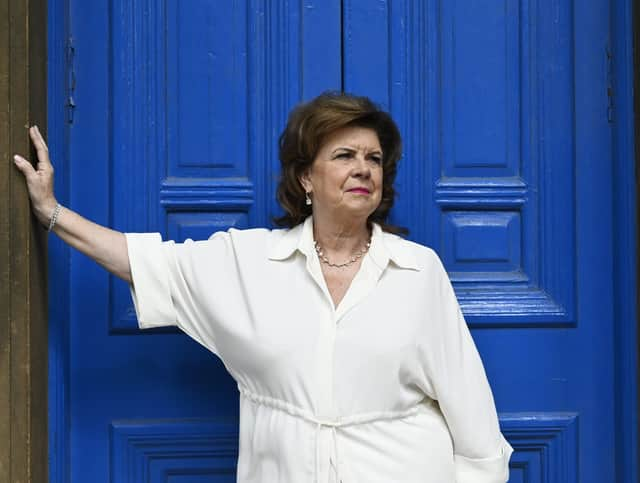
“I think you always have to try and find the truth. Even if you’re playing comedy characters such as Rab C Nesbitt's wife. Ian wrote about the women he was brought up with and I remember years later he said to me, ‘you always played Mary warmer than I wrote her’ and I said, ‘because I didn't see her as cold or vicious. I wanted to represent her as the women I knew’. I always try and look for that. I don’t know whether I manage, but I try.”
Smith praises Loan as having an authentic voice, capturing the complexities of her grandmother and family and friends as they deal with loss.
“I think Eilidh’s done that anyway in the way she's written it. And Cathy's not a warm, cosy character. She's at times not very likable. I don't mean Cathy in real life, I mean the character. She's tough. She swears. She can be quite vicious or dark, but you realise that underneath it all is, she's just lost her husband and her life doesn't seem to have meaning anymore. And there’s that sort of selfishness of grief, when you're going through it.
“I mean, when my mother died, I was in a terrible, terrible state, and I realised after a few months that I'd been half a wife, half a mum, half a sister, because they were all grieving as well, but I was fully consumed with my own grief. You lash out at other people or don't maybe behave well, and that is what Eilidh has captured. So, although there are very funny moments in the play, the audience won’t be coming out feeling it's all very cosy.”
Cathy is billed as a dark comedy, so how do you make death funny?
“Well there's black comedy in everything, even the worst moments of life, particularly in Scotland, whether you're in Aberdeen, the Borders or Glasgow, there's a dark humour we all have, a sort of sarcastic humour. That actually is about survival I think, and that situations are ridiculous. You’re all in this awful thing and a way out is humour.”
“And it's about the dynamics of a character, that the husband she’s lost was the life and soul and easier to like, but Cathy's dark sarcasm and ability to see things, and the way they all communicate, will make audiences laugh.
“You get more of a point across to audiences by making them laugh. If you can make them laugh, they come with you, you can take them anywhere. You can take them to the darkest of places.

“And it's a very working class thing as well. In the same breath as you're sitting there crying, you can burst out laughing at something and go, look at the state of that. That's ridiculous.”
“Joni Mitchell says ‘laughing and crying, you know it's the same release’ and there’s a great truth in that. I think that mixture is also very Scottish.
“Cathy’s got a line at the beginning at the funeral, which is, ‘what is it with the bagpipes? Why do we have to have them at everything? Christenings, funerals, weddings, gender reveals… win a raffle, whip out the f***ing bagpipes’. She comments about the priest, the platitudes people come out with and has observations about the mourners: ‘mind that guy, used to work in Babcock’s, with the one eye, he’s about 102 now, standing outside shivering. I mean, could he no have turned up on time? Make an effort!’
Loan’s Cathy may begin with a funeral but it is a play about learning to live again, although Smith is tight-lipped about how the eponymous grandmother achieves this.
“I don’t want to give it away. But it’s about how she starts to recover. It's not a happy end tied up in a bow, but about how you survive? I think that's what Eilidh and her family worried about when her grandfather died, that Granny Cathy would waste away. How do you find the will to go on and I think that will resonate with people. It does with me.”
Has Smith had any feedback from Cathy? Has she given her any notes?
“No. We did a photo session together and she came to see us when we were shooting the poster and we got photographs taken together. But Eilidh sat and read the play to her mum and granny. They weren’t going ‘you can't say that’, and they laughed, and cried, so Eilidh’s been given the stamp of approval.”
As a fellow grandmother, what kind does Smith think she is to her 12-year-old granddaughter and two and a half-year old grandson?
“Oh, I'm a good hands-on granny. I think I'm a better granny than I was a mum. I think it's a wonderful role to have. My dear mother, no longer with us, taught me how to be a grandmother.
She was very young when she had us so she was growing up with us and probably making more mistakes, as you do when you're a mum because nobody gets it all right, but as a grandmother you get to come in and just love.”
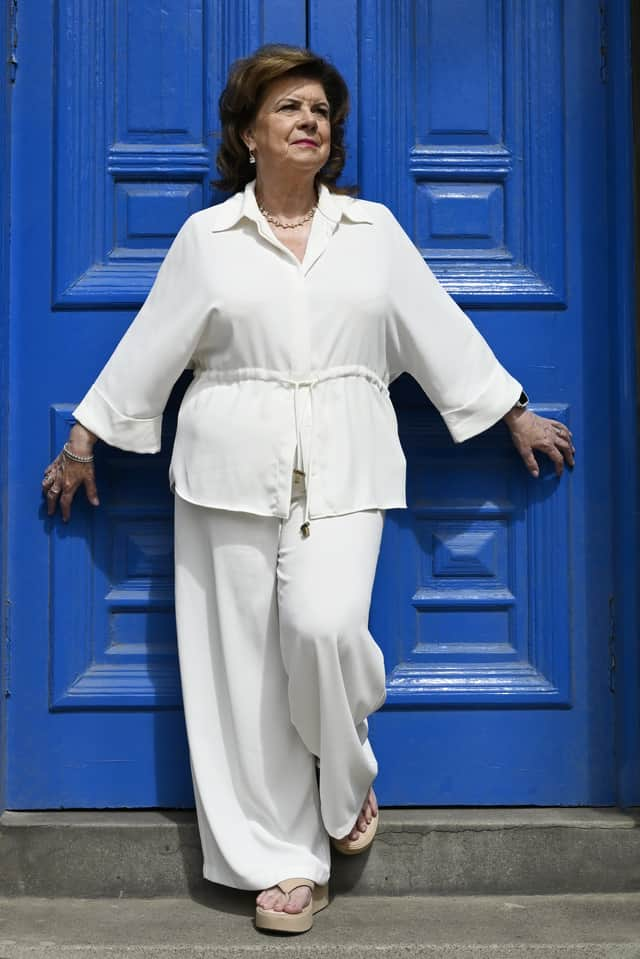
“We are fortunate in my grandchildren live where we live. We converted our house into two separate ones and they're on two floors upstairs, and we're downstairs, so I see my grandkids every day. It’s very joyous and wonderful. But also we’re very separate. It's not Everybody Loves Raymond. I said to my son-in-law, is that what it’s like? When you hear Bob and I coming. We try and get a good balance. I love it. It is one of the greatest joys of my life.”
Smith may earn praise for her ability to play the ‘Glasgow wumman’ down to a tee but Cathy, with her black-veiled hat is a very different character to Christine - with the neck brace, stick, unreliable bladder and relaxed wardrobe, the Two Doors Down role that earned Smith a BAFTA for best actress in 2018 and is due back on our screens in 2027 with series eight.
“And the wig and the fat suit,” says Smith. “There are similarities because they're both Glasgow grannies and there are elements of sarcasm that are like Christine, but Cathy's more ‘at herself’. She knows her own mind, what she wants. She's a tough cookie. Whereas Christine is very needy and needs Beth very much, and she's much more of a taker, wants to be centre of attention. And she’s not hand- on with her granddaughter or daughter [played by Sharon Rooney] because they're in Wales.”
Does Smith think Sophie and Madison will ever return to Latimer Crescent?
“That's up to the writers and the wonderful Sharon Rooney, who's always working, doing movies and stuff. She's fantastic. I would have her back in a heartbeat. I've always thought that her and wee Madison could turn up…”
When Smith talks about Christine, her affection for the character shines through. What is her favorite thing about playing the nightmare next door neighbour?
“Oh, there's a wonderful thing as a woman, where you really don't care what you look like. The costume and makeup department love it because I'll look at clothes and go ‘no, too nice,’ then ‘that’s hackett, I’ll put that on.’
“It's a great relief at the end of the day to get the wig off and step out of the fat suit. Doon [Mackichan] who plays Cathy always says ‘you look great but I go home looking terrible’. Because she's in makeup for hours with the fake tan, fake nails, wig, loads of makeup, whereas, I get a bit of base and possibly a wee bit of mascara occasionally, and if we're going out for a fish tea, some lipstick.
“There’s something liberating in going ‘I don't care’. And what matters more to me is, is she funny? Does this character work?”
Simon Carlyle [writer and co-creator of Two Doors Down, as well as Boy Meets Girl and Bad Education, who died in 2023], said he wanted her to look like a puppy breeder. No offence to the glamorous puppy breeders out there, but a certain type of puppy breeder. It's liberating.
“Germaine Greer said you get to a certain age and don't care any more because you're not in the market.
“And I like the fact Christine’s got no man to tell her what to say. She’s got no time for men. No time for Eric, any of them. And no propriety. She will just say what she wants. There's something really liberating in that for women who are brought up with ‘don't say that, it isn’t polite’, and ‘be a good girl’. That's my favorite stuff about her. And she's got some amazing lines.”

Last year Smith was officially awarded the Freedom of the City of Glasgow in recognition of her contributions to the arts and advocacy for women's rights. What does this involve?
“I hoped I’d get the keys for every pub in Glasgow, but I didn't. I'm the fifth woman in 850 years to be given this. It's ridiculous. And it’s great men - Billy Connolly, Alec Ferguson, Kenny Dalgleish, so of course as a woman, I said I'm not worthy of that, there's loads of other people that should get it. They had a huge dinner in the City Chambers which was magical, and I named every table after a woman that should have got it, in my opinion, from Oprah Winfrey to Mary Barbour to Elsie Inglis. But I am allowed to graze my cattle in Glasgow Green,” she laughs.
Has she got cattle?
“No, but if I did. And I think I'm allowed to hang my washing on Glasgow Green. The press wanted me to do that and I went, ‘did you ask Billy Connolly to hang his washing out on Glasgow Green?’ No. I said, ‘don't you think that's quite a reductive image?’ So, the photograph was me grazing cattle on Glasgow Green, which is brilliant.”
Another honour was the BAFTA Scotland Award for Best Actress – Television in 2018 for her role as Christine in Two Doors Down.
“Well, I was ignored for so many years by BAFTA in Scotland so I actually was sitting in my pyjamas watching X Factor when, (Two Doors Down co-star) Grado texted me going, ‘you won’. What was lovely was apparently the roar that went up in the room - that was really validating for me.
“But I get very honoured. And in the same year at the UK Panto Awards, I got Best Fairy so what more could you ask? And I was so delighted Doon got the BAFTA as well in 2024 for Two Doors Down.”
“But with comedy, if you're up against drama, invariably you never win. Because the key to comedy is you make it look easy. And the thing about drama is you make it look really hard. I have done both and I love drama as well, but it's a lot harder to make an audience laugh than to make them cry.”
Back on stage with Cathy at the Edinburgh Fringe, Smith hopes to do both.
Elaine C Smith stars in Cathy, which runs as part of TravFest 2026 between Thursday 6 and Sunday 30 August at the Traverse Theatre, Edinburgh. Tickets on sale at www.traverse.co.uk
Comments
Want to join the conversation? Please or to comment on this article.