
The 'ultimate insurance policy': Scotland-based Nato Submarine Rescue System prepares for 2,000ft dive
Nemo to sail from Rosyth to be tested to its limits off Norway

It is the “ultimate insurance policy" for stricken submariners.
The Scotland-based Nato Submarine Rescue System (NSRS) is in constant readiness to be deployed anywhere in the world to come to the aid of underwater craft in distress.


Based in Renfrew, it has never been used in action since entering service nearly 20 years ago, but takes part in regular training exercises, such as a two-week operation off Norway next week.
However, NSRS staff know they could be scrambled at any moment to play a key role in a rescue.
Some of the current team took part when the system’s predecessor saved seven Russian sailors from a submarine entangled in cables off the far east of the country in 2005, after it was flown out from Prestwick Airport.
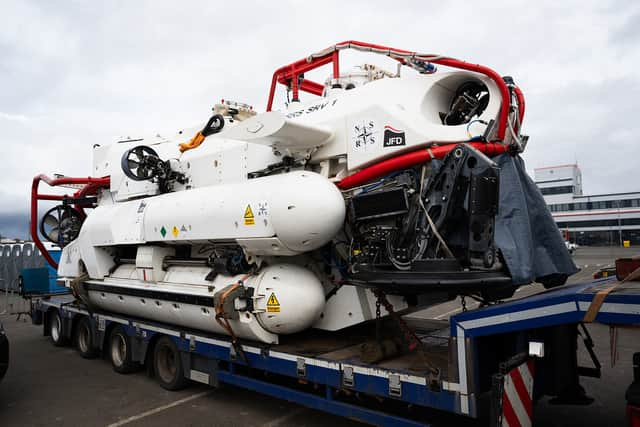
Memories of that drama may have come to mind as more than 100 people and 27 lorries with equipment converged on Rosyth on Friday to load the system’s components onto a Norwegian coastguard patrol vessel for the latest exercise.
It will involve Nemo, NSRS’s submersible rescue vehicle, diving to its maximum 610m (2,000ft) depth to link up to a “target” on the seabed, in place of a sunken submarine.

The craft will then be used for a separate mass evacuation from a submarine in the depths, with those ”rescued” passing through NSRS’s “transfer under pressure” (TUP) system.
This series of interconnected chambers, which resemble shipping containers, for ease of transfer, comprise the largest compressed air decompression system in the world.
It can accommodate 76 people, who would spend up to two-and-a-half days inside. In a rescue, up to 12 submariners at a time would be transferred to Nemo after it has “mated” with the escape hatch of the stricken submarine. The rescue vehicle, which has two pilots and a rescue compartment operator, then returns to the surface.

It is hoisted onto its host ship so the rescued sailors can be moved directly to the TUP while still under pressure so they do not suffer decompression sickness, or “the bends”.
Loading the 350 tonnes of equipment, including Nemo and the TUP, onto the Norwegian vessel Bergen was due to take 18 hours, and involved the structure holding them in place on board being welded to the deck.
The scale of the operation on a quay beside Rosyth dockyard, with large cranes looming over the ship, was such that it included a large catering tent erected to feed the 106 workers involved.

The exercise will not involve a third part of NSRS, which is normally tested separately - its intervention remotely operated vehicle (IROV).
The crew-less craft can dive to 1,000m (3,281ft) to locate a submarine in distress, clear obstructions, deploy locator beacons and deliver supplies.
While Nemo can reach the scene of a rescue within three days by air or sea, IROV can be deployed in 56 hours - just over two days. The pair will next train together next year as part of the large Nato submarine exercise Dynamic Monarch, which takes place every three years.

There are also exercises off Scotland several times a year, such as near Fort William and in Loch Long, including with Northern Lighthouse Board vessels because of their high manoeuvrability.
NSRS, which replaced the Royal Navy’s own system in 2008, is jointly run and funded with Norway and France.