
I met with extreme train travellers known as 'track bashers' in a Glasgow rail depot

Unique excursion to historic engine sheds for little-known pursuit
It was an extreme form of Saturday night entertainment - three hours aboard a train being shunted at walking pace up and down the tracks of a rail depot in Glasgow.
In more than two decades covering transport, I’ve encountered many unusual activities, none more so than on the railways, which I like to call a parallel universe for their disproportionate number of peculiarities.


However, what I saw on that train proved to be the most eye-opening yet. Sure, I was aware of train spotters, who record train numbers, but “track bashers” - who on earth are they?
It turns out they don’t hit anything, just seek to travel over every inch of track possible.
I discovered this when chatting to those on a chartered excursion from rail maintenance firm Alstom’s Derby works to its Glasgow outpost on Saturday on the eve of the latter’s first open day in 25 years to mark its 150th anniversary.
I should have realised there was something unusual afoot as it was the first train carrying passengers ever to enter the depot - that is, apart from a man on the Sleeper who overslept.

One of the 250 people aboard the Branch Line Society-chartered train helpfully explained their mission - and it turned out he’s a veteran at this game.
Simon Mortimer, a lab equipment salesman from Coventry, told me: “Railway enthusiasm has many facets.
“Everybody has heard of train spotters, and there are also ‘traction bashers’, who try to travel in every train, and my hobby is what is called ‘track bashing’ colloquially.
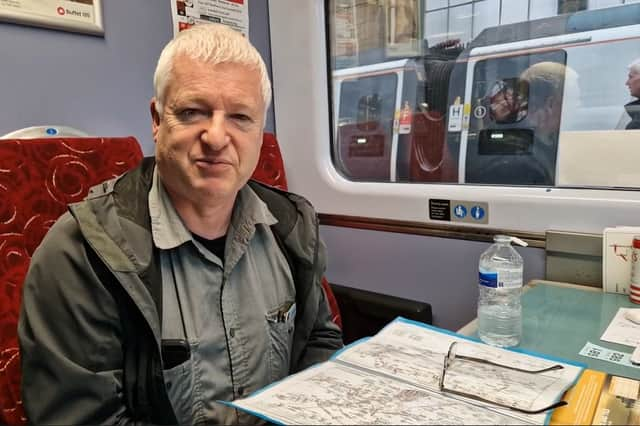
“You try and travel over as many different railway lines or even railway yards as possible.
“We’ll go in and out of the [Polmadie] yard, so where my track atlas at the moment is not coloured in red. In the next couple of hours, some of those lines will become, with the aid of a red biro, covered in red because I will have traversed them.

“In the context of all the passenger tracks in the UK, I’ve covered all of it, but I’ve also traversed pretty much all the passenger tracks in about 25 other countries as well.”
Ben Goodwin, an organiser of Alstom’s Polmadie 150 open day last Sunday, said the hobby was also known as “buffer kissing” - the German term for a railway enthusiast being pufferkuesser.
He said: “Track bashing is a way to describe the railway enthusiast hobby of travelling on as much of a rail network as possible, often with the goal of covering new territory or collecting mileage on specific types of trains.

“With Alstom's Glasgow Traincare Centre never hosting a passenger service before, it offered a unique opportunity for enthusiasts to 'collect' track across our site.
“Sidings and depots like Polmadie are the ultimate goal when it comes to exploring the rarest parts of our railway network
"As rail fans, we often use specialised maps to track the lines we have travelled over and we were delighted to provide them on the Polmadie 150 charter, so passengers were able to mark off the specific tracks the train traversed around the site across the evening.
“It's thought to date back to the decline of steam locomotives, when rail fans wanted to log the engines they travelled behind before they were replaced with diesel and electric traction.”
Comments
Want to join the conversation? Please or to comment on this article.