
Ministers to rule on self-driving taxis in Scotland as Wayve readies for London summer launch

Passengers expected to start using autonomous cabs in English capital within two months
Scottish ministers are to decide whether to permit self-driving taxis north of the Border after a firm announced autonomous cabs would carry their first passengers on UK roads “in the next couple of months”.
Wayve is teaming up with Uber to offer a similar service in London to that operated by companies such as Waymo in US cities like San Francisco and Los Angeles.
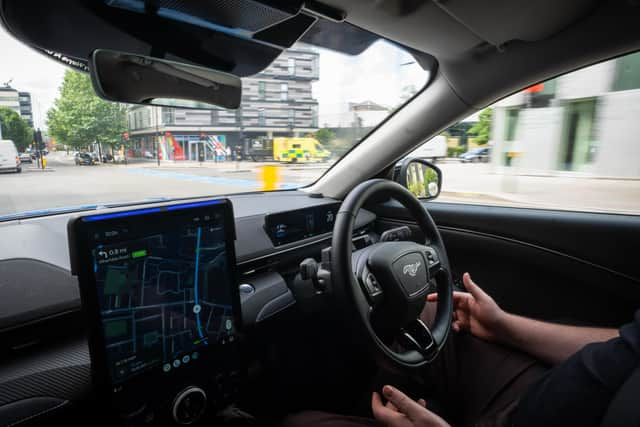

A driver will initially sit behind the wheel to be ready to take control during journeys while the technology is demonstrated to be safe.
However, self-driving vehicles have had a bumpy start in Scotland, with an autonomous bus trial over the Forth Road Bridge between Edinburgh and Fife, which boasted of being the world’s most advanced, scrapped last year because of poor passenger numbers.
The UK Department for Transport (DfT) last month invited applications for a trial of autonomous taxis, buses and coaches across Britain.
It said no submissions had been received for such bus or coach services in Scotland, while approval of self-driving taxis was a matter for the Scottish Government.
A Wayve spokesperson said: “We are not actively testing or driving in Scotland at this time.”
Neale Kinnear, founder of the Affective Mobility consultancy and a past head of transport safety at TRL, the UK Government’s former Transport Research Laboratory, said: “The decision of when [self-driving taxis will start operating] will be a commercial one as much as a regulatory one.
“Having successfully trialled and launched in London will clearly make it easier to choose other UK cities for future rollout of the technology, likely in Glasgow or Edinburgh first in Scotland - but after Birmingham and Manchester?”
Professor Subramanian Ramamoorthy, chair of robot learning and autonomy at the University of Edinburgh, said: “If it works well in London, I expect that would be good evidence in support of extending to other UK cities such as Edinburgh.
“I expect the issues would be more around business decisions - London is a big market, which means any fine tuning required for that city would be worthwhile.
“If the market is geographically spread out and locally sparse, I am not sure how the cost-benefit analysis plays out.”
Kaity Fischer, vice president of commercial and operations for Wayve, said: “We’re looking forward to launching in the next couple of months.”
Uber users will be offered self-driving vehicles at the price as its other minicabs.
Cars with Wayve’s self-driving systems have six cameras, a radar and an AI-powered computer in the boot which control their responses.

The company plans to expand to more than 10 cities globally with Uber, including Tokyo later this year.
Ms Fischer described London’s roads as the “ultimate testing ground for autonomous technology”.
She said that compared with San Francisco - where several firms operate self-driving taxis - London has 20 times more roadworks and ten times more vulnerable road users, such as pedestrians and cyclists.
Ms Fischer said combining that with London’s “2,000-year-old streets”, which are not in a grid layout and have “potholes and cobblestone paths”, created an “incredible proving ground”.
Annie Duvnjak, who leads global mobility autonomous operations at Uber, said it will launch with a “small fleet” of self-driving in London, before “scaling up over time”.
She said passengers soon “forget you’re in an autonomous vehicle, and that’s the beauty of it.”
Uber already offers self-driving journeys in the US cities of Austin in Texas and Atlanta in Georgia.
Ms Duvnjak said such vehicles would not remove the need for drivers because on some routes and in some weather conditions “it might not make sense for an autonomous vehicle to take a ride.
Waymo – a subsidiary of Google-owner Alphabet – has also been testing its self-driving minicabs in London, ahead of launching commercial services.
UK government Transport Secretary Heidi Alexander said the technology has “the potential to transform how people travel” by “reducing road danger while driving growth and creating high-skilled jobs across the UK”.
A Scottish Government spokesperson said: “The Scottish Government will continue to engage with the UK Government to consider the impact and evaluation of the London pilot programmes.”
Comments
Want to join the conversation? Please or to comment on this article.