
Exclusive:CalMac 'on the edge' of further major disruption until new ferries arrive - chief executive Duncan Mackison
Three more vessels due from Turkey by early next year

CalMac will remain "on the edge" of further major disruption until new ferries rejuvenate its fleet next year, its chief executive has warned.
Duncan Mackison said the operator was in "crisis management mode" after nearly one third of its vessels were out of action, with long-serving staff describing it as the toughest time they had known.


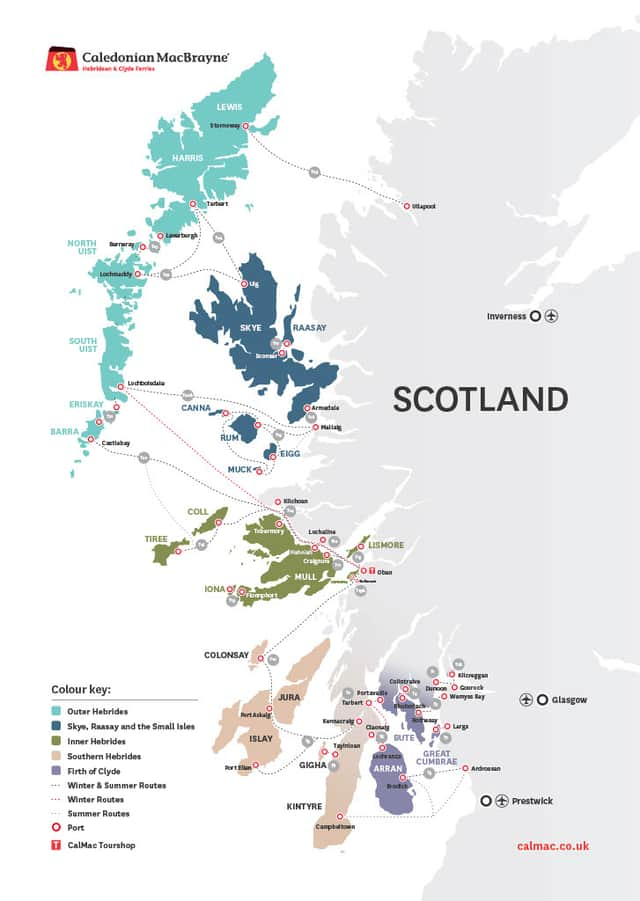
Two major ferries - Isle of Arran and Isle of Lewis - remain out of action while a third - Finlaggan - is undergoing scheduled maintenance, and they are not expected to all be back until the end of May.
Meantime, another of CalMac’s large ferries, Hebrides, was still undergoing repairs to its bow door seal in Aberdeen on Saturday, two weeks after it was due back from annual maintenance.
The lack of spare ferries has forced CalMac to move vessels around the network and suspend bookings on some routes, to the frustration of passengers.
However, Mr Mackison said he was delighted with the performance of its newest ferry, the Turkish-built Isle of Islay, and hopes the scheduled completion of its three sister vessels by next February will transform the company’s fortunes.

He said the addition of Loch Indaal, Lochmor and Claymore would halve the average age of CalMac’s fleet from 24.5 to 12.5 years, which would mean “issues will reduce”.
Claymore was launched at the Cemre yard in Yalova on Saturday and is due to be completed in February.

Mr Mackison also revealed that the recent significant disruption, which he has described as unprecedented, was “not a complete surprise”.
At its peak, ten ferries had either broken down or were undergoing scheduled annual overhauls.
Mr Mackison told Scotland on Sunday: “I said a few months ago that things could get worse before they got better.
"What we experienced was things getting worse. We had a combination of outages at the same time.
“We were anticipating it. We were doing everything we could do, but it's when you get a combination of factors that it really builds up.”
However, the chief executive said that when 42-year-old Isle of Arran and 31-year-old Isle of Lewis returned to service, CalMac would still not be out of the woods.
He said: "Even when we get them back, with older vessels, that risk and threat remains, so we have to accept we are on the edge of something like that happening [again] until we get the new vessels in from Turkey over the remainder of this year and the start of next year.
“We need to make sure we have got the resilience in the fleet if we can, so if something like that happens again we have got some room to play with.”
Mr Mackison hopes to boost resilience by further extending CalMac’s charter of the catamaran Alfred to October. It has operated on the main Arran routes since 2023.

However, in an illustration of CalMac’s challenges, to get Isle of Arran back into service, a spare part has had to be specially made.
Repairing another older ferry, Lord of the Isles, involved “harvesting” an engine part from the scrapped Hebridean Isles.
Mr Mackison said things had been as difficult as they had ever been for the UK’s biggest ferry operator.
He said: “It’s been a tough six or seven weeks - a very, very intense period.
“We have been in a crisis management mode, and to an extent we continue like that.
“The combination of vessel breakdowns and disruption has been unprecedented and the network at times has been very fragile in terms of the service we have been able to offer.
“People have been under pressure. As ever, frontline staff bear the brunt, having to deal with disruption and cancellations and reallocating passengers to different sailings, and deal with the frustrations and upset that goes with that.

“We’ve had to work really hard to look after people, but I’m proud of what our staff have been able to do on the front line.
“We are trying hard to be open about the choices we have and the decision that we’re making.
“We can’t please everybody because sometimes we just aren’t able to do that, but people have understood that we’ve been in a difficult situation.”
Mr Mackison admitted that things had been “very difficult” for some islanders, but stressed: “What we’ve had to do is operate in an environment where we are trying to maintain services to as many islands as we possibly can.”
On the prospects for this summer, he said: “I can reassure everyone that we are working hard to minimise disruption - not just the breakdowns but the impact of moving vessels. We are trying to stabilise vessels on routes wherever possible.”
But he was optimistic about the improvements the Turkish ferries would bring on the strength of Isle of Islay’s performance since entering service to Islay in April.
He said: “It’s a case of let’s just get through this year and do absolutely everything we can with the vessels we have got at the moment, but we look forward to next year when the [average ferry] age will come down.”
That will also give CalMac a “resilience”, or spare vessel, so that if something happened to another ferry it could be directly replaced rather than multiple vessels having to be moved between routes.
Mr Mackison said of 450-passenger Isle of Islay: “It’s a good, simple design and has nice, open passenger accommodation areas and a very large vehicle deck.

“The main thing for us is the propulsion system, which is very different from anything else that we’ve got, and is really welcome.
“It gives us a lot of power and manoeuvrability. The propellers are suspended on units underneath the rear rather than being at the end of long shafts, which means you can rotate them through 360 degrees.
“It means that in combination with the really powerful bow thrusters, you can turn it 360 degrees on a sixpence and can bring it in sideways parallel.

“You’ve got a very controllable ship that can operate into jetties and harbours with a high degree of confidence, and also be able to operate in higher winds.
“We’re really pleased with that, and think that size of vessel, that capacity and that level of power and manoeuvrability is a really helpful addition.”
But Mr Mackison said CalMac still required a pipeline of more new ferries.
He said: “What we really need is a steady drum beat of new vessels coming in - one every year to 18 months.
“It’s important to keep pushing that because the older ones are not getting any younger.”
Comments
Want to join the conversation? Please or to comment on this article.