
Bikes outnumber cars in Scotland-first commuting milestone on busy route into Glasgow city centre

One in six journeys made by cycle on segregated South City Way
Bikes have outnumbered cars for the first time in a rush hour traffic survey by Cycling Scotland which said the figures "wouldn’t look out of place on a Dutch or Danish street".
The official cycle development body recorded the milestone on the South City Way segregated cycle lanes on Victoria Road, a popular commuting route into Glasgow city centre from the south side.
It said more people cycling than drove there from 8-9am and 5-6pm on September 24 and 25 last year, with the totals reflecting the continuing success of the route - an average of 334 bikes compared to 270 cars.
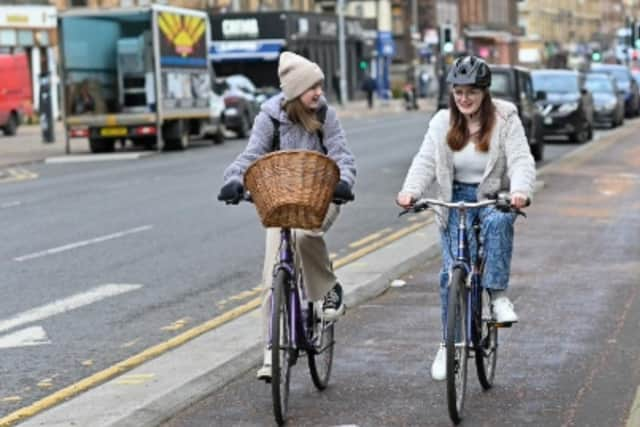

A spokesperson said: “As best we know, this is the first time more bikes have been counted than cars consistently at morning and evening rush hour peaks over the course of a traffic survey in a city in Scotland”.
A total of 16 per cent of journeys were made on the route on those two days overall which is another new record. The proportion has steadily increased over the last few years.
In all, 5,287 bikes were recorded on Victoria Road over that 48-hour period – an average of 2,643 cycle journeys per day.
In addition, counting equipment on the route recorded more than 131,000 cycle journeys in September - 85 per cent more than 71,000 in September 2021.
Cycling Scotland said there is a “bus gate” - which other vehicles are not permitted to drive through - at the north end of Victoria Road about one third of a mile from its traffic survey location beside the junction of Alison Street and Victoria Road.
However its spokesperson said: “It’s been in place for many years and well before construction of the South City Way.
“While the bus gate will affect traffic levels heading towards the city centre on Victoria Road, which may use alternative arterial routes, this doesn't change the continuing growth in cycling modal share on that route, which is measured a significant distance away.”
The organisation records traffic flows twice a year at 100 locations across Scotland.

Bike use is likely to have increased further since the survey because of the success of a new electric cycle hire scheme launched in Edinburgh in September, with its operator Voi also taking over the established Glasgow scheme and transforming it with an all-electric fleet in November.
Glasgow cyclist Katy Hastie said of the South City Way: “It’s made a colossal difference having the protected routes.
“Being well separated from traffic means I’m able to travel in safety.
“I wouldn’t be cycling as much for my daily commute or at all without the protected cycle lanes now in place.”
“I really like that I can squeeze some fitness and fresh air into my daily routine with cycling – and how efficient it can be.
“Often, it’s the fastest and cheapest way to get somewhere.
“It makes a huge difference mentally, health-wise, and is quick and mega cheap.”
Glasgow City Council transport convener Angus Millar said: “These results demonstrate the growing impact of high-quality cycling infrastructure across Glasgow, showing that more people are choosing the bike as an option to get about the city when safe, protected routes are provided.”
In Edinburgh, Leith Walk recorded its highest yet proportion of cyclists on September 24-25, of 9.7 per cent - 4,744 bikes among 48,832 journeys.
City of Edinburgh Council transport convener Stephen Jenkinson said: “We’ve consistently seen where we commit to creating and improving cycling infrastructure, new users will follow.
“From supporting more liveable local neighbourhoods, to getting physical exercise and choosing to get around more sustainably, I’d encourage anyone thinking of getting on a bike this year to give it a try.”
Nick Montgomery, monitoring and development manager at Cycling Scotland, said: “Where local authorities are investing in protected cycle lanes and improved networks of cycling routes, there are big increases in people travelling by bike.”
Comments
Want to join the conversation? Please or to comment on this article.