
Exclusive:New AI traffic lights being trialled in Glasgow change to green for these vehicles

First use of technology that automatically detects flashing blue lights
Traffic lights that detect the blue flashing lights of emergency vehicles and change to green to let them through junctions are being tested in Glasgow, The Scotsman has learned.
It is believed to be the first use of the artificial intelligence (AI) technology that automatically changes the lights for police, fire and ambulance crews.
The system is designed to make it easier for police cars, fire engines and ambulances to get through junctions whose path is blocked by traffic queueing at red lights.
It is being trialled at Helen Street in Govan, which contains a Police Scotland control centre. Similar technology is in use on the Clyde Arc - known as the Squinty Bridge - to give priority to buses and cycles.
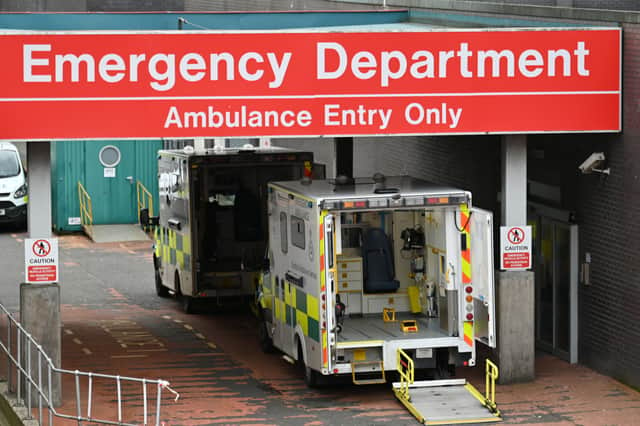
Project EVA (Emergency Vehicle Assist), which is being developed by Glasgow City Council, is also due to deployed on one of the approaches to Glasgow Royal Infirmary in the city centre to speed up access to incoming ambulances.

Brian Davidson, a city council traffic engineering officer, told a Transport Smart Class Scotland event in the city: “The police came to us and said when they are on an emergency shout with the blue lights and sirens going and come up to a set of red traffic lights, nobody will go [through] to let them get past.
“They said wouldn’t it be great if we had a button in the police car that you could press in an emergency, and we said ‘nah, you’re going to press it when you’re going to get chips’.
“But we thought ‘could we detect the flashing blue lights’, and used YouTube videos to try and train the AI - and it worked really well. Early indications are that it is going to be really useful.
“It’s something that other UK authorities have asked about and are interested in, but we are not quite ready to make it commercially available yet.”
A Glasgow City Council spokesman said: “We are currently trialling new AI-based image processing hardware that helps to make traffic light systems more responsive and provide priority for certain vehicles.
“Project EVA focuses on emergency vehicles and can detect flashing blue lights, which then allows a green traffic light to be called for the approaching emergency vehicle.
“Driving through a red light is still an offence, even if it is to allow an emergency vehicle to pass through. But with the Project EVA system, waiting vehicles can safely move forward and clear a path for the emergency vehicle.
“Similar technology is being trialled on the Clyde Arc bridge, which includes dedicated lanes for the Fastlink bus service. The hardware being trialled is able to detect buses and bicycles and then allow the traffic lights to respond and provide priority for them to move through the junction.
“Further checks on the impact and effectiveness of these systems have to undertaken before it can be confirmed for ongoing use.”
The council is being assisted in Project EVA by Smart Technology, which pioneered the “Ultra Smart Cycle System” that enables a set of traffic lights to be temporarily controlled by a remote control device.
This is used by parents running the Shawlands Bike Bus in the south of the city who keep the lights green for 45 seconds so pupils riding to school en-masse can get through.
Comments
Want to join the conversation? Please or to comment on this article.