
Acclaim for The Scotsman founder's influential railway foresight in new book
New accolade comes amid preparations to celebrate bicentenary of Scotland’s first modern line

The co-founder of The Scotsman has been lauded as “Father of the Railways” in a new book published in the run-up to the 200th anniversary of Scotland’s first modern line.
Charles Maclaren is praised for his foresight in predicting rail would "open up prospects of almost boundless improvement" in a series of articles championing its development which were published in the newspaper in 1824.


They were reprinted in England and US the following year and also translated into French and German, reflecting Maclaren’s international influence, seven years after he launched the newspaper with William Ritchie.
The title was later to pioneer the use of railways to boost circulation by transporting newspapers in its own train from a siding beside its printing presses in the centre of Edinburgh.
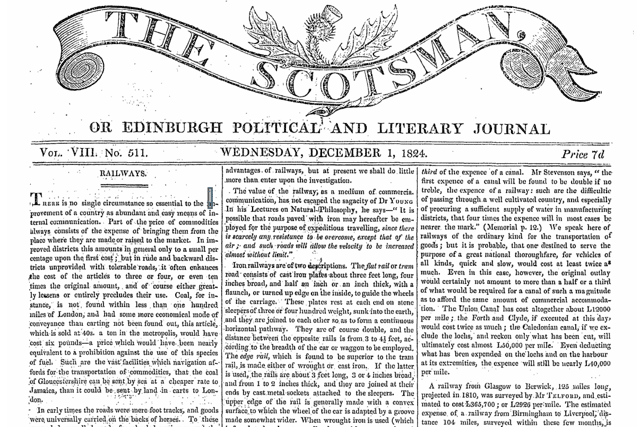
In a new history, Early Railways of Scotland, authors Anthony Dawson and Ed Bethune wrote: “He was an early and eager advocate of railways.
“He counselled that railways should be much more than feeders to canals or coal carriers. He saw them as a joined-up network, powered by steam locomotives.”
The book comes as events are being planned to mark the bicentenary in May of the ten-mile Monkland and Kirkintilloch Railway.
It is regarded as Scotland's first modern line for the first large-scale use of iron rails, over which ran the first Scottish-built locomotive.

Mr Dawson said: "Charles Maclaren should be considered one of the 'fathers' of the railways, alongside existing English luminaries as George and Robert Stephenson.
“Writing when the locomotive-worked public railway had yet to come to fruition, Maclaren was a visionary who saw the railway as a mature transport technology in its own right.
“Hitherto, where railways had been worked by locomotives in England, they had been over relatively short distances on private industrial lines.
“In Scotland, whilst passenger-carrying public railways were in existence, the steam locomotive had only made faltering steps.
“Thus, when Maclaren described in his four essays the concept of a railway network - not just a jumble of unconnected industrial lines - capable of carrying passengers and goods he was very much predicting the future.
“This was a huge leap of faith in what was still a relatively new and untested technology.”

Andrew McLean, head curator at the National Railway Museum in York, said: “Charles Maclaren was a true transport visionary. He grasped early on the potential of a railway system in Britain and across the globe.
“He foresaw a rail network connecting towns and cities which, in turn, would transform society and the economy - and his vision would come to pass later in the 19th century.”
Mr McLean said Maclaren, from East Lothian, was likely to have been familiar with the Tranent-Cockenzie waggonway - Scotland’s first railway, which was built a century earlier in 1722 with wooden rails to haul coal to power coastal salt works.
Mr McLean described the Monkland and Kirkintilloch Railway as a “significant step forward in the development of Scotland’s railway network” for its first to use of wrought iron rails.
It linked a colliery in Monklands with the Forth & Clyde Canal in Kirkintilloch. Its anniversary is to be marked from March with an exhibition at Auld Kirk Museum in the East Dunbartonshire town and a series of talks and guided walks.
Comments
Want to join the conversation? Please or to comment on this article.