
'There's a lot of my mum in Grace' - Blue Lights star Siân Brooke looks to her mother for inspiration
From Guilt to Blue Lights, the actor looks for authenticity and what it is that makes people tick
Siân Brooke is back in body armour and boots on the streets of Belfast in a new series of the BBC‘s BAFTA-winning, pulse-pounding, crime drama Blue Lights.
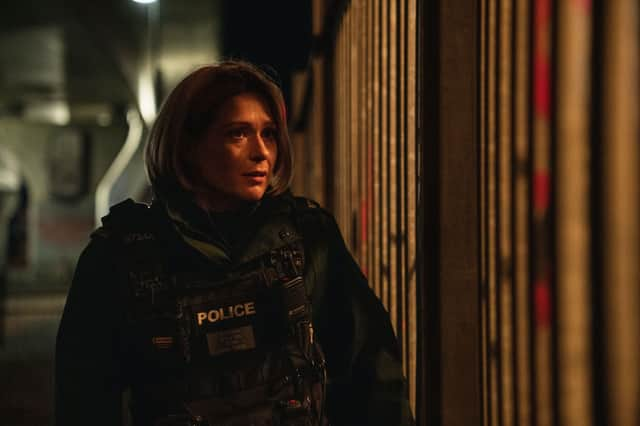
For Brooke, a familiar face on TV from BBC Scotland’s Guilt, Sherlock, Trying and Supacell, stepping back into the dark green uniform of constable Grace Ellis felt familiar as the rookie cops near the end of their probation and are now seasoned officers accustomed to the gritty reality of the Belfast beat.


“It was so alien at the beginning because there are so many items you have to wear - belt, vest - and simple things like getting in and out of a car are clunky and troublesome, but as time has gone on, now you put it back on and it’s ‘there you are old friend’. And in this series Grace gets into non-uniform stuff as well and that was really weird, not being in the uniform and yet being Grace.”
As well as the uniform Brooke has another asset in getting into the role, as the daughter of a policeman and a mother who studied dance and teaching at university and took her daughter to rehearsals after school and at weekends.
“On top of a full-time job and with three kids, so there’s a lot of my mum in Grace,” says Brooke.
“And I do ask my dad about police protocols and abbreviations and say ‘would you do that?’ It’s great to have that hotline straight to him and I did run the script past him because I thought this is really well written and reminds me a lot of him and the job, the friendships and banter, and he agreed.”
In season three of the hit show, which has just won a BAFTA for best drama, the action and stunts are bigger, the drama and humour darker and the emotional tension heightened as a tense storyline takes us to South Belfast. The team are on the trail of the white collar criminals, the lawyers and accountants hiding behind the high walls of their villas, who facilitate and profit from the drugs trade. Workplace relationships are also under strain as Grace’s sidekick and ‘will they won’t they’ love interest (they did, and kick off this season as a couple) Stevie (Martin McCann) is offered temporary promotion to sergeant, while fellow officers struggle with undiagnosed trauma and family dramas.
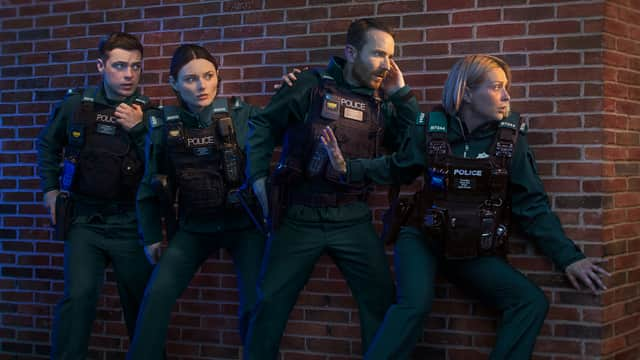
Key to the show’s success is its authenticity, thanks to co-creators and Belfast locals Adam Patterson and Declan Lawn who met while working as investigative journalists on Panorama. Their storytelling has a ring of truth informed by interviewing real life local police officers and this season tackles the ‘professional apparatus’ around organised crime as well as looking at child sex exploitation and cross-border trafficking.
“Every city is more complex and nuanced than you think,” says Brooke, “and especially Belfast and its troubled history. The genius of the writing is that because they're from there and have lived through The Troubles, they know the history. They were journalists and understand how important research is and carry that into the drama. There’s an understanding of the landscape of Belfast now and in terms of the story, how it operates.”
How does Brooke think Blue Lights has developed over the seasons?

“It's always character driven, which is partly why the response to the show has been so great. I think people really relate to these characters and have let them into their hearts so there is an interest in how they cope with the job. And this time round all of them get stretched to the nth degree.”
For Grace, a single mother of a teenager who left social work to go into the police, it’s a case of her new and old worlds colliding.
“Grace gets thrown back into the world of her old job and meets a former client who she left in a good place who is now in with the wrong crowd. Grace being Grace, with that dogged determination, pulls at the thread and realises it’s attached to a greater criminal organisation. So the story works on frontline policing, the drug dealing and exploitation they deal with on a day to day basis, and how it is actually supported and enabled by a bigger web in terms of the criminal organisations running the show and the white collar crime.”
“Grace wants to bring about change and believes it’s possible. In this series she's highly frustrated that the police system isn't as peoplecentric as the social worker in her believes in. She thinks ‘we have to help this person, why can't we?’ And actually there are steps and processes that have to happen. But Grace doesn't always follow the steps and the processes…”
Brooke describes Grace as dogged and determined. What else would she say about her?
“She's highly principled. When we started filming Blue Lights it was just coming out of COVID and I felt like the world was lacking a bit of that in terms of society and the people in charge. So it was wonderful to see this woman stick her head above the parapet regardless of the consequences. And I love that she's stayed true to that. She's not trying to get up the ladder by conforming. She doesn't care about that. She absolutely does want to bring about change. And in this world that we live in, the global politics, the crazy world at the moment, it's nice to have a character who is optimistic that that might be possible. It’s not always. She's an idealist, but you need people like that because that's the only way change really happens because they have to be brought down by a pragmatist and then they meet somewhere in the middle. She’s less naive about what is achievable, and understands you can’t get everything”
The pragmatist being her life and work partner Stevie?
“I think in the first series she was a lot more naive in what she thought was achievable. Now she understands you can't get everything, but it's not going to stop her. It just means it's a slower process.
“With her relationship with Stevie, she's become a little more vulnerable and a bit less independent. She's let the hatches down a bit. But there’s a lot that tests them. Whether or not they continue to be a couple throughout the show….”
Yes, he might know how to make great cupcakes for stakeout snacks but he’s now her boss.
“Yes, he's a skipper so he's after people to conform and follow procedure and Grace is not like that, so it’s interesting to see where that goes.”
Why does Brooke think Blue Lights is so popular with viewers that season four is already being written?
“I watch stuff because I care. I care about that character and these have been fully formed from the get-go. I think people recognise a bit of themselves in each person,” she says.
“Also I think it demystifies a job that can seem quite ‘other’ to people. You know there's a uniform there and that's where it stops. And I think the writers have dealt with the history of Northern Ireland and not shied away from it and that's a brave thing to do. There’s an appetite to understand both modern Belfast and the history.”
If Grace is an optimist in a difficult place, how does that play out in the series?
“She has to sacrifice some home truths or secrets about herself in order to bring about change.”
How about you, would you say you are an optimist in life, like Grace?
“I think I am, but I'm probably a pessimistic optimist,” she says.
Hope for the best, but expect the worst?
“Absolutely. Anything else is the bonus,” she laughs.
This is a philosophy that has stood the 45-year-old London-based actor from the Midlands in good stead throughout a career that was kickstarted by seeing A Midsummer Night’s Dream at age 11.
After attending youth theatre while at school, with the encouragement of supportive parents she studied at RADA and since graduating has played a variety of characters. There’s the crushingly insensitive but funny Karen in Trying, Eurus Holmes, the evil younger sister in Sherlock, supervillain Victoria in Supacell, former spy Barbara in The Undeclared War alongside Simon Pegg and a woman involved in the real life story of Shannon Matthew’s fake kidnapping in the 2017 BBC drama The Moorside, with Sheridan Smith and Gemma Whelan.
What is it that makes her go for a role?
“I think probably as I've got older there is more choice available. When you're younger you just want to work and get more work and work for more people because you'll become more flexible as an actor, seeing how actors and directors compare.
“But I’ve always wanted variety because I think I'd get bored otherwise. I always want to test myself and pull myself in another direction because I've learned a lot doing that, about the actor I am and the actor I'm not. The things that spark me are character-driven and that's probably the reason I went into this profession. I love human beings and all their little quirks and want to constantly pick away at what makes them tick. So it will always be character-driven for me.

Does Brooke enjoy switching up the tension of Blue Lights for the comedy lighter feel of Trying?
“That show is like soul food. I’ve got friends who smile when they talk about it. It’s exactly the same doing it, really joyous. We're filming now and we've been outside and the weather has been against us but everybody's just like, oh, that's okay. No big dramas. It's nice to return to something where you enjoy reuniting so much with each other. It's a very, very special show with really gentle souls that work on it. And I love playing Karen because she says all the things I would never have the balls to say in real life. She’s devoid of empathy and opinionated and self-centered. It's so liberating to not feel you have to comply with any social etiquette whatsoever. She just listens and responds and usually that response is an affront.”
Talking about ‘character-led drama, does she think that was the success of Guilt, set in Edinburgh, in which she played Claire, wife of Mark Bonnar’s shifty lawyer Max?
“Yeah, and Neil Forsyth’s writing was just brilliant, really witty and fast-paced. I loved doing that and that part and it was great it was BBC Scotland. It was a sort of unexpected hit that grew and grew. It's nice to have that ownership over a show, which I think Belfast has with Blue Lights. There’s very much a pride about those shows. Homegrown is the word.
“Taking the BAFTA back to Belfast when we were in the middle of filming the series, to the crew and cast and everybody was a real galvanising, wonderful, celebratory moment.”
“We filmed Guilt in Glasgow, a city I love, as well as Edinburgh. I've worked there three times now. One of the first jobs I did on TV was a show called Garrow’s Law [a 2011 BBC legal drama] and then a series called Not Safe for Work [2015 Channel 4] which was really off the wall and I loved, then Guilt. So I’ve spent some time in Glasgow and it will always be close to my heart.”

“And I've recently just worked with Glaswegian director Paul McGuigan, who is just a genius, on The Undeclared War 2, with Simon Pegg, which is coming out on Channel 4 some time next year.”
The six-part Channel 4 cyber-thriller set in GCHQ's elite Malware Department is dealing with a Russian cyber-attack when it uncovers a greater threat and Brooke joins season two along with Chloe Pirrie, as Barbara Patrick, an analyst and wife of Pegg’s Director of operations.
“Barbara’s so different and that stretched me. This woman used to work for MI6 and is fluent in Mandarin. It was brilliant and I loved working with Simon Pegg. I think the writing in that is very clever and pertinent for now, especially with all the global politics going on. It's definitely got its finger on the money.”
As well as working on the fifth season of Apple TV’s Trying with Rafe Spall and Esther Smith, Brooke returns to film Supacell, the British superhero television series for Netflix as the evil Victoria Kesh, chief of The Organisation, which is researching the superpowers that arise from a mutation of the sickle cell gene, alongside Eddie Marsan.
“So I'm filming Trying at the moment and in a few weeks jump into Supacell which I'm really looking forward to again - it’s very different - then in March series four of Blue Lights starts so it's going to be busy. I'm very lucky and grateful because this is not the norm in this profession. I'm accepting it as a very lucky place at the moment. But who knows? That pessimistic optimist goes, ‘yeah but you might not work after that’.” She laughs.
Does she ever take characters back to the London home she shares with husband award-winning theatre, film and TV director husband Bill Buckhurst and their two sons?
“The times I’ve taken them home is when I've played real life characters because there's a responsibility about not doing an impression but nailing them in a way that honours that character, so that there's an authenticity. I devour their world and watch interviews and get their walk and voice and it has to sit with you until there's an ease and you can slightly forget it. My husband says when I'm playing those parts - not that I think I ever really bring parts home because I don't think it's healthy - we lose a little bit of you and this other person comes in for a little while and there's little flavours of that person.”
Brooke also has her own project she’s interested in developing in future.
“It’s very much Midlands based. I'm very passionate about telling stories about it as that’s where I'm from and I feel like it's undiscovered. Peaky Blinders is brilliant and it's paved the way, but it's a bigger place than people think and very varied. As well as Birmingham there's East Midlands, West Midlands, where I'm from, and Staffordshire, and lots of different voices and stories to tell. So, yeah, so that's a bit of a pet project of mine. When I started out, I didn't really really embrace my roots because it wasn't cool to be from the Midlands but as I've got older, I'm like, that's where I'm from. I'm going to do a Grace and that's MY campaign - put the Midlands on the map.”
All episodes of the new series of Blue Lights are available on iPlayer now.
Comments
Want to join the conversation? Please or to comment on this article.