
The wilderness starts at Britain's most remote railway station


No roads, no traffic, no distractions: Andrew Dunbar discovers why Corrour, Britain's most remote railway station, draws walkers and campers back year after year.
The train door slides shut, the engines grumble and the train starts to move away, its dark-blue livery and bright yellow cab snaking between the green and black-hued hills until it disappears. It’s only then that I notice the silence. No cars; there are no roads here. Only the sigh of a light breeze. I am alone, surrounded by moorland and hills, and exposed to the grey, clouded sky. A smirr of fine rain begins to settle on my jacket. I am suddenly aware of how far I am from anywhere.

I’ve arrived at Corrour, the most remote railway station in the UK, accessible only by the West Highland Line, built in 1894. The estate owner, Sir John Stirling Maxwell, insisted on the station as a condition for allowing the railway to cross his land. It was a mile from the station by pony and trap to the boat-house on Loch Ossian, from which a steam yacht took guests to the house, three miles east.

Today, the boat-house is a weathered, green-wood-clad hostel, nestled amongst mature Scots pines, almost surrounded by the loch; neighbouring islets are crowded with tall trees. Celebrating its 95th anniversary this year, it's simple: composting toilets, no TV or wifi, and warmth provided by good company and a generous stove.

“You get a real hit of rest and recuperation here”, says Jan, the warden, a neat velvet cap crowning her long grey hair. “You can be in a simple environment and survive and thrive without tech.” After 16 years, she carries a quiet matriarchal authority. She has stood at the station in winter, “watching the train’s lights disappear into the distance, then the station lights turn off", leaving her in pitch darkness; endured blizzards so fierce she "woke in the morning to find the vestibule filled with snow.” She’s also noticed the quieter changes - “I saw a red squirrel on the south loch path yesterday, so they are coming back.”

I meet Alan, a retired GP from Aberdeen, with black-rimmed glasses and a warm smile. He’s been making the pilgrimage to Corrour for over 40 years and tells me how in the 80s, stags would wander onto the front lawn. The more curious would come inside “carefully tilting their antlers to fit through the door”, looking for peelings.
The walking is the point. “Staying here’s a good way to access hills that are too far to reach in a day, and they are never crowded”, Alan continues. There are seven Munros directly accessible from the hostel; the easiest being Beinn Na Lap at 935m, 10 km return from the station, which at 410m is the highest in the UK, sparing a decent portion of the ascent.

The walk I’d recommend is the 17 km (4-5 hours) return from Rannoch, one stop south by train. The rail journey takes 10 minutes, but as the moor slips rapidly past the window, I start to wonder what I’ve let myself in for.

From Rannoch station, I hike a mile down the road before turning onto a well-worn track. I pass the low peak of Sròn Smeur before forking left along the hulk of Sròn Leachd a’ Chaorainn. Away from the road, I hear only my footsteps crunching on the gravel and the chirp of a meadow pipit. The path undulates gently upwards, its verges dotted with spiky-leaved marsh thistle, crimson in bud, and delicate pink lousewort. There are false summits but I carry on steadily, the wind lifting as I gain height.
The vast expanse of Rannoch Moor opens before me - a blurring of green grasses and brown heather, scattered with birch and rowan, the silver Blackwater reservoir in the distance backed by the darker Mamores, their peaks brushed with snow. Along the horizon, like a silent thread, lies the single-track railway I arrived on.

The view stretches, Blackwater reservoir seeming to change shape as I traverse the high path. I walk on, placing one foot then the other, almost afraid to stop. I pass the ruins of the old shooting lodge as the faint white shape of the Corrour Station House finally emerges, and the path slowly descends to Loch Ossian.

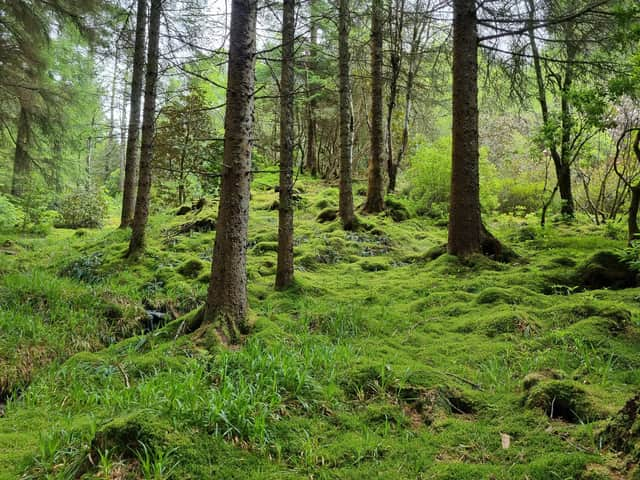
The simpler circular loch-side walk passes through native woodland; pines broad and tall, naturally spaced, the ground thick with spongy hummocks of impossibly green moss I want to touch. Its survival is deliberate. Since Lisbet Rausing, of the Tetra Pak family, bought the estate in 1995, native woodland has grown from 39 to 707 hectares. Fewer deer, better woodland.
Waiting for the train back, my feet sore and knees protesting, I get talking to Karolina, an Eastern European in her twenties, wearing an outsized backpack lit by a fluorescent yellow rain cover, laden with a tent and sleeping bag.
This is her fourth weekend here. I ask what draws her: “It’s easy to get here from London, but it’s still remote.” She pauses. “It feels like a little community - I always meet someone interesting in the hostel”. She alternates between the hostel and wild camping, depending on the weather. “I found a hidden spot to camp; you have to know where to look. And I think I managed to spot a crossbill, and maybe a black-throated diver.” She pulls out her phone and shows me her camp, pitched amongst the pines, beside the black waters of the loch. In the distance, our train appears, threading through the hills again. It comes to a halt and the doors open.

Getting there: Corrour is served by three services daily each way between Glasgow and Mallaig, plus the Caledonian Sleeper from London Euston daily except Saturdays.
Where to stay: The hostel (hostellingscotland.org.uk/hostels/loch-ossian) has dorm beds (£25); book ahead for summer weekends and bring earplugs. For more privacy and less snoring, the Station House (corrour.co.uk/station-house) has rooms from £195 within the old signal box.
Eating: The welcoming Corrour Station House offers shelter, coffee and food from 8.30am, with dinner until 7pm. Open April to October. Dinner reservations advised - servings are generous; try the venison stew.
Comments
Want to join the conversation? Please or to comment on this article.