
The Outrun's Amy Liptrot takes a deep dive into the world of seaweed for her next book
The bestselling author returned to Orkney with a vow to write something uplifting in her latest wildlife memoir
It’s first thing on a weekday morning when the country is shivering under a blanket of snow, schools are shut and there’s traffic chaos but bestselling author Amy Liptrot’s white blonde hair is still damp from her dawn dip in a freezing river. She appears so bright eyed and energised by the experience, it’s enough to make you believe in the benefits of outdoor swimming on a winter’s day and the possibility she’s part selkie or mermaid.
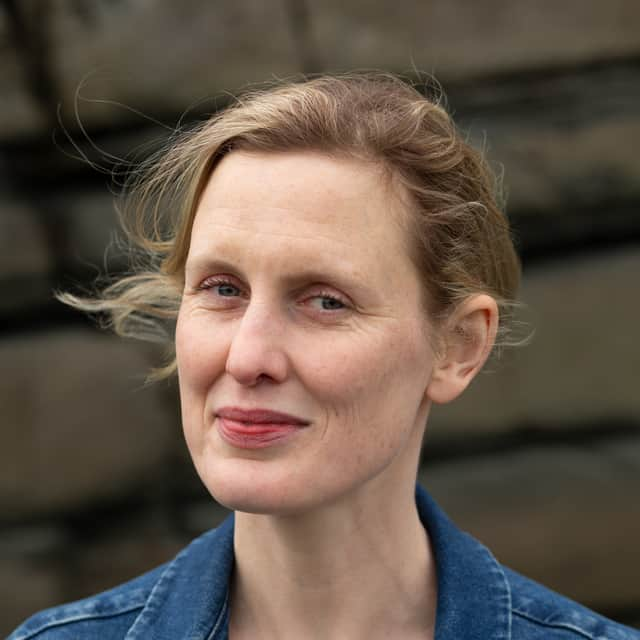

“I’m just warming up after being in a cold river,” says the Outrun author, wrapped up in a thick jumper, back at the Yorkshire home she shares with her partner and two young sons.
“I’ve had quite an exciting morning. Yesterday we were breaking the ice with a hammer and this morning I tried to go to one of my favorite spots but the road was too icy and I got stuck in the car and had to turn back, so ended up going in the river on the edge of town. There was quite a current so I just swam for about a minute then jumped out - I'm slick getting back into my fur-lined jogging trousers.”

Liptrot is a convert to outdoor swimming, and having grown up in Orkney is used less than balmy seas. She is currently engaged in what we decide to call Wet January, where she swims every day during the month.
“I’ve swum regularly outside for more than ten years,” she explains, “but I've got a new bout of enthusiasm for it this winter. Particularly for the boost it gives my mood and if I go first thing in the morning then I hit my writing desk energised. And also, I'm raising money for Medical Aid for Palestinians.”
Does Liptrot swim for the mental or physical benefits, or both?
“I would say the mood boost is the number one reason. The feeling of wellbeing that it can give me all day. Sometimes I get a bit anxious and find a cold swim is a highly effective remedy. It blasts away lower level anxiety. But it's not for everyone - it's pretty extreme, particularly in January when it's snowy.
Liptrot grew up on a sheep farm in Orkney and after studying English Literature at Edinburgh University headed for London where she lived for ten years before alcohol and drug addiction found her at rock bottom and she returned home and rebuilt her life sober. With a job monitoring corncrakes she started to swim in the sea and rediscover her love of the landscape and wildlife, writing about her experiences in what became her debut book. Published in 2016 The Outrun won the Wainwright and PEN/Ackerley prizes. In the year following the events of the book she headed alone to Berlin to find love, once more wild swimming, observing the urban wildlife and experiencing the highs and heartbreak of dating, as always writing about her life and pouring it into her second bestselling book, 2022’s The Instant.

Now 44, Liptrot has continued to write, with her third book, The Tangles, published later this year and a fourth in the early stages. Along with swimming and keeping a daily diary, she has also become a mother to two boys and will be speaking with James Jauncey about her inspiration, life and books at the Winter Words Festival in Pitlochry next month. She joins a lineup of authors at the four-day festival including Ian Rankin, Nicola Sturgeon, Val McDermid, Sally Magnusson, Michael Pedersen and David Eustace.
A lot of time has passed since the events of The Outrun, which was turned into a 2024 film by Saoirse Ronan - who starred as a version of Liptrot - and her husband Jack Lowden, and a play that debuted at the Edinburgh International Festival, and Liptrot’s life has been transformed.
“It's ten years since The Outrun was published and it's about events three or four years preceding that,” she says. “All being well I'll be celebrating 15 years sober on the spring equinox and I have a whole different life since then. But ten years since The Outrun came out is a milestone.
“Also the film release really brought me back to a very important and distinctive time of my life and the book and film have meant it's always going to stay with me. The film brought new readers to my book who will hopefully stay for my future work, which is fantastic.”
Liptrot appreciates book appearances for the chance to meet her readers and finds that they often skip the small talk.
“People often want to tell me about the parallels between their life and mine and very often it's to do with alcoholism or addiction in themselves or a loved one. I’ve found nearly everybody has somebody close who has had an addiction. But there are also people who grew up in Scottish Islands or on a farm or relate to my life in different ways.”
“I can tell in somebody's eyes that they feel they know me, which they do because that's why you write. It is a deeper way of expressing yourself and a privilege to have that relationship with readers who have taken the time to understand and absorb, particularly those that reach out by coming to events or sending messages. Since The Outrun, communication with readers has become an important part of my life and if I hear somebody's appreciated what I've written, that can be a boost for what I'm writing now.”

What's the thing people most ask her about?
“I always get asked what my family think of what I write,” she says. “Having a writer in the family who writes so honestly about their life is perhaps not what everyone would wish for. It's definitely been uncharted territory for my family, particularly with the film, and I would say everyone has tackled it very bravely and generously.
“It's not normal really, particularly with the level of exposure of the film. And I obviously write about things from my viewpoint, but other people involved in the story have their viewpoint and experience. I’m sure readers and viewers have the intelligence to understand that is my version and other people have theirs, particularly when you're writing about a family story. I know my parents both found the film hard, hard viewing.”
Some of Liptrot’s current ‘whole different life’ is revealed in her latest book, The Tangles, inspired by a frond of kelp that wrapped around her hand while she was swimming in the sea and sparked a fascination with seaweed and the underwater world.
Liptrot writes about subjects that she finds fascinating, taking the reader along with her, whether it’s corncrakes on Orkney, raccoons in Berlin or how the internet impacts on relationships and how you recover from heartbreak, serving up ‘nuggets of interestingness in different ways’ as she puts it. It’s the same with seaweed, particularly Scottish seaweed, and how it fits into our lives.

Swimming and the sea are never far away from Liptrot, who grew up near a cliff’s edge, and rediscovered it in The Outrun. In urban Berlin she found echoes of an undersea world in a vast techno club and swims in the city’s numerous waterways while wearing a necklace with a tiny frond of seaweed trapped in amber and even now in landlocked Yorkshire she’s swimming every day. So it’s no surprise she returns to it in The Tangles which like her previous work, mixes memoir and musings, ecology and exploration, delivered in her honest and expressive style. But this time round Liptrot set out to imbue her writing with joy.
“I suppose after writing two books centred on quite difficult experiences and trauma, I really wanted to write about something more positive and joyful. Still through my own experiences, because I've developed a way of writing about those.
“The tangles of seaweed kept pulling me in. It was something I kept hearing about in the news and science and seeing on coastlines and I gave myself a challenge to try to write a book about it, even though I'm not from a science background. I wanted to explore what it was that drew me to the subject and back on Papay [Papa Westray in the Orkney Isles] I learned a lot. It wasn't until I'd finished writing that I realised the rockpools where I used to swim are really top class arrays of the different species of seaweed, and they were deep in my childhood sensory experiences, so The Tangles is about memory and childhood too, and how these things play out through life.
“It’s a lot of firsthand experience, a lot of research into seaweed’s history, ecology and modern day applications, which are very exciting and positive, particularly in the realms of food and agricultural fertilizer. Then this is set against my family life, while writing the book because we temporarily moved back to Papay, the small island where I wrote The Outrun.”
So far so joyous, however life got in the way.
“We rented a house on the beach the year before last and the children joined the tiny island school for half a year and we had a beautiful, but also quite hard time there. The weather was brutal. It was a particularly hard winter and bad weather continued into June. Also my dad died during that time, which was part of the reason we were there because he wasn't well.”
“So it was a more complicated time than I'd anticipated. But it was still a very beautiful time that I hope I’ve captured. Losing him near the beginning was such a big part of our time there but I almost couldn't have wished to be in a better place while in the early days of shock and grieving… being on the seashore and able to visit the farm and just be there.”

Once again swimming in the sea gave Liptrot solace as she explored the underwater forests and their inhabitants and seaweed’s role in Scotland’s past and future.
“Seaweed has been a big part of the economy and culture of the Scottish islands. The 17th century kelp industry was backbreaking work, collecting, drying and burning it for the glass and soap industries. It's an abundant and local natural material that has useful properties and I wanted to put some of this science and possibility out there. There are already a lot of new seaweed businesses around cosmetics, food and horticulture.”
“There’s also its value as a habitat and provider of oxygen and role in protecting against coastal erosion, both when it's washed up on the beach and out to sea where it mitigates wave action.
“It's just under the surface, close to shore, but a bit hidden. The best thing was getting under the surface snorkeling, that was an absolute revelation. You see it washed up and smelly on the shore but the fresh seaweed that's growing, when the tide comes, lifts up and dances and that's when it's at its best, when it's really alive and the beasties come in among it, crabs and fish and seals.
“If you’re in it when there's sunlight, the turquoise of the water perfectly complements the gold of the kelp and the orange sea crustaceans and purple urchins. It's like a tropical technical world down there that you wouldn't expect in the north of Scotland.

“I wanted to convey some of the wonder of Scotland's kelp forest, but also that they are threatened through climate change and industrialisation. We have an abundance right now which we might not have in five or ten years' time.
“I talk about potential impact of fish farms on the delicate ecosystems of seaweed. One of Scotland’s biggest fish farms has been built off Papay and I'm very interested to see how the nutrients that come from the fish might impact the seaweed.”
As someone who knows the challenges of making a living in a rural environment, Liptrot is keen to explore subjects without taking a binary approach.
“I wouldn't say I'm a campaigning writer. I talk about the different sides of things like salmon farming, which is one of Scotland’s biggest industries and a huge employer and food provider, and I think there are mitigations and ways for it to be done more sustainably which are better to be explained at length in book than sound bites.”
“So The Tangles is almost like the third in the trilogy of kind of nature memoir. I thought when I started it was going to be more traditional nonfiction, science-based, which it is, but what readers enjoyed in The Outrun and The Instant came alongside me as I learned and wrote. So my own winter on the island with my family is high in the mix and hopefully readers will learn about seaweed along the way.”
Does Liptrot ever worry about being so honest about her life in her books?
“I think, particularly with this third book, the ethical dilemma of writing about my life has caused me quite a lot of worry. Particularly when the things I'm writing about are part of other people's lives as well. Such as losing my dad, also writing about my children, even though it's very positive. And honestly, it's made me want to have a break from doing that for a while. I do feel it comes at some cost. People thank me for writing The Outrun and I’m always like, ‘oh no, I've got a lot out of it myself’, but I think I've come to see that by sharing your story you give part of it away and that isn't always easy.”
So will the fourth book take a completely different direction and form?
“I'm trying out a different genre, shall we say. I’m only a few weeks in and trying to enjoy exploratory and playful writing. It’s early stages, that's all I'm saying...”
In the meantime there’s The Tangles to look forward to and we can be sure Liptrot will never be far from Orkney and the water.
“Even though I live in Yorkshire, I see myself as Scottish and Orkney as my heartland. It’s somewhere I return to and will continue to write about.”
She leaves with one of her ‘nuggets of interestingness’, plucking something from an old printers’ tray full of pebbles and shells on the wall behind her.
“This is dried carrageen, a kind of seaweed. You can boil it and make pudding because it’s like gelatine. I made a sort of pannacotta that’s one of my favourite things to make with seaweed, and it has a very nice floral scent when it’s dried, kind of a seashore potpourri.
“It will all be in The Tangles… information and recipes perhaps. I’m not much of a cook but it was a fun experiment,” she laughs. “That’s how I discovered by accident that burnt seaweed is a particularly disgusting smell…”
Amy Liptrot will be at the Winter Words festival which runs at Pitlochry Festival Theatre from 12-15 February. For more details visit https://www.pitlochryfestivaltheatre.com/winter-words-festival/
The Tangles by Amy Liptrot will be published by Canongate Books.
Comments
Want to join the conversation? Please or to comment on this article.