
Exclusive:Smoke and mirrors surround so-called pilot scheme allowing alcohol at Scottish football
Despite widespread publicity, initiative does not move the needle

It has been billed as a potential step change in the matchday experience for Scottish football fans, marking the beginning of the end for a ban on alcohol that has been in place across the nation’s stadiums for nearly 45 years.
But amid a flurry of headlines surrounding the so-called ‘wet run’ that will see a handful of clubs allow a limited number of supporters to drink in designated areas at a series of upcoming fixtures, experts have cast doubt on the initiative, describing it as “misleading” and questioning how it will be evaluated.
The widely publicised venture began yesterday at two Premier Sports Club ties, with both Arbroath and Stirling Albion allowing fans to purchase alcoholic drinks in special fan zones and a concourse area out of sight of the pitch. They will soon be followed by up to five other clubs, including Ayr United, Partick Thistle, and Queen of the South.
Amid similar moves to allow alcohol trials in the English game, the apparent development has been welcomed by many supporters in Scotland, many of whom have long bemoaned the lack of parity with other sports, such as rugby, where alcohol is available for purchase and consumption.


Even so, there is uncertainty surrounding the scope of the so-called pilot scheme, and at a time when Scotland continues to suffer from a toxic relationship with alcohol, with First Minister John Swinney’s administration treating its harms as a public health emergency, others stressed the folly of undermining efforts in aid of that goal.
‘Presenting it as a pilot is misleading’
The Scottish Professional Football League (SPFL) has said that with “close oversight” from licensing boards, local authorities, and Police Scotland, the offering by the clubs was a “welcome step” in its aim to improve the experience of football supporters who turn up week in, week out, to follow their teams.
It said feedback would be gathered from fans, as part of a “welcome step” in its aim to ensure they “receive parity” with other sporting, social and cultural events across the country, where alcohol can be consumed. Unsurprisingly, such comments have led to reporting that a ban on alcohol in Scottish football stadiums is being ‘lifted’. That is, for the moment at least, not the case.
Alcohol has been sold in the hospitality sections of stadiums for years, and records maintained by local authority licensing boards show that several of the clubs involved in the latest initiative, including Arbroath and Ayr, have successfully applied for what is known as occasional licences, which allow for the sale of temporary alcohol in other areas. The routine mechanism has been in place for years, and has been widely utilised by clubs up and down the country, including a recent Old Firm tie hosted by Rangers.
Tellingly, at no point has the SPFL itself referred to the latest plans as a “pilot scheme” - that tag has been assigned by the media, commentators, and fans. Indeed, for those who have closely studied Scottish football’s fraught relationship with alcohol, such as Dr Richard Purves, a senior research fellow at the University of Stirling’s institute for social marketing and health, the depiction of the upcoming games as an historic moment is wide of the mark.

“The first thing to understand about these ‘pilots’ is that they’re mainly focused on two areas - special fan zones set up outside the stadiums, and expanded hospitality options inside the stadiums, where alcohol is served as part of a higher-priced ticket package,” he explained. “Importantly, neither of these approaches actually requires a change in the law - they just need the approval of local licensing boards. So, while it might seem like a major shift, it’s not quite as big as it appears.”
Laura Mahon, deputy chief executive of Alcohol Focus Scotland, also said it was wrong to characterise what is on offer as “the lifting of Scotland’s alcohol ban at football,” explaining: “It’s standard match day hospitality using an existing legislation. Presenting it as a pilot is misleading.”
Even so, the publicity surrounding the drinks sales at the cluster of cup ties continues to resonate, particularly among those old enough to recall the dark days which presaged a crackdown on boozing inside stadiums.
The game that changed it all
In one of the most infamous games in Scottish football history, Celtic secured a 1-0 extra time victory over Rangers in the 1980 Scottish Cup final, but few recall the score. The fixture came a week after Aberdeen saw off the Glasgow giants to claim the league title, and with Dundee United having earlier claimed the League Cup, tensions were running high ahead of a tie in which losers would end the season empty handed.
Come full time, that pent up aggression led to hundreds of fans invading the pitch, with bricks, bottles and cans hurled as mounted police attempted to quell the violent clashes. One eyewitness in attendance, the veteran football commentator, Archie MacPherson, infamously described it as “like a scene out of Apocalypse Now.”
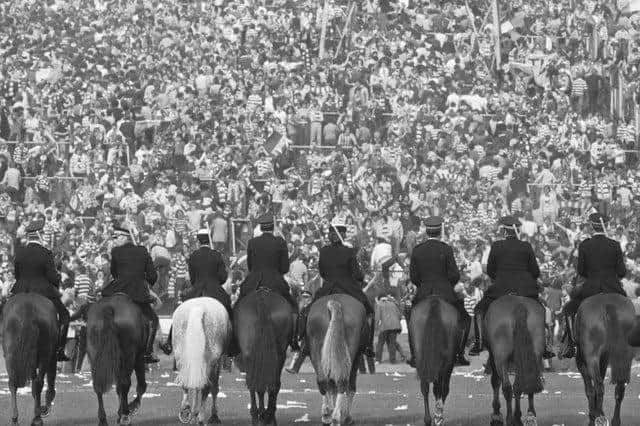
While there were criticisms of the policing operation and the barriers at Scotland’s national stadium, the cursed drink was singled out by George Younger, the then Scottish secretary, as the main contributing factor.
The ignominious events at Hampden that day led to more than 200 arrests and £20,000 fines for both clubs. The riot did not spark calls to ban alcohol at football matches - that was proposed under the McElhone Report three years earlier - but it undoubtedly expedited provisions under Criminal Justice (Scotland) Act, which eliminated the consumption of alcohol at grounds, including drink bought outside and brought into games.
‘The world has changed’
Supporters groups have consistently pointed to significant evolution in the matchday experience over the past four decades that ought to render the ban null and void. Modern stadia, for one thing, are largely unrecognisable from the dank, cramped terraces of the pre Taylor report era - some of the flashpoints in the 1980 final involved fans using rubble from Hampden’s crumbling infrastructure as missiles - with seating, improved safety measures, and CCTV in abundance in the game’s upper tiers.
But so too, the way in which fans engage with the game has changed, with families and children among a more diverse make-up, and supporters more generally less focused on the consumption of alcohol as part of their matchday experience. Dr Geoff Pearson, a law professor at the University of Manchester, who is regarded as one of the UK's leading experts on football-related disorder, told Scotland on Sunday that while the legislation brought in in the 1980s was probably needed at the time, the norms of fan behaviour had changed “radically” since then.
He said that the evidence of the effectiveness of alcohol restrictions in terms of reducing drunkenness and disorder around football was “mixed,” with some studies even suggesting that prohibitions could be counterproductive by encouraging binge drinking prior to games. “I think it is time to revisit the criminalisation of the consumption of alcohol in stadia, and investigating different ways of permitting alcohol consumption at matches, without increasing risks to public order or safety, seems a sensible move,” he said.

It is clear that a growing groundswell of fans also want change. Research published this year by the Scottish Football Supporters Association (SFSA), which found that nearly three quarters of fans (74 per cent) agreed that, in principle, all fans should be able to buy alcohol at grounds during match days
Stuart Murphy, CEO of the SFSA, said the advent of the pilot was a “significant” step, and expressed hope that it would ultimately lead to more fans being allowed to have a drink at stadiums when cheering on their teams. “It’s looked unlikely for a long time, and in all the conversations I’ve had with the Scottish Government, they’ve been really reluctant to go down this road, but I think we’re long overdue to give this a go,” he said. “It is pretty unfair that Scottish football fans are treated differently to fans of other sports, and the world has changed.”
Money, undoubtedly, is also a factor in the latest alcohol sales push, with a growing number of clubs looking to new revenue streams in order to make ends meet, let alone turn a profit. Indeed, several of the sides involved in the pilot reported losses in their most recent annual accounts. Alcohol sales would never come close to rivalling other valuable income sources, such as SPFL payments, especially when costs such as mitigation measures and infrastructural improvements are factored in, but every little would help.
Public health concerns remain
Many, however, will ask at what cost? Ms Mahon said the amount of drink that will be on offer to fans at the games - five pints - almost met the weekly low-risk alcohol limit, and described it as an “excessive” amount that raised serious concerns about responsible practice.
“Scotland is in the grip of an alcohol crisis, with deaths at a 15-year high and alcohol consumption 50 per cent above the chief medical officer’s low-risk guidelines,” she insisted. “This is not the moment to start chipping away the protective measures we have in place. Even without alcohol in stadiums we still see violent disorder during or immediately after football matches in Scotland, as well as spikes in domestic violence. Increasing the availability of alcohol would only add fuel to those fires.”
“Meanwhile, allowing alcohol sales inside grounds would further entrench the role of alcohol sponsors in football. It would turbocharge already extensive marketing exposure - from shirts and hoardings to social media campaigns, product endorsements and competition tie-ins.”
She called on the Scottish Government to “hold the line,” and said the existing legislation should not be removed without robust and independent advice, adding: “Anything less puts public health second to profit.”
For its part, the government appears to agree. The sports minister, Maree Todd, has said the government’s position has not changed, noting that it is for local licensing authorities and Police Scotland to “satisfy themselves that the pilot projects are permissible.”
Warning of increased risk
In any case, some evidence suggests that those in favour of a wholesale end to the alcohol ban at football face an uphill battle. As part of research funded - with no concession to irony - by the Scottish Football Association (SFA), Dr Purves recently scrutinised the potential impact of permitting alcohol to be on general sale at football games. He found that any such step would bring about increased risks in relation to fan safety and public disorder - although the level of that risk, he pointed out, would be ”greatly dependent” on the individual match, and factors such as crowd size and the time of kick off.
He said the majority view among stakeholders interviewed for his study was that “either Scottish football is ready for alcohol to be available at matches or it isn't,” but said that regardless of which side of the argument people favoured, there were logistical issues to address if sales were to become more commonplace.
For example, while proponents of alcohol sales at games argue it could encourage fans to arrive at games earlier and improve safety around stadium entrances, Dr Purves said it was hard to predict how effective such a move would be, with many supporters having established matchday routines. He also pointed to logistical problems with many stadiums not designed to hold large crowds in concourse areas for long periods. “There often isn't enough space, seating, or tables - just a few narrow shelves around the edge,” he said. “If fans are required to stay in these cramped areas while drinking, it could affect both safety and comfort.”
He told Scotland on Sunday it was not entirely clear what the goals of the pilot scheme were, but said that it is designed to test the impact of increased alcohol availability, it must be set up in a way that allows for “proper evaluation.”
“Any evaluation should look at outcomes that could be influenced by greater access to alcohol, things like fan violence or disorder, police incidents, how much alcohol people are actually drinking, and hospital or emergency room visits,” he reasoned. “Just as important is who runs the pilot and the research behind it.”
Comments
Want to join the conversation? Please or to comment on this article.