
John Swinney accused of 'absurd' defence as ministerial code breach claims intensify

Charity accuses Scotland’s First Minister of ‘cynical’ reply to applications
The Scottish Government is facing calls for a full investigation into dozens of complaints concerning breaches of the ministerial code around its handling of controversial plans for a new fossil fuel power station, with First Minister John Swinney accused of launching a “cynical” and “absurd” defence of senior government figures in their dealings with developers.
Mr Swinney’s administration has received formal notice from a leading environmental charity demanding a full investigation into dozens of alleged breaches of the code relating to a new gas-fired power station in Aberdeenshire, a development that critics warn will further hinder efforts to meet nationwide climate and emission reduction targets.
In correspondence sent to Friends of the Earth Scotland (FoES), Mr Swinney rejected the charity’s claims that current and former ministers had breached the code. However, FoES has now escalated the issue, stating that it remains unsatisfied as to whether the government has adhered to “both the spirit and letter” of the code. It described Mr Swinney’s response as one characterised by “inconsistencies” and “weak excuses,” with “no evidence to support its claims.”
The Scotsman revealed in July how FoES initially complained to Mr Swinney’s administration, alleging a “deeply troubling pattern of behaviour” over the way ministers have dealt with SSE and Equinor’s power plant proposal, which remains under consideration. The charity claims ministers were briefed by civil servants to offer their support for the development, and said there were over a dozen meetings between ministers and developers where government records were either missing or not available.
A key element of the original complaint by FoES was a meeting that took place in September 2023 between two senior executives at SSE and Gillian Martin, the-then energy minister, who is the acting Cabinet secretary for net zero and energy. SSE submitted brief details of the meeting to the Scottish lobbying register. The Scottish Government said it had “no records” of the engagement.
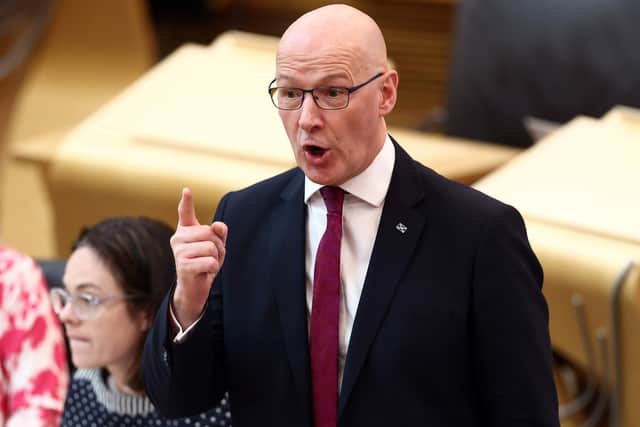

In a letter to Florence Garabedian, the interim CEO of FoES, Mr Swinney rejected claims that the meeting constituted a breach of the code, and claimed that Ms Martin’s meeting was one of a dozen such engagements that were “clearly stated” to have taken place in “either a party political or constituency capacity.” He added that it was not a requirement to record such meetings “unless the discussion turned to official business.”
However, FoE Scotland said Mr Swinney’s response “ignores the substance” of its complaint, pointing out that the lack of record keeping by ministers, irrespective of what capacity they later asserted they were acting under, undermines trust in the decision making process for the application. It has reiterated to Mr Swinney that it is “particularly concerned” about the meeting between Ms Martin and SSE, given that the energy minister was responsible for the decision in the section 36 process.
In his correspondence to Ms Garabedian, Mr Swinney also claimed there was “no evidence” of former first minister Humza Yousaf having offered public or private support for the Peterhead application, or having made any statement on its merits. Mr Yousaf visited the existing Peterhead gas power station in July 2023, taking part in a promotional video for SSE and stating he was “really impressed” with the site’s future plans.
But FoES said Mr Swinney had failed to “adequately address concerns” over Mr Yousaf’s visit, arguing that any reasonable person would have interpreted Mr Yousaf’s remarks as being in breach of the code.
In his rejection of the charity’s complaints, Mr Swinney also said that a quote provided by the then Cabinet secretary for energy, Michael Matheson, in a May 2022 press release by SSE did “not speak directly to the application” for the power plant, adding that because he was not the planning minister, he would have had the “primary decision making role” in respect of any recommendation for the application.
Those claims, too, have been roundly dismissed by FoES, who pointed out that Mr Matheson’s quote began: “The innovative Peterhead CCGT Power Station is a fantastic example of how Scotland's energy sector can make the transition to net zero.” The charity said it contested the notion that Mr Matheson’s statement did not support the planning application, and “cannot conceive how it could be read otherwise.”

Imogen Dow, head of campaigns at FoES, said: “This is a deeply cynical attempt by the Scottish Government to judge itself clear of repeated and substantial breaches of the ministerial code in relation to the handling of a planning application for new fossil fuel burning at Peterhead. This defensive response, which has literally been signed off by the First Minister, is full of inconsistencies, weak excuses and provides no new evidence to support its claims.
“At times this response borders on the absurd. We are expected to believe that ministers aren’t always ministers, that civil servant briefings don’t influence the reader, and when ministers appear in promotional videos for a private company or are quoted in fawning press releases that they aren’t expressing an opinion about the project. This complaint must be escalated because the public must be reassured that this planning application is being assessed fairly.”
A Scottish Government spokesman said: “Any claim ministers have come to a conclusion on the application for a new power station at Peterhead is false. A decision on the application will be taken in due course, following consideration of the application, consultation responses and public representations.
“Claims of breaches of the ministerial code are equally false. It is untrue to claim the code requires a minute to be taken of a Minister presenting an award at an awards ceremony, or that being sent factual briefing on the project represents a breach of the code.
“As a result, after careful consideration of the points made by Friends of the Earth Scotland, it was concluded that ministers had not acted in breach of the Scottish ministerial code. We will consider this further letter and respond in due course.”
Comments
Want to join the conversation? Please or to comment on this article.