
Mountain lovers called to help save 250 miles of path through Scotland’s treasured peaks
A major campaign is underway to protect Scotland’s mountains for future generations.
With mountains comes freedom - but someone, ultimately, has to pay for the pleasure.
Now, a major fundraising campaign is underway to protect the invaluable network of paths across some of Scotland’s most beloved peaks.
A rise in hill goers prompted by lockdown and the increasing intensity of Scotland’s weather means that critical work is required to protect the mountain landscape from erosion and footfall.
The Outdoor Access Trust for Scotland [OATS] estimates it will cost £30 million to repair and maintain around 250 miles of mountain path in the worst condition. The organisation’s ‘It’s Up to Us’ campaign, which is being run in conjunction with Mountaineering Scotland, is responding to a huge funding gap for such work.


The Scottish Government has extremely limited funds earmarked for paths on land in the country’s two national parks or via organisations such as the John Muir Trust or National Trust for Scotland.
But no public money is now available for paths on private land, which covers around 83 per cent of Scotland, with Europe, before Brexit, a key funder in this area.
OATS has just completed the restoration of almost two miles of path on An Teallach above Loch Broom in Wester Ross, on the privately owned Eilean Darach estate, which is primarily used for hunting.

It was a job completed over three months a year across three years, using a mixture of its own money - often raised through car parks at key outdoor sites - charitable money and donations from a small and often generous section of the mountaineering community.
Now, the challenge is on to get the wider hill going public aware of their impact on the hills - and the cost of protecting the landscape and habitats through a strong path network.
READ MORE: The easiest Munros to conquer in 2025
Dougie Baird, chief executive of OATS, said: “To be honest, if everybody who did a Munro on Saturday or Sunday gave a pound, we wouldn’t need any money from the government.
“What we find is that there is a small subset of people who get it and they give generously and some might give regularly, but it is a very small number. We are trying to get the message when it comes to path repairs that ‘the council is not going to come and do this, forestry is not going to come and do this’. It is us or it is nobody.
“That is what we are trying to get into people’s psyche.
“When we build a path, we are making it out of natural products, rocks, gravel, dirt and vegetation. So it is probably not that obvious that it has been worked. I don’t think most folk think about it, to be honest.”
It is estimated that walking tourism in Scotland generates an estimated £1.6 billion a year for the economy, with the health benefits - both physically and mentally - unrivalled for those who find their way in the mountains.
Mr Baird said: “We are trying to raise awareness and tell the government ‘this is important work’ and it is a really good investment that would give you a really good return.
“At the same time saying to the public, please just give a wee bit back to the hill - it makes a massive difference.”
READ MORE: Scottish mountain legend the ‘Glencoe Fox’ leaves entire fortune to the future of the hills
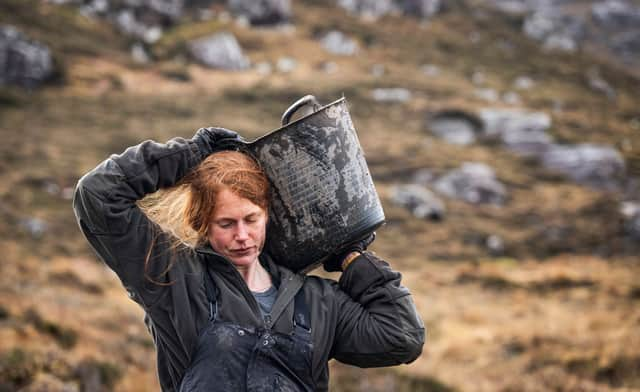
Mr Baird described An Teallach as an “iconic mountain” where “old school” conservation skills were deployed to reinforce the path, with boulders taken from the hill and moved into place and gravel laid with a shovel. A helicopter dropped materials off to complete a small stretch of path where no boulders could be found nearby.
Mr Baird said private landowners, while not trying to impede path maintenance work, did not generally support it financially.
He said: “An Teallach is an iconic mountain. Most folk who are into their Munro bagging in Scotland would have that in their top five. It is an amazing mountain with two Munros and a narrow ridge between them, which is probably a Grade I ice route in winter. It is a fantastic mountain.
“It is on private ground, so there is not a single tax dollar for this mountain, not one. Nothing from NatureScot, nothing from the council. It is not in a national park, there is no more European money.
“In so doing, we are trying to make the case to the government that there has been a lot of money lost through Brexit that has not been replaced. We have lost Europe and that is a massive issue for us - that is money that could have been used on private ground.
“And the view from the Scottish Government is that is not a high enough priority.”

Mr Baird said Scotland was particularly susceptible to erosion on its mountain routes given the cold and wet weather conditions, stunted vegetation and weak soils.
“It doesn’t take too many pairs of feet to wear that vegetation away,” he added, with rain filling holes, which then become ditches.
“You compare this to somewhere like the Alps and central Europe where you have trees to a much higher extent and much less rainfall and you have those tree roots holding the vegetation and soils together. Those mountains can carry an awful lot more.

“If you look at places that have this problem, it is Scotland, the Lake District and now Ireland as well. If you imagine sticking a needle right through the planet and it came out the other end, you would find Tasmania having similar problems.
“A couple of hundred people a year can wreck a pathway. They do a lot of trail work, but their government funds it, which is very different to what we have here.”
NatureScot was contacted for comment.
Anyone can donate to the It’s Up To Us campaign here.
Comments
Want to join the conversation? Please or to comment on this article.