
Scottish hillwalkers urged to bag a meteorite on Munros in once-in-a-century opportunity

Scientists say discovery could help understanding of solar system’s history
For those who regard the challenge of scaling Scotland’s greatest peaks as an out of this world experience, it is a unique opportunity.
Hillwalkers setting out to bag a Munro in the coming weeks are being asked to help scientists by recovering previous samples of a meteorite which lit up the skies over Scotland earlier this summer.
Spectacular footage and images of the streaking fireball meteor went viral in July as it entered the Earth’s atmosphere, before breaking up.


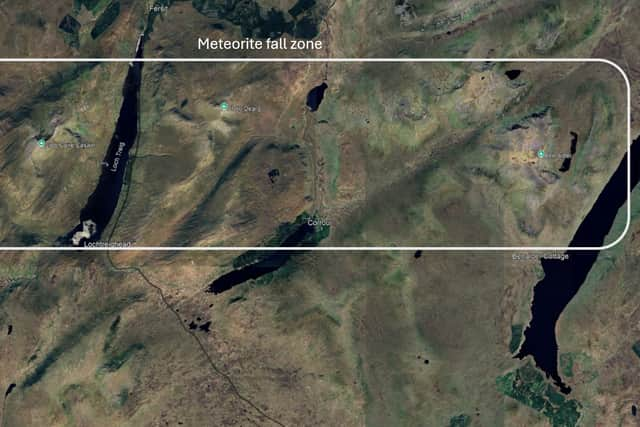
An analysis by experts at the UK Fireball Alliance suggests that fragments of the rock may be scattered across swathes of the Highlands, with larger chunks falling over the plateau of Ben Alder and smaller pieces dropping over Stob Coire, Easain, and Chno Dearg.
Now, the researchers are appealing for the public’s help to find parts of the space rock. Even if just one piece is found, it would mark the first time in more than a century that a meteorite has been successfully recovered in Scotland.
Professor Luke Daly, a reader in planetary geoscience at the University of Glasgow’s school of geographical and earth sciences, said: “Meteorites are time capsules of the early solar system, which hold a wealth of information about how our solar system formed and developed.
“This is a very exciting opportunity to learn more about where this rock came from and where it has been and fill in a bit more of the jigsaw of our solar system’s history.”
Prof Daly, who led the team which recovered the largest intact fragment of the Winchcombe meteorite in 2021, the first of its kind to be retrieved on UK soil in nearly 30 years, added: “We know from intensive analysis of the Winchcombe samples that meteorites are very quickly affected by contact with the Earth’s atmosphere.
“The longer these pieces sit out on the Scottish hills, the more they will be weathered and the less we’ll be able to tell about their composition. The clock is very much ticking on our chances to learn as much as we can from these rocks, so any help that hillwalkers can give us could make all the difference.”
The team has advised those searching for the rock that the meteorites are black and shiny, with an almost glassy appearance. Since they could be composed of around 30 per cent iron, they may also look slightly rusty in the wake of the recent rainfall across the north of the country. The analysis of the meteor’s fall line indicates that the majority of the mass landed on the top of Ben Alder, where exposed granite could make the dark space rock more visible.
The UK Fireball Alliance is a collaboration of camera networks which monitors and tracks meteorites as they enter Britain’s airspace. Its volunteers used footage drawn from 14 different cameras to reconstruct the meteorite’s path and how it fragmented as it fell.
Jamie Shepherd from the UK Meteor Network said: “I've had a life-long fascination with meteors and meteorites. The next one to be found will be history-making and it's very special to be part of the recovery team.”
Comments
Want to join the conversation? Please or to comment on this article.