
Readers' letters: Lower the voting age, but make sure all votes count
Readers have differing opinions over Labour’s changes to electoral law, such as reducing the voting age to 16
The Westminster Parliament is slowly, but steadily, catching up with parliaments in the rest of the UK, by extending the vote to 16-year-olds at the next general election. It is long overdue.
Surely 16-year-olds, who are allowed to marry, enter parenthood and fight for their country, among other things, should be offered a vote.
The second stage in this process is to ensure that their vote counts. The rest of the UK can show the way.
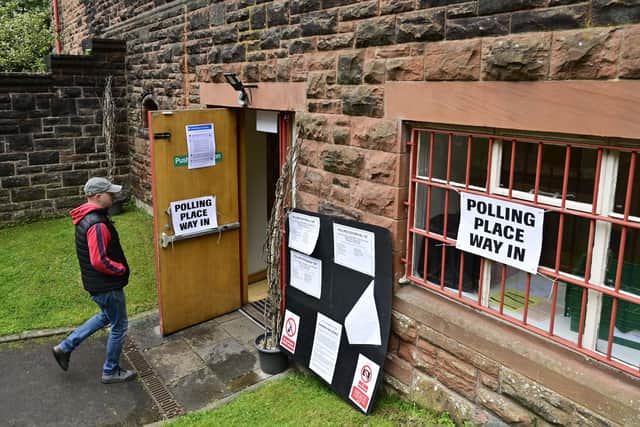

The first-past-the-post system, with which the Westminster parliament is still lumbered, infamously presented Labour with a landslide majority in last year's election, with a mere 34 per cent of the vote. Significantly, it offers Nigel Farage’s Reform UK a majority with as low as 28 per cent of the vote.
Both the Scottish and Welsh parliaments have adopted, successfully, a form of proportional representation, ensuring that our votes really matter. Surely it’s well past the time for the Westminster parliament to catch up and offer reform, if certainly not, Reform.
Ian Petrie, Edinburgh
Voting system
The Labour government is making some changes to election law, but the really serious one, the voting system, remains unchanged. First-past-the-post only works well with two parties in contention, but we are well beyond this in both the UK and Scotland.
We need not turn to proportional representation (with its resultant problems); an alternative majoritarian system can be used, and it would be fairer than the one on offer, which recently produced a government on one-third of the votes giving two-thirds of the seats.
William Ballantine, Bo’ness, West Lothian
‘Seismic’ reform
The UK government’s press release of 17 July on giving 16-year-olds the right to vote says this will be part of “seismic changes to modernise UK democracy”. It includes the phrase “UK democracy” 11 times, but ignores the fact that because of the unelected House of Lords, the UK is not, never has been, and never can be, a full democracy. The House of Lords’ website states that it emerged in the 14th century in England.
The press release also says “the government will bring the UK’s democracy into the 21st century”. But the Labour party said in the last century, in 1910, that “the Lords must go”. Achieving that would be “seismic change”.
E Campbell, Newton Mearns, East Renfrewshire
Social breakdown
Reading and seeing the latest news in The Scotsman and elsewhere, there is no doubt in my mind that the overly-liberal approach towards society that has been progressed over the last 20 years, has most definitely resulted in social breakdown.
In an era when our youngsters are routinely influenced by social media, why are we giving 16-year-olds with so little actual life experience the right to vote in the election of our govennment? These same children are not allowed to purchase or consume alcohol at the age of 16, among other restrictions applicable.
The story is that it is their democratic right to be treated “equally” to the rest of the population. If that’s so, then why not extend this farce to 12-year-olds and upwards?
True democracy occurs in a disciplined society, but we are seeing constant “protest” parades on our streets. In a truly democratic and peace-loving country, people who have a problem with government policy or action should be “protesting” through the office of their relevant MP or MSP.
No wonder our police service is in such disarray trying to deal with these street protesters who achieve nothing other than boosting their own self-importance.
All in all, our country is in an uncontrolled mess.
Derek Farmer, Anstruther, Fife
Cabal’s successes
There is surely little point in David Millar (Letters, 17 July) asking other correspondents to provide examples of what the Scottish Government “cabal” (as he puts it) has done well if he simply disregards whatever they come up with.
I pointed out a week or so ago that in terms of levels of poverty (surely one of the key measures of any government) Scotland had been lower than England and Wales for about 20 years but Mr Millar seems unwilling to accept even hard facts if they do not fit his Scottish Government bad narrative. Anyway, a few “achievements” that come to mind are:
Free tuition; free prescriptions; the Scottish Child Payment; free bus travel for almost two million people in Scotland; free school lunches for all primary 1-5 pupils; highest number of GPs per person in the UK; best performing core A&E services in the UK; free NHS dental care for under-26s; Scotland was the first country in the world to make sanitary products available free of charge to those who need them; Scotland has more police officers per head than England and Wales; free eye tests.
I could go on, but will Mr Millar read this far?
Alan Woodcock, Dundee
Forsyth saga
Joyce McMillan (“Starmer is wedded to Thatcher's flawed, reactionary ideology”, 18 July) classifies Michael Forsyth as a reactionary proto-Thatcherite deregulator.
Despite regarding myself as left-leaning ever since the days of Attlee, I feel obliged to write in his defence. In 1996, when Secretary of State, he appointed me to chair an expert group to learn lessons from the lethal E.coli O157 outbreak in central Scotland and make recommendations. He accepted them in full and became an arch regulator, even though the food safety regime we proposed was going to cost Scottish butchers many thousands of pounds for equipment alone.
And on a separate note, Joyce’s opinion that neoliberalism regards a rule-based international order with contempt, but this doesn’t obtain much in food safety. The system that Forsyth drove forwards was HACCP-hazard analysis and critical control points – developed by Nasa to stop astronauts getting diarrhoea in space and now universally employed worldwide. When I worked for the UN World Food Program we made its application mandatory for all donated foods.
Maybe Joyce will have reservations about it because the partners who collaborated with Nasa to develop it were a commercial food company and the US army.
Hugh Pennington, Aberdeen
Personal ideology
I look forward to reading articles by Joyce McMillan in The Scotsman, mainly because I have to reach for the dictionary to understand some of the phraseology and the context they bring to the article.
Examples from yesterday’s article had me reaching for enlightenment several times. For example, “neoliberalism” and “reactionary” leapt out, “progressive” and “green-democratic revolution” had me puzzled. “Far right” who are at the root of all evil in this country apparently, I understand – except when used in the context of the Reform party who appear to be just another populist, spend party!
Be that as it may, to understand the article we have to realise that “neoliberalism” is apparently based on reducing government influence in the economy: ie low taxation, small government, personal self-reliance and responsibility. “Reactionary”, however, suggests a slightly different viewpoint, an opposition to change and associated with restoring values such as discipline, respect for authority and hierarchy
We have to understand that both of these words lead to bad outcomes whereas “progressive” and “green-democratic revolution” outcomes are good in that they generally lead to greater control by government, higher taxation all spent by a government that understands ordinary people’s needs, wants and desires, thus relieving us of any responsibilities except to accept what is good for us.
Please don’t think that I criticise as I enjoy reading Joyce McMillan, although I personally don’t agree with her far left, progressive slant being more of a neoliberal, and partly reactionary type of person.
A Lewis, Coylton, South Ayrshire
Cleaning up
Many thanks to Paul Dimarco whose letter (18 July) is timely and appropriate. I have often felt disgusted at the state of statues around Edinburgh.
Can our beloved council truly not afford the services of a dedicated statue washer, who might have a round of all memorials around Edinburgh and give them a regular wash?
Jenny Martin, Edinburgh
Cash cow
The UK Government abandons an energy zonal pricing plan that would have meant much cheaper energy prices in Scotland, where the energy comes from.
That would have been much fairer as it is our landscape blighted by the infrastructure. Our communities damaged and our tourism damaged. Our people’s health compromised and our wild Highlands plastered with concrete and steel.
The UK Government is never of a mind to work in favour of Scotland. Ed Miliband, after delaying the decision in a three-year consultation period on zonal pricing ignored the experts including Octopus Energy who have said in recent times that some areas in Scotland could have free energy.
The huge debt Westminster has now accumulated amounts to trillions. They expect the poorest in society and Scotland the cash cow to pay for it. Scotland is moving in a different direction from England, and we can't finance their incompetence any more.
Herbert Petrie, Dyce, Aberdeen
Write to The Scotsman
We welcome your thoughts – NO letters submitted elsewhere, please. Write to [email protected] including name, address and phone number – we won't print full details. Keep letters under 300 words, with no attachments, and avoid 'Letters to the Editor/Readers’ Letters' or similar in your subject line – be specific. If referring to an article, include date, page number and heading.
Comments
Want to join the conversation? Please or to comment on this article.