
Where now for the SNP and its independence strategy after election rejection

The SNP’s independence strategy lies in tatters after the Scottish public rejected its importance at the ballot box.
After an utterly disastrous night, the SNP’s independence strategy, already hanging by a thread, looks destined for the long grass.
The SNP’s general election could not have gone much worse – although the party narrowly clung onto some seats, including the once ultra-safe Dundee Central.
John Swinney is fortunate he has taken over leadership of the SNP so close to the election, giving the First Minister the chance to wash his hands of some responsibility for the disaster. But by no means entirely.
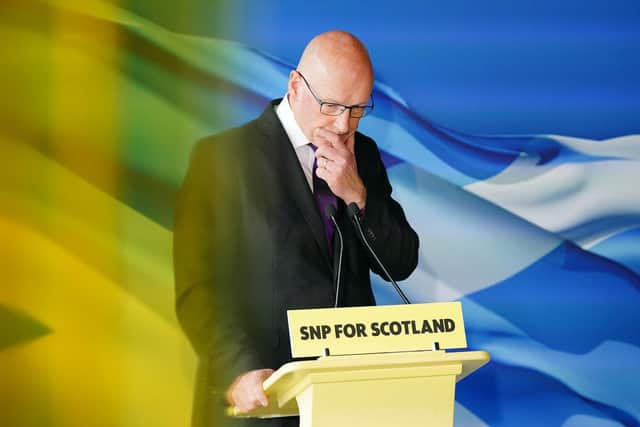


Mr Swinney has acknowledged his party’s independence strategy is a bit of a car crash and it needs a complete rethink.
After the dismal results, the SNP leader on Friday admitted his party needed “to take the time to consider and to reflect on how we deliver our commitment to independence”. But he was adamant that commitment “remains absolute”.
The language from Mr Swinney, who is almost always careful with his words, was blunt. “We need to get that approach correct in the forthcoming period”, he said – an acknowledgement the strategy has been flawed.
When he took charge of the SNP, Mr Swinney candidly admitted the party needed to rebuild trust with the public, given the mess he inherited.
But speaking on Friday, Mr Swinney openly admitted “the Scottish National Party needs to be healed and it needs to heal its relationship with the people of Scotland”.
As the SNP headed into the election, its independence strategy made little sense as a genuine prospect. Wary of losing its Scottish majority at Westminster, the party was trying to cling onto its apparent mandate for a second referendum from the 2021 Holyrood election with its fingernails. But in politics, it is crystal clear that you are only as good as your last election – as the SNP is finding out.
Even if the SNP had won every single Scottish seat, Labour leader Sir Keir Starmer had already ruled out any discussions about independence or a referendum, so the strategy was destined for failure.
The SNP made its vow to place its independence strategy on “page one, line one” of its manifesto, but spectacularly failed to capture the public mood in Scotland about the decade-long squabble over the constitution.
If we want a flavour of the Scottish public’s appetite for independence, look no further than Alex Salmond’s Alba party who outdid the SNP in enduring a humiliating election performance. Mr Salmond’s party, claiming it can one day replace the SNP as the serious voice of independence, won less than 12,000 votes in total across the 19 seats it contested, losing its deposit in all of them.
Similarly, the Tories have been hit, in part, by placing such importance on the constitution when it is clear the majority of Scots want to talk about different things. Labour had read the room, helped by largely staying out of the independence tussle that has done the party no favours in the past.
Going forward, the SNP has limited options in rethinking its independence strategy. That task is made even harder when returning just a handful of MPs to Westminster and waving goodbye to its prominent two questions at PMQs.
Mr Swinney is trapped between a rock and a hard place. The public will not accept repeated attempts to push independence in the same manner, particularly after such a terrible set of election results. But the SNP will come under immense pressure from activists who are still crying out for a realistic route for independence, many of whom will be extremely frustrated.
Former SNP Westminster leader Ian Blackford, who decided not to seek re-election, set out a home truth for his party colleagues when he warned “to some extent people have fallen out of love with us and we must ask why".
He also suggested the SNP had been out of kilter with the Scottish public over its insistence at making independence the key part of its election campaign.
Mr Blackford acknowledged that although almost 50 per cent of Scots support independence, “perhaps it hasn’t been their number one priority”.
The SNP now faces the prospect of a frantic and toxic party conference, where Mr Swinney will have pressure piled on him to come up with some sort of blueprint that restores faith he can deliver independence.
The 2026 Holyrood election will be the next chance for the SNP to attempt some sort of recovery, and given it will have been in power for around 19 years and Labour is already trying to start that election campaign, things are going to be tough.
The selection contests for those Holyrood seats have the potential to be nasty, too. Prominent voices like Joanna Cherry, who dramatically lost her seat, will want a route back to frontline politics. Ms Cherry had a previous attempt at moving to Holyrood ended after a sustained campaign by SNP constitution secretary Angus Robertson. Ms Cherry, and maybe others now evicted from Westminster, will feel they have nothing to lose in pushing for a chance at the Scottish Parliament in two years.
Nicola Sturgeon has insisted the SNP is not “dead and buried” ahead of that crucial 2026 election and she is correct. Labour will find things difficult two years into a UK government that might be slow in displaying obvious and tangible change. But more pressure will be on the SNP.
Mr Swinney’s next move on independence could be crucial. The obvious avenues to delivering independence are pretty much closed off. It will take some doing to convince his activists and, vitally, the Scottish public that not only he can deliver independence, but that there is a need to.
Comments
Want to join the conversation? Please or to comment on this article.