
The movement to bring public diners - and good, cheap, nutritious meals - back to Scotland

Campaigners say public diners should become commonplace across Scotland.
Back in the mid-20th century, Scots up and down the country were able to enjoy cheap, nutritious meals at subsidised civic restaurants.
Almost 100 of these government-supported public diners operated in Scotland up until the 1960s, and this year a trial diner will open in Dundee.
There are obvious financial benefits here for people struggling with the cost-of-living crisis - but those campaigning to see the idea of public diners brought back to life say there are other benefits too, such as ensuring people are eating nutritious food, tackling loneliness and making sure those who are time-poor are still able to get a good meal.
Public diners were created in the wake of the Second World War by Winston Churchill to ensure ordinary people could enjoy a balanced meal, while simultaneously boosting morale.
Now, it is hoped reviving this idea will help improve Scotland’s relationship with food.
Next week, Paul Sweeney, Labour MSP for Glasgow, will be sponsoring an exhibition in parliament by Nourish Scotland to try and convince other MSPs of the idea.
“For me it comes back to my experience during the pandemic,” Mr Sweeney told Scotland on Sunday. “During the first lockdown I spent a lot of time delivering prepared meals to vulnerable people and that raised my awareness of how food plays a critical role in health and wellbeing.
“It is not even a financial issue.
“Physical ability, mental health issues and stress can keep people from good nutrition.
“Preparing meals can be overwhelming for people if they are elderly, have childcare, there’s work pressures or they are working from home.
“All kinds of things can affect how well you are eating.”
So the idea is about more than just making good food - it is also about creating spaces that are social and allow people to experience the communal dining they might not be able to get at home.
Mr Sweeney said: “A lot of people are moving towards a more co-living model if they are young professionals.


“We have purpose-built student accommodation and Glasgow has just approved its first co-living development with shared dining and kitchen.
“People are moving towards a different model than the traditional semi-detached suburban dream with shared facilities, so there is an opportunity here around cooking, dining and eating together.
“Single people can also struggle with food waste, and communal dining spaces can control that. Those with eating disorders can be supported as well as that sort of dining experience could mean they find the stress of dealing with food less onerous.
“Other cultures have normalised communal dining and that is something we can look at.
“We have had a very industrialised food system for a long time and that is different to how other cultures approach food.”
Under Churchill’s watch, the British Restaurant chain was set up to offer the British public affordable, healthy meals.
It boasted around 2,000 outlets in its heyday - more than McDonalds has now.
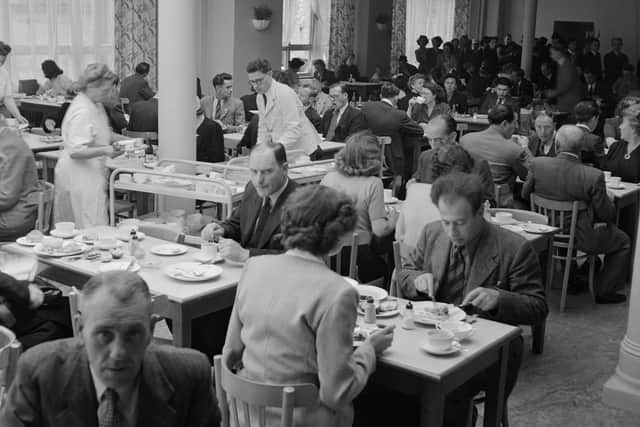
The British Restaurant was initially known within the UK Government as “communal feeding centres”, however the chain was rebranded after Mr Churchill who wrote to the Minister of Food, Lord Woolton warning that the term was “suggestive of Communism”.
He said: “I hope the term “Communal Feeding Centres” is not going to be adopted. It is an odious expression suggestive of Communism and the workhouse. I suggest you call them “British Restaurants”. Everybody associates the word restaurant with a good meal.”
Similar models can be found in other countries, such as Turkish public restaurants, Mexican public dinning rooms or Polish milk bars.
Food policy charity Nourish Scotland says public diners are a “good public health investment”, given that diet is a leading cause of preventable illness. They also support equality by giving everyone the chance to enjoy good quality food in a social setting. The view is that public diners are for everyone.
Nourish Scotland is working on a three-year research project in collaboration with Institute of Development Studies and the University of Nottingham to explore the role public diners can play in reducing health inequalities.
The work will include running two test sites – in Dundee and in Nottingham – to fully understand the operational aspects and the impact these restaurants can have on the city and wellbeing of people who live, work and study there.
Nourish Scotland is hoping the upcoming trial restaurant in Dundee will prove a success, and will lead to civic dining becoming a normal feature of Scottish life. It has drawn on models across the word - from Poland to Brazil - to create the best possible place for the city. The diner is expected to open in summer this year.
A spokeswoman said: “Public diners aren’t charity nor luxury - they are everyday eating places.
“On a high street and open all week, they are convenient places to eat solo, with friends or with family.”

She added: “Public diners are a holistic food system intervention for public health, climate and the right to food.
“They could form an important part of our social infrastructure, alongside public libraries, leisure centres and schools. They could become a valuable part of community life, creating valuable third spaces.
“They have the potential to contribute to many of the policy objectives including 20-minute neighbourhoods, ending the need for food banks, local food growing strategy, community empowerment, the Good Food Nation ambition, and healthy diets.
“They are firmly in line with the human rights centred approach which the government wants to progress.”
Comments
Want to join the conversation? Please or to comment on this article.