
John Swinney vows to leave 'no stone unturned' amid fears over Trump tariffs

First Minister John Swinney said tariffs would be damaging for economic activity
John Swinney has pledged to leave “no stone unturned” to protect Scottish businesses following tariffs imposed by US president Donald Trump.
The First Minister said the move would be damaging for economic activity in Scotland and around the world.
However, he confirmed he had not scheduled any meetings with US government officials while in New York for Tartan Week from Friday, sparking criticism from opponents.
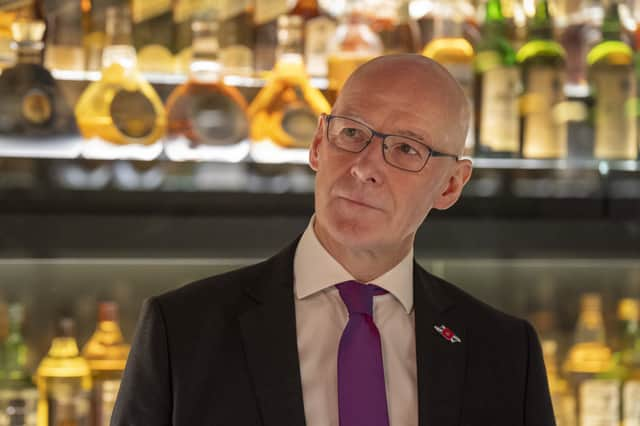

Mr Swinney said international trade is reserved to the UK government, and he did not want to “get in the road of those negotiations”.
He said: “It’s their responsibility. They’ve got to fix it. What I can do is I can use my time to attract investment directly into Scotland and that’s what I’m going to do.”
Scottish Liberal Democrat leader Alex Cole-Hamilton said: “In the middle of a trade crisis, taxpayer-funded flights and overseas government missions should be being used to deliver for those Scottish businesses under threat for tariffs. Instead it seems like John is on a jolly.”
The Scotch Whisky Association has estimated the 10 per cent tariff imposed by Mr Trump could result in between £200 million and £400m worth of export losses annually.
Speaking at First Minister’s Questions in Holyrood, Mr Swinney said: “We will leave no stone unturned in promoting and protecting Scottish business, and in finding a way through these challenges. But we all have to be aware that there will be negative implications based on what we heard [on Wednesday].”
A spokesman for the First Minister told journalists there had been no attempts to meet with anyone in the Trump administration while Mr Swinney is in America.
“I don’t believe any meeting was sought, no,” he said. “The focus of his visit to the US in the coming days is around Tartan Week, so he’s going to be in New York promoting Scotland as a place to do business, promoting Scottish culture.”
Scottish Conservative leader Russell Findlay raised the issue of tariffs at First Minister’s Questions, saying the move will put jobs at risk.
Exports from Scotland to the US are worth some £4 billion a year, Mr Findlay noted, claiming Mr Trump’s tariffs will “cause significant harm to many of our industries including food and drink, textiles, engineering, and pharmaceuticals”.
Mr Swinney said the imposition of tariffs “is not good news”, adding: “It will be damaging for economic activity, not just in Scotland and the United Kingdom, but across the world, and there will also be negative implications for the population of the United States.”
He said he would be engaging with Scotch Whisky Association when he is in the US.
He added: “I can assure Mr Findlay that this Government will leave no stone unturned in ensuring that we take forward the concerns of the industry, working with the UK government and the industry, to protect the prospects of an industry that contributes very significantly to the economic wellbeing of Scotland.”
Mr Swinney later told journalists he was not confident the UK government would be able to secure a deal with the US that protects Scottish industry.
“Am I confident the UK government can secure a deal from the United States?” he said. “No, I’m not.”
Deputy First Minister Kate Forbes earlier urged the UK government to leave no stone unturned in its efforts to secure a trade deal with America.
The Scotch Whisky Association said it was “disappointed that Scotch whisky could be impacted by these tariffs”.
William Wemyss, the founder and chairman of Wemyss Family Spirits, which has the Kingsbarns Distillery near St Andrews, Darnley’s Gin and Wemyss Malts among its brands, said 10 per cent tariffs would be a “damaging setback for our industry”.
He said: “As a small, family-owned Scotch whisky business, we rely on stable, tariff-free trade to grow, invest and bring our products to whisky lovers across the Atlantic. The US is our single largest export market, and demand remains strong, but tariffs inject real uncertainty, particularly for independent producers like us.”
Comments
Want to join the conversation? Please or to comment on this article.