
Swinney put under pressure over health during first TV leaders' debate

The six Holyrood party leaders clashed over health, energy bills and immigration
John Swinney came under pressure over NHS waiting times during the first TV leaders’ debate of the Holyrood election campaign.
The First Minister was told to “take some responsibility for once” by Scottish Labour leader Anas Sarwar as the pair clashed over health.
It came as the leaders of the six Holyrood parties - the SNP, Labour, Reform UK, the Conservatives, the Liberal Democrats and the Greens - also crossed swords over issues such as energy, the cost of living, immigration and independence during a BBC Debate Night special.
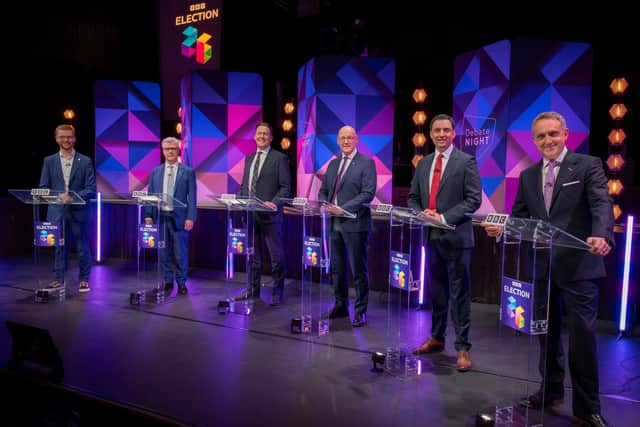

Mr Swinney was challenged by an audience member who accused the SNP of creating a “two-tier” health system, citing someone they knew who had waited more than two and a half years for an audiology test and was “driven towards paying £1,800” to go private.
The First Minister accepted there are people who have “waited too long for treatment”, adding: “When I became First Minister, I pledged to get long waits down and that is exactly what is happening.”
He said long waits had reduced for “nine months in a row”, with more operations being performed in the NHS and the Scottish government increasing the number of GPs.
Mr Sarwar asked Mr Swinney if he knew how many people are on a two-year waiting list. The Scottish Labour leader said: “How many people in Scotland are waiting more than two years? Five thousand.
“In in England, 10 times the size, it’s 300. You’ve been in power for 20 years, take some responsibility for once. Why should they give you one more minute when that’s your record?”
A mental health nurse later criticised the party leaders for lacking concrete plans to help frontline staff.
Earlier, Mr Swinney and Mr Sarwar also clashed over energy and the cost of living.
The First Minister said Mr Sarwar “promised to deliver change” at the general election in 2024 “and fuel bills have gone up, so you cannot take a word seriously of what Anas Sarwar says”.
He also accused the UK Labour government of an “anti-Scottish” move by blocking Chinese firm Ming Yang from opening a wind turbine factory in Scotland.
“My concern is that Scotland’s renewable industry is being undermined by the actions of a Labour government that’s just turned its back on £1.5 billion worth of investment,” he said.
Mr Sarwar responded: “Are you honestly saying that, as First Minister of Scotland, you would ignore a national security briefing that says there’s a national security challenge coming from investment from China?”
Separately, an audience member raised the SNP’s failed pledge to create a state-owned energy company.
Elsewhere, the parties locked horns over immigration, with Mr Sarwar taking aim at Reform UK’s Scottish leader Malcolm Offord.
“Let’s not fall for the trap that Malcolm Offord wants you to fall into,” he said. “He wants to use migration not to make our country better, but to play a dog whistle and divide our country.”
Mr Sarwar said Reform spent tens of thousands of pounds “questioning my loyalty to my country”.
This was a reference to an ad campaign posted online ahead of a by-election in Hamilton last year, which said: “Anas Sarwar has said he will prioritise the Pakistani community.”
The Scottish Labour leader said: “My family came to this country in the 1940s. Scotland has seen his type before and rejected them, and I’ve got no doubt they’ll do the same again.”
Lord Offord said he was in favour of immigration for those coming to work, but he did not support those who are “jumping the queues” of public services “to the detriment of local people in our own communities”.
Scottish Green co-leader Ross Greer called him a “absolute chancer”.
“This is a failed Tory minister who gave the Tory Party £200,000 and then they gave him a seat in the House of Lords and ministerial office – I’m sure that was totally coincidental,” Mr Greer said.
“He was part of that failed Tory government, the former leader of Reform in Wales is currently doing a 10-year jail sentence for taking Russian bribes, they are not the answer to any of the challenges in Scotland.”
The Scottish Green leader added that “we don’t have enough immigration”.
Lord Offord said his party would “challenge the cosy consensus” in Holyrood.
He told the audience: “What do we stand for? Most? We stand for people who work. We stand for people go to work, do the right thing in their community, and feel that they get punished.”
On independence, Mr Sarwar was pushed on what would constitute a mandate for a second referendum. The SNP has said it will demand another vote if it secures an overall majority, but UK Health Secretary Wes Streeting ruled this out on Sunday.
“I think it’s fair to say for those that argue for independence, it’s for them to set out the route that they think it would take,” Mr Sarwar said. “My job is to try and persuade you that, right now, there is so much we have to do.
“Our country needs change right now – you have given John Swinney and the SNP 20 years… give me five and we’ll confront the big challenges this country faces.”
Mr Swinney said it was “perfectly conceivable” that a second referendum could happen by 2028.
Setting out his pitch, Scottish Liberal Democrat leader Alex Cole-Hamilton said people “are tired and frustrated and they’re right to be, and we think that Scotland deserves better than that”.
Scottish Tory leader Russell Findlay said Holyrood had failed to deliver for the people of Scotland.
Earlier, Ailsa Henderson, a professor of political science at Edinburgh University, said the evidence suggested the percentage of people turning out to cast their vote on May 7 could be in the "low to mid 50s".
That compares to 63.5 per cent in 2021, although this was the highest turnout in the history of devolution and could be partly attributed to the Covid pandemic.
In 2016, turnout was 55.6 per cent, and in 2011 it was 50.4 per cent. The lowest turnout was 49.4 per cent at the 2003 election.
"We need to be conscious of turnout, for example," Prof Henderson told BBC Scotland's Sunday Show. "We know that in a tight election turnout tends to go up, so we wouldn't necessarily expect this election to have higher turnout than in 2021.
"If we want to look at turnout, we ask people how likely they are to vote on a zero to 10 scale. And if we look at the people who are saying 10/10, I'm likely to vote, we're down around nine or 10 points on 2021.
"And all of that suggests that we could be looking at turnout that's in the low to mid 50s in this election, and that's important because different supporters are more likely to turn out in a low turnout election.
"Any party relying on older voters will probably be more secure in their vote share if it's a low turnout election.”
Comments
Want to join the conversation? Please or to comment on this article.