
Supreme Court sex definition will have huge impact and could revive SNP's gender reforms
The Supreme Court ruling is poised to have huge consequences politically and practically.

The Supreme Court clarifying the definition of a woman in the UK Equality Act is based on biological sex has thrown open the door to a whole world of political uncertainty and will likely lead to a string of changes to rules for organisations.
The full impact on the decision, particularly the real-life consequences for transgender people, are not yet known. But what is certain is we are heading for yet more political uncertainty.
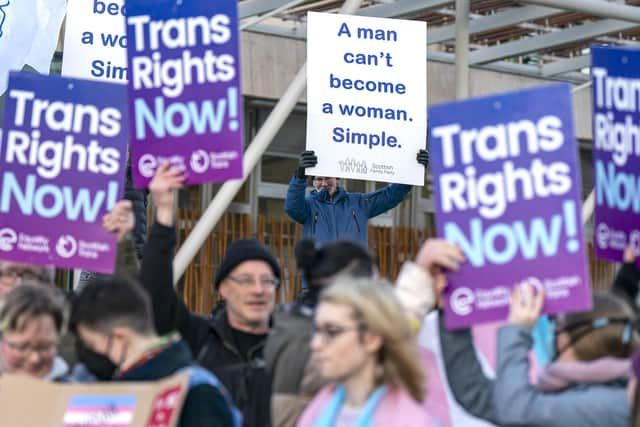

There had been speculation the ruling could even revive the Scottish Government’s gender recognition reforms (GRR) - although this has been denied by SNP ministers.
Judge Lord Hodge made clear that despite ruling that sex-based protections should only apply to people that are born female, trans people are still protected in law against discrimination due to gender identity or because of their perceived gender. A trans woman can still claim sex discrimination because she is perceived to be a woman.
He told the court the Supreme Court is counselling “against reading this judgement as a triumph of one or more groups in our society at the expense of another”, insisting “it is not”.

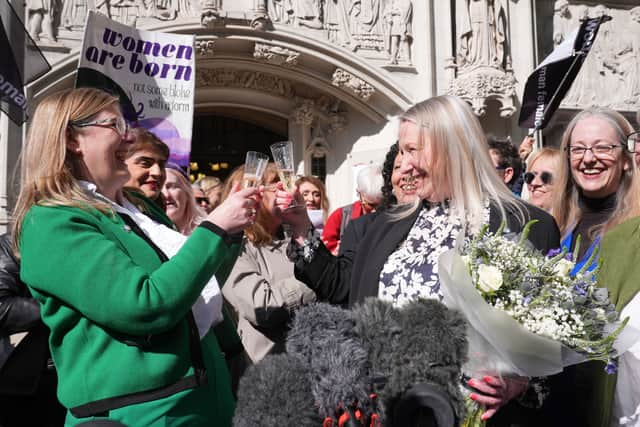
But that is not how For Women Scotland (FWS), the pressure group that took this case to the Supreme Court and won, having consistently battled against transgender rights, sees this.
Despite the judge’s warning, FWS popped champagne corks outside the Supreme Court. Meanwhile, the group’s political cheerleaders, the Scottish Conservatives, branded it “a victory for women and for common sense”.
For the Scottish Government, it will almost certainly need to redraw guidance in light of the judgement. The ruling will have consequences for the UK government too, given the clarification refers to two pieces of reserved legislation.
The Equality Act currently allows exclusions of trans people from single-sex spaces when appropriate to provide “a proportionate means of achieving a legitimate aim” such as privacy or to prevent trauma.
The UK government had previously suggested equalities legislation was due to be updated - so this judgement should, in theory, make that task clearer for Labour ministers.
Sir Keir Starmer’s government had already committed to reforming the Gender Recognition Act (GRA), which Scotland’s laws were to replace north of the Border. Given the Supreme Court judgement ruled on the relationship between the GRA and the Equality Act, it will impact that new legislation the Scottish Government had stressed it would adopt on a UK-wide basis.
For a marginalised group that has seen the level of targeted hate-incidents rise, the judgement will be concerning news. For trans people living in Scotland and across the UK, the judgement will be felt as another blow and another part of their rights and existence being eroded in law.
In February, the Scottish Government confirmed to The Scotsman that it had no plans to revive its gender recognition reforms, overwhelmingly backed by MSPs before being blocked by the previous Tory UK government over concerns the legislation meddled with UK-wide equalities laws.
During the long and technical debate over the gender recognition reforms, the Scottish Government argued, correctly, that you do not need a gender recognition certificate to enter single-sex spaces such as toilets - despite a wave of misinformation by opponents. The impact of a gender recognition certificate was not poised to be altered by the Scottish Government’s plans to streamline the method for obtaining the paperwork - but this ruling may do so.
This Supreme Court judgement will likely lead to single-sex spaces guidance being updated by the Scottish Government and for public and third-sector organisations. The Equality and Human Rights Commission (EHRC), which has informed the Scottish Government’s interpretation of the law, has already pledged to update guidance.
The judgement points to examples including rape or domestic violence counselling, domestic violence refuges, rape crisis centres, female-only wards and changing rooms, insisting “the provisions relating to single-sex services can only be interpreted by reference to biological sex”.
It adds: “It is fanciful (even perverse) to think that any reasonable objection to the presence of a person of the opposite sex could be grounded in (gender recognition certificate) GRC status or that a confidential GRC could make any difference at all.”
Politically, the SNP Government has continued to stand by its gender recognition reforms as the right thing to do, despite Humza Yousaf’s administration refusing to appeal its defeat following a judicial review of the UK government’s decision to use section 35 of the Scotland Act to block the law.
There has been a suggestion that a defeat for the Scottish Government in this Supreme Court case would effectively annul that section 35 order.
Unconfirmed reports suggested the UK government had received legal advice that should FWS win the case, as it has, the section 35 order would no longer be legally valid.
If that materialises as being true, Mr Swinney and his Government could face an unprecedented situation. We could see further legal proceedings, MSPs may not even need to reconsider the laws. There is even speculation the GRR could simply become law by default.
Finance Secretary Shona Robison, who oversaw the GRR through Holyrood in her previous role, has suggested the Scottish Government still has no intention of reviving the GRR, despite speculation it could. For the SNP, questions will now emerge over whether that is a political choice rather than a legal argument.
Politically, the SNP will not want gender and trans rights to be a big talking point heading into next year’s election. It is unlikely Nicola Sturgeon, an unashamed transgender ally, would have backed away from improving the lives of trans people because it was politically perilous.
The Supreme Court case was brought about simply due to the Scottish Government including trans women in regulations for gender balance on public sector boards. What is crystal clear is this ruling will have much wider consequences for Scotland’s two governments and transgender people across the UK.
Comments
Want to join the conversation? Please or to comment on this article.