
Exclusive:Superyachts floated as way to help secure Ferguson Marine shipyard's future
Labour’s Paul Sweeney said the Clyde shipyard would be ‘well suited’ to the high-value market

Superyachts have been billed as a way to help secure the future of the troubled Ferguson Marine shipyard as the facility battles for survival.
Senior Labour MSP Paul Sweeney said the state-owned yard would be "well suited" to establishing a foothold in the specialised, high-value market.
He pointed to the work carried out by other European yards such as Benetti in Italy, Feadship in the Netherlands and Lürssen in Germany.
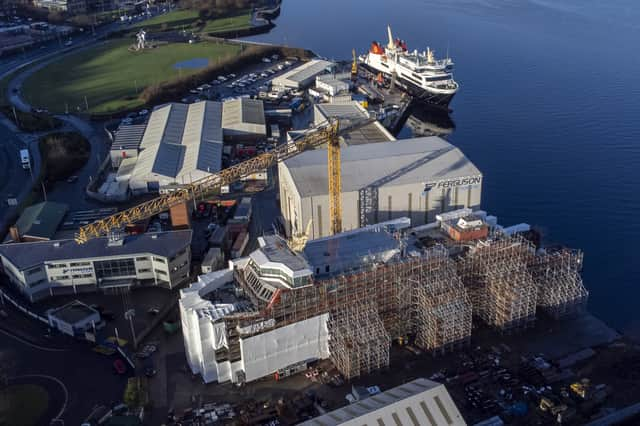

David McVeigh, business development director at Ferguson Marine, said that while superyachts were not a “core focus”, the yard had the relevant capabilities and skills to build them and would be open to exploring this with the right customer.
GMB Scotland, the biggest union at the yard, is focused on its campaign calling on the Scottish Government to directly award the contract for a new CalMac ferry.
Mr Sweeney, who chairs Holyrood’s cross-party group on maritime and shipbuilding, said Scottish superyachts could incorporate high-end local products such as Harris Tweed, Bridge of Weir leather and Linn audio equipment.

"I think it's definitely something that Ferguson's should explore in more detail,” he said. "Superyachts would be a really promising market for Scotland, just given all the hinterland that we have in terms of niche, high-end products."
Businessman Jim McColl previously put forward the idea of working on superyachts when he rescued the Port Glasgow yard from administration in 2014.
A vintage 25m (82ft) yacht was purchased, but later sold off by the Scottish Government when the yard was taken into public ownership in 2019.
Ferguson, the last commercial shipyard on the Clyde, has been embroiled in political controversy over the building of two CalMac ferries, MV Glen Sannox and Glen Rosa, which have been mired in delays.
Mr Sweeney said he believed there was “definitely potential in Scotland trying to establish a foothold” in the superyacht market.
He said: "Because generally the country is associated with some fairly high-end consumer products anyway, you could actually try and market it. Whether it's golf, whisky, high-end audio, high-end fabrics and textiles etc, I think there's actually something in this."
He added: "The Far East yards dominate on high volume, if relatively low value, shipbuilding. So I think we really need to think about where could Scotland get some commercial market share that would be sustainable."
In the first instance, Mr Sweeney suggested a yacht could be purchased, refitted and showcased at a boat show.
"I think there's something in that,” he said. “There's something quite exciting about that. But it would need a concerted effort to do something with the government and shipbuilders."
He added: “It’s just one example of a subsector or a niche that Scotland could probably have a decent shot at.”
However, the Glasgow MSP, who previously worked at BAE Systems on the Clyde, said the model for financing shipbuilding in Scotland needed to be reconsidered.
Mr McVeigh said: “While superyachts are not a core focus for us, we certainly have the capability and skill within our workforce to enable us to build them, as well as access to the right supply chain to achieve that high-end finish.
“If the right customer wanted the quality and strength associated with Clyde-built vessels coupled with, for example, Italian sparkle and luxury, we’d certainly explore that with them.
“We are, however, focused on securing new orders for commercial ships across different industries in what is a buoyant global shipbuilding market.
“We are also working to secure a share of the 150 vessels in the pipeline for the UK and devolved administrations over the next 30 years with the key to unlocking these opportunities for UK shipyards, including Ferguson Marine, in considering UK social value in the tenders."
Louise Gilmour, GMB Scotland secretary, said: "Of course, superyachts could be built in Inverclyde. But, for generations, the yard delivered small, reliable ferries serving Scotland's islands. The workers deserve the chance to do so again, starting with the new Lord of the Isles.
"Two weeks ago, [First Minister] John Swinney asked for more time, but the situation is beyond urgent. The last non-naval shipyard on the Clyde needs a ship to build.”
Deputy First Minister Kate Forbes said: “The decision to take Ferguson Marine into public ownership saved the last commercial shipyard on the Clyde and more than 300 jobs.
“The Scottish Government remains firmly committed to supporting the yard to competitively bid for future contracts and to securing a sustainable, long-term future that will be shaped by a business plan being finalised by Ferguson Marine.”
Comments
Want to join the conversation? Please or to comment on this article.