
Exclusive:SNP's top civil servant insists 'not everything is broken' amid pressure on services to make cuts

SNP ministers have pledged to cut £1.5bn from Scotland’s public sector.
Scotland’s most senior civil servant has refuted claims that “everything is broken” under the SNP’s management - amid a warning for the public sector to "get on with" cutting costs.
Joe Griffin, the Scottish Government’s permanent secretary, who earns £180,000 a year, has appeared to vent his irritation over hesitation within Scotland’s public sector to make required cuts and reforms amid a bleak financial backdrop.


Speaking at a conference on public sector reform, hosted by Glasgow University’s Centre for Public Policy, Mr Griffin also came to the defence of the Scottish Government - which has repeatedly been under fire for spiralising costs and public inquiries into several big infrastructure projects including the Edinburgh trams, new ferries and hospitals.
Mr Griffin warned that public sector reform, and the £1.5bn of cuts and savings needed to be made are, “one of the biggest challenges for this generation of the public sector”.
READ MORE: Lord Advocate's legal probe over seized Russian-flagged oil tanker amid extradition concerns
He pointed to the need to “transform our public services to be efficient, joined-up, preventative and sustainable in order to deliver better for communities”.
Mr Griffin said: “Ministers have been clear there is a financial component that drives reform. By our figures, the deficit set out in the medium-term financial strategy is projected to grow to £2.6bn by 2029-30.
READ MORE: Deposit return scheme case against SNP government thrown out by court amid 'wishful thinking'
“Public sector reform is an important component of our approach to tackling that gap. The fiscal position is pretty well known and is unlikely to change in the near future.”
But he claimed that cuts and reforms are “not just about saving money”, but part of the strategy is about “doing things differently” and trying to “improve outcomes”.
He called on the public sector to stop “waiting for instruction” and instead “to proceed until apprehended”.
Mr Griffin added: “I think there’s an awareness, a self-consciousness of the environment that we’re operating in.
“I think there’s an awareness of pressures that are on us, but public servants have just got to get on with it. I think it’s absolutely critical.”
Mr Griffin was pressed about the spiralling costs of public inquiries into policy failures such as the Edinburgh trams and children’s hospitals, alongside the soaring costs of ferries.

In response, he said: “Where there are inquiries into failure, we need to learn the lessons.
“We need to be a learning organisation that takes account of where things haven’t worked.
“I don’t subscribe to the view that everything is broken. But when mistakes have been made, we need to learn from that, we need to improve. That’s absolutely a part of our culture.”
Professor Graeme Roy, chairman of the Scottish Fiscal Commission, highlighted an “assumption from government that they are going to save £1.5bn on day-to-day spending”, warning that “crucially, £1bn of that is going to come from the health service”.
He stressed that the Scottish Government is “increasing health spending on the condition that the health service is going to make £1bn of efficiency saving over the next three years”.
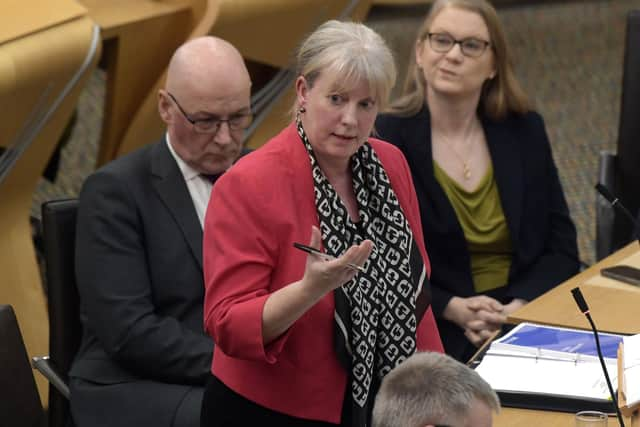
In her Budget speech last week, SNP Finance Secretary Shona Robison, confirmed that her government’s “approach to public sector reform will deliver £1.5 billion in efficiencies”.
She added: “(This will contribute to) helping us protect frontline services from the worst impacts of a tightening fiscal environment, not least due to constraints the UK government has put on Scotland’s budget - including the near £400m shortfall in funding as a result of the Chancellor’s decision to increase Employer National Insurance contributions.
“Our ambition is clear – a Scotland where public services work seamlessly for people, modern in their design and delivery, accessible where and when they are needed, flexible in how they respond, and consistently focused on the best outcome.
“In short public services that are centred on the needs of the citizen, not the needs of the system.”
Comments
Want to join the conversation? Please or to comment on this article.