
SNP's pre-election Budget favours soundbites over substance
The SNP is comfortably ahead in the polls, and does not want to rock the boat

There were no major giveaways. No rabbits pulled triumphantly from hats. Nevertheless, this was a Budget firmly focused on the upcoming Holyrood election.
Finance Secretary Shona Robison, an MSP since 1999, may not be standing again, but her draft tax and spending plans were aimed squarely at May’s vote.
She outlined measures to support families, cut business rates and reduce the tax burden for lower earners, all of which will no doubt be welcomed by those affected.
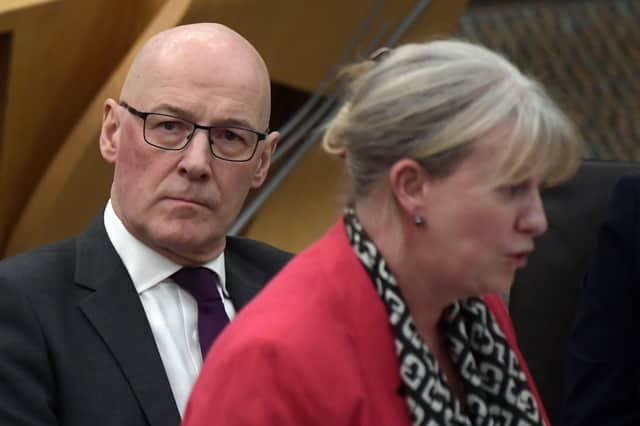

But ultimately, this was about not rocking the boat. The SNP is comfortably ahead in the polls. Meanwhile, finances are tight and public services are under strain, leaving ministers with little room for manoeuvre.
“This was a continuity bank manager Budget,” a disgruntled Labour figure told me, referring to First Minister John Swinney’s slightly boring reputation. “There’s nothing to it.”
Many of the announcements seemed geared towards generating slogans on SNP election leaflets. Take the changes to income tax, for example. The thresholds for the basic and intermediate rates will increase by 7.4 per cent, more than twice the rate of inflation.
“As a result, even more people in Scotland can expect to pay less tax than if they lived in England, Northern Ireland or Wales,” Ms Robison told MSPs. “That’s over 55 per cent of Scots set to pay less income tax because they live in Scotland.”
In reality, compared with the current tax year, this represents a maximum saving of £31.75, or 61p a week. Meanwhile, those earning more than £33,493 will pay more tax than elsewhere in the UK, and someone earning £50,000 will pay £1,496 more.
It is hard to avoid the conclusion this was about soundbites, rather than substance.
Elsewhere, a national insurance anomaly meaning those earning between £43,663 and £50,271 pay a marginal tax rate of 50 per cent, compared to 28 per cent elsewhere in the UK, remains in place.
I asked Ms Robison why the Budget had done nothing to address this. “I appreciate the issue,” she said. “It’s been raised with me before. But addressing it is very, very costly indeed.” It would be “eye-wateringly expensive”, she added.
In an eye-catching move, SNP ministers announced their own version of the mansion tax unveiled by the UK Labour government last year. This will see two new council tax bands introduced by April 2028 for houses worth more than £1 million.
Of course, the Scottish housing market is very different to the south-east of England, and only 391 such properties were sold north of the Border in 2024/25. Ms Robison said the move could raise around £16 million, which is, frankly, small beer.
She was unable to say how much money might be raised by separate plans to bring forward a private jet tax in 2028/29. “There will be analysis done about the number of private jets operating in and out of Scotland,” she told journalists.
“I think it’s about a principle though, that private jets are operating more these days than they ever were in the past, and I think the owners of them can make a contribution to our public services and our revenues.”
Funding to deliver a breakfast club for every Scottish primary and special school by August 2027 will no doubt be welcomed by parents, as will more wraparound support in the afternoons and early evenings.
Thousands of young Scots will also have access to a range of free sport activities this summer, including “a universal learn to swim offer for every single primary school child in our land”.
But the SNP manifesto in 2021 promised to provide “free school breakfasts and lunches to every primary school pupil in Scotland, all year round”, so this is not a new pledge. Indeed, it has actually been delayed.
Asked about this by journalists, Ms Robison blamed the impact of Covid. “What we’re doing is focusing this Budget on key measures that are deliverable, are affordable, and help families, and I think families will welcome what we’ve set out,” she said.
Then there is the annual showdown with councils. Funding for local government is set to increase by 2 per cent in real terms, which is below inflation. Last year, Scots faced steep council tax rises, and similar hikes this year would dwarf any savings on income tax.
“We have given a reasonable settlement to local government, as we have in other years,” Ms Robison told journalists. “For that, as I said in my statement today, we would hope that council tax increases would be at a reasonable level.”
A source close to Mr Swinney conceded there will likely be “lots of noise” around the issue in the coming weeks, but played down any looming row. “When is there ever not noise?” they said. “It’s not high on my worry list.”
There is also what Ms Robison chose not to highlight in her speech. The respected Fraser of Allander Institute pointed to “a significant cut” in spending.
“Relative to plans laid out in June, the Finance Secretary has had to cut day-to-day spending by £480 million, largely due to much weaker underlying tax forecasts from the Scottish Fiscal Commission,” its deputy director João Sousa said.
This Budget allows the SNP to head into May’s election having mirrored many of the UK Labour government’s key announcements, while going further in areas such as tax.
An increase in the Scottish Child Payment for families with children under one also helps Mr Swinney underline his commitment to tackling child poverty.
It is a careful and relatively drama-free set of proposals, with an emphasis on easy headlines. But those looking for bold new ideas will be disappointed.
Comments
Want to join the conversation? Please or to comment on this article.