
Exclusive:SNP 'squandering' £16bn of ScotWind investment amid wind turbine manufacturing fears

Up to £16 billion of renewables manufactured pledged to take place in Scotland could be lost due to a lack of infrastructure and facilities
SNP ministers have been accused of “squandering the opportunities of the green revolution” amid fears up to £16 billion of wind farm manufacturing promised to Scotland may be forced to take place overseas.
The Scottish Government has been warned it risks repeating the mistakes of the past, which has seen Scotland scale up offshore wind, but fail to reap the economic benefits despite then first minister Alex Salmond declaring back in 2011 the country was to become the “Saudi Arabia of renewables”.
Union bosses have warned jobs and skills associated with the renewables boom will continue to be shifted overseas, despite a flagship round of seabed leases meant to ensure that a certain proportion of manufacturing takes place in Scotland and the UK.
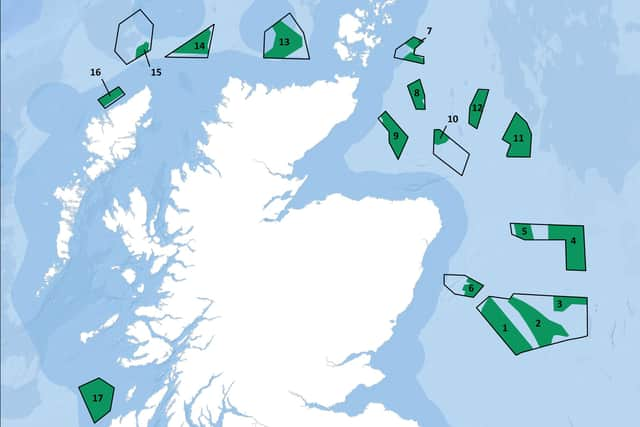
Analysis by The Scotsman shows the energy companies who won offshore contracts through the ScotWind auction in 2022 have pledged a total of £16bn to fund manufacturing and fabrication of turbines and offshore infrastructure in Scotland.
Despite the huge pledges, manufacturing and fabrication commitments outwith Scotland total at least £38.1bn - although some companies have declined to publish their pledges for outside the UK.
But concerns have been raised over the promised £16bn of manufacturing investment in Scotland, with not a single factory capable of producing wind turbines up and running in the country.
Vestas intends to lodge plans for a facility to construct turbine blades in Leith, inside the Forth freeport zone, which would be Scotland’s first and the UK’s third such yard. But no final investment decision has been made, with more certainty on orders by offshore wind developers required.
Ahead of the energy companies stepping into their lease of the seabed from Crown Estate Scotland, they will need to hand over an updated statement, which will be assessed by officials. Although companies could be fined if they do not live up to manufacturing commitments, it is likely they would be able to point to a lack of infrastructure and facilities for justifying offshoring the production.
In their statements, the companies behind the Green Volt project warn they see “rest-of-world fabrication of sub-components, shipped to the UK for assembly, as the most feasible approach”.
ESB, the firm behind the Sealtainn development, said “when assumptions on cost-competitiveness of Scottish yards and ports relative to other providers in Europe and elsewhere were introduced to the model”, it concluded “the majority of floating platform fabrication is likely to occur abroad, with specific works packages such as final assembly and commissioning of sub-structure components undertaken through a regional base such as Shetland or North East Scotland”.
Shell and Scottish Power, who are jointly developing the CampionWind and MarramWind projects, have warned “it is evident that significant investment will be required into Scottish facilities to prepare the Scottish market for the pipeline of projects which will be developed through ScotWind leasing”.


They added: “By leveraging the global supply chain, investment opportunities will be created to drive a world-leading floating offshore wind supply chain in Scotland with potential export opportunities to the global market.”
BlueFloat Energy and Renantis, who won the Bellrock lease, have said “the skills gap in the offshore wind industry is significant and as the UK’s offshore wind targets and project pipeline increases”, pointing to “further challenges with regards to ensuring we have the required resources to deliver these projects”.
SSE Renewables, Marubeni Corporation and Copenhagen Infrastructure Partners - behind the Ossian offshore project - have stressed there is “a significant opportunity to bring new capabilities to manufacture offshore export and inter-array cables in Scotland”, as well as “scope to increase the proportion of wind turbine generator blades made in the UK for future based on recent investments in new and existing facilities”.
Richard Hardy, national secretary for energy trade union Prospect, told The Scotsman “there won’t be any investment because we don’t have any capacity”.
He said: “The manufacturing investment won’t happen until we have the ability to manufacture the stuff for ScotWind. There is very little at the moment in terms of capacity. We have been saying this for five years - it is very frustrating. We won’t get a wealth return in Scotland until we have the ability to build the stuff in Scotland.”
Mr Hardy added: “It would be great if there’s £16bn to spend, but if they spend it here, there’s not very much for them to spend it on.
“Everybody is ahead of the game now - turbine manufacturers in Korea and Denmark are way ahead of the UK, so we should really just be looking at floating wind. That’s where we should be focusing our manufacturing investment.
“If companies can save a couple of million by doing it overseas, they will do it overseas. It’s all a bit of a mess at the moment. There’s money being spent, but just not at the scale we would like in Scotland or the UK.”
Louise Gilmour, GMB Scotland secretary, said: “It is sadly no surprise that lucrative renewables contracts and skilled jobs continue to be off-shored. If contracts could be won and jobs created by big talk and empty promises, we would be in a far better place.
“Seizing the manufacturing opportunities of renewables will demand an industrial strategy for Scotland and the will to deliver it. Solid plans and the necessary investment are needed, but so are decision-makers acting with urgency and ambition.
“For years, we have heard about what might happen tomorrow while nothing at all happens today. Investment plans with real potential to build our industrial capability and create skilled, well-paid jobs are talked to death before being quietly forgotten.
“With urgency, ambition and investment, Scotland can begin to exploit the opportunities of renewables. Without it, those opportunities will continue to be squandered.”
Emma Harrick, head of energy transition and supply chain at trade body, Scottish Renewables, said “significant investment in our industry” is required to make the most of “an unprecedented opportunity to grow the renewable energy supply chain in Scotland and to establish the facilities we will need to manufacture and supply the components for wind turbines”.

She stressed that despite “several major announcements from international investors highlighting the intense global interest in Scotland’s renewable energy resource” this year, “we will need to unlock further funding to establish new industrial manufacturing hubs to maintain our position as a world leader in floating offshore wind”.
Ms Harrick added: “To build investor confidence, there are a number of barriers to deployment that must be addressed, not least those of timely planning and consenting, grid connections, growing a local supply chain, establishing essential infrastructure and developing the skills and resource needed for Scotland to make the most of its offshore wind potential.”
The new Labour government at Westminster has pledged to boost manufacturing of renewables to ensure Scotland and the UK better enjoys the financial benefits of the renewables boom.
Scottish Labour net zero spokesperson Sarah Boyack said “The SNP Government has not only sold off Scotland’s seabeds on the cheap, but it has failed to ensure that supply chain investment comes to Scotland.
“Once again the SNP is squandering the opportunities of the green revolution and allowing jobs and investment to go overseas – but Labour will make Scotland a clean energy superpower.”

She added: “Labour’s plans for a publicly-owned GB energy company will make Scotland a world-leader in renewables and bring the jobs of the future here, as well as driving down bills and delivering energy security.
“The SNP must follow Labour’s lead and set out a real plan to deliver green jobs and make sure Scotland feels the benefit of the ScotWind contracts.”
A Scottish Government spokesperson said: “The Scottish Government is committed to maximising the economic opportunities for the Scottish supply chain from our offshore wind potential, and the conditions around licence options for ScotWind include a developer obligation for local supply chain.
“We are also investing up to £500 million to anchor our offshore wind supply chain in Scotland, with investment of up to £67m to support the sector in 2024/25.
“This investment will support market certainty, helping to create a highly productive, competitive economy, providing thousands of new jobs, embedding innovation and boosting skills.”
Comments
Want to join the conversation? Please or to comment on this article.