
Exclusive:SNP ministers 'must tackle Dickensian low pay' in social care sector
Theresa Shearer, the chief executive of Enable, said pay must be boosted or reforms will be irrelevant

SNP ministers must tackle “Dickensian” levels of low pay in the social care sector or their planned reforms will be irrelevant, the chief executive of one of Scotland’s largest social care organisations has said.
In a strongly-worded intervention, Theresa Shearer of Enable, which supports people with learning disabilities and their families, said the wider sector will continue to suffer "horrific" levels of sickness and staff turnover until the issue is addressed.
"Whatever their blueprint is, if it doesn't include sectoral bargaining and parity of pay then the rest of it becomes irrelevant," she told The Scotsman.
First Minister John Swinney has said overhauling social care will be a key part of his planned public sector reforms, which include slashing the number of NHS boards in Scotland from 14 to two.
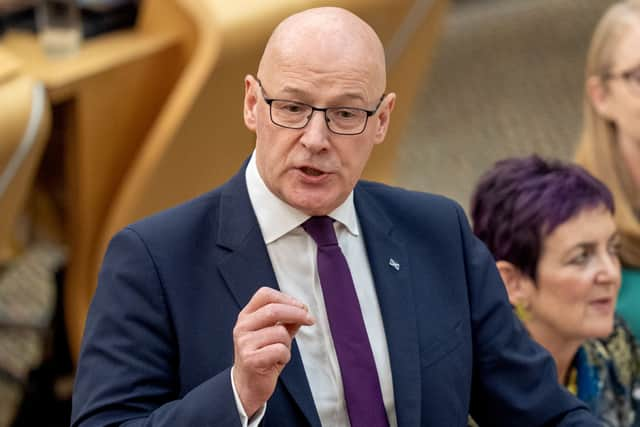

Addressing MSPs earlier this month, he said the current social care arrangements are “overly complex” and there should be “a single line of decision-making, accountability and funding, with the NHS taking the lead”.
Ms Shearer, who has led Enable since 2015 and is also vice president of the European Association of Service Providers for Persons with Disabilities, said Mr Swinney’s plans were "ambitious" and had moved social care up the agenda in Scotland.
However, she insisted reform must be built on a foundation of better pay and conditions. Research by the Health Foundation previously found one in five residential care workers in the UK lives in poverty, while 15 per cent rely on Universal Credit.
"If you're having your workforce facing in-work poverty, and if your child is more likely to face material deprivation because you work in care, not in the NHS but outside the NHS, then anything you do around the periphery won't matter,” Ms Shearer said.
She added: "We need to commit to, that whatever reform looks like, it will be built on the foundations of parity of pay with the NHS."
Ms Shearer said there is a “human, moral argument” for this based on inequity, but there is also an economic argument, “which is we're going to continue to have horrific levels of turnover, horrific levels of sickness, haemorrhaging money” and people experiencing a “lower quality of care” until the issue is fixed.
She said: "Imagine going to work every day and working in care, which is often difficult, where you are making decisions to support an individual to live a life in their community.
"That is a rewarding role, of course it is, but it's a complex and demanding role, and so to go out to work and to not even be assured of not having to deal with in-work poverty appears to me Dickensian."
She added: "For me, the foundation of reform has to be the terms and conditions of the frontline social care workforce."

Ms Shearer said she would support the idea of a new living wage targeted at the social care sector, to give it "parity with the NHS as a minimum".
She added: "We already know that not only is social care underfunded, but there are significant levels of unmet need in social care."
Elsewhere, Ms Shearer said the sector needs to be simplified. Scotland has 1,300 social care providers for a population of 5.5 million people, she said, while Sweden, which has roughly double Scotland’s population, has significantly fewer and achieves some of the highest satisfaction rates of anywhere in the world.
She argued the sector should also implement reforms itself.
"What are we going to do as a sector to help improve those terms and conditions?” she asked. "For example, one of the things that Enable does is pays above the Scottish Living Wage.”
She said the charity, whose 3,500-strong workforce supports more than 15,000 people, is able to do this partly because it has integrated with three other charities and “created some economies”.
Scottish Conservative health and care spokesman Miles Briggs called her comments a “damning indictment of the SNP’s shocking failure to support Scotland’s social care over the last two decades”.
He said: “Local care services are in permanent crisis and hardworking staff have been abandoned by SNP ministers. John Swinney is still refusing to provide any detail on his public sector reforms, but he cannot plough ahead without listening to those on the frontline.
“If they are ill-thought-out, then they could have even more devastating consequences for those working and reliant on Scotland’s care providers.”
Scottish Labour health spokesperson Jackie Baillie said: "Social care is at breaking point, and it is piling pressure on our entire NHS. We will never fix the chaos in our NHS without dealing with the crisis in social care.
“The SNP needs to properly support social care services and deliver fair pay and conditions for workers. Scottish Labour has been clear in calling for social care pay to be raised to a minimum of £15 per hour.”
SNP community care minister Alison Thewliss said: “We value the vital role social care workers play in delivering high-quality care.
“We are committed to further improving support for the social care workforce and the introduction of sectoral bargaining is progressing in partnership with both trade unions and provider representatives.
“Once in place this will help drive improvements in pay and terms and conditions, building on the support for payment of the real living wage that the Scottish government has helped enable since 2016.
“Our 2026 programme for government committed to an intensive dialogue with local government over the next three months to reach a shared vision on the reform of social care which makes best use of the funding in the system, delivers fairer and more efficient services and achieves economies of scale, while maintaining a focus on community need. We fully recognise that supporting the workforce is a critical element of delivering that reform.”
Comments
Want to join the conversation? Please or to comment on this article.