
Exclusive:SNP Government told avoiding cuts ‘impossible’ without following UK welfare reforms
The fresh analysis from the Institute for Fiscal Studies follows the Chancellor’s Spring Statement on Wednesday

It is “almost impossible” for the Scottish Government to avoid cuts to other services if they choose not to follow the UK government’s welfare reforms, the Institute for Fiscal Studies (IFS) has warned.
Finance Secretary Shona Robison had vowed the Scottish Government will do “everything in its power” to avoid passing on UK benefit cuts unveiled in the Chancellor’s Spring Statement.
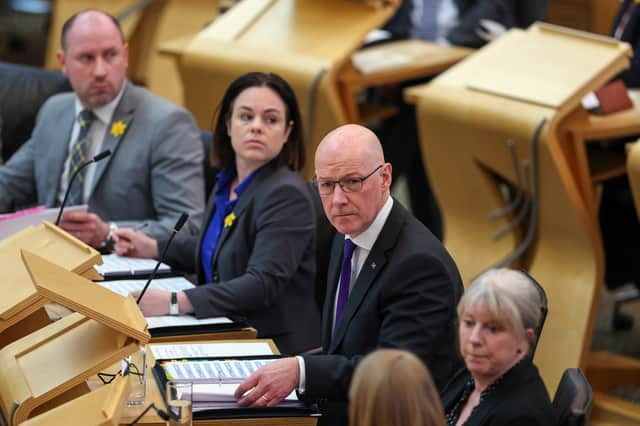

The package is expected to save £4.8 billion rather than the more than £5bn in 2029/30 hoped for by UK ministers.
Now David Phillips, the head of devolved and local government finance at the IFS, has said avoiding welfare cuts would mean the Scottish Government reducing budgets elsewhere.
He said: “What the Chancellor announced on public service spending across the UK as a whole is an average 1.2 per cent increase in day-to-day public service spending between 2025/26 and 2029/30. That’s averaging 1.2 per cent in real terms across the UK as a whole.
“The Scottish Government has got a higher level of public spending per person, but the way the Barnett Formula works is not to give the same percentage, but the same pound per person increase. So it will be less than a 1.2 per cent increase in Scotland, it might be a 0.9 per cent increase.
“If you start to use some of that money for benefits, it will be almost impossible to avoid cuts, if you want to meet the pressures on welfare. Some kinds of unprotected cuts will almost certainly be needed, even without finding £500 million for benefits.
“The Scottish Budget will increase, health and social care will probably absorb all of that and more. So even in the absence of this, you are looking at cuts in some areas.”
The issue had caused a spat between the administrations. Ms Robison has condemned what she described as “austerity in stilts” from the Spring Statement, claiming: “The UK government appears to be trying to balance its books on the backs of disabled people.”
Scotland Secretary Ian Murray has instead insisted there is no cut to the block grant.

Mr Phillips, who is also an associate director at the IFS, explained they were both right.
He said: “Shona is right in saying the budget you are giving us means we have to make some cuts in some areas. The UK government is right saying they are increasing your overall funding, and are increasing it on what the last Westminster government was planning to give you.
“They should be trying to find as much as they can in way of productivity. There is a belated realisation in Scotland that productivity did fall during pandemic, there are issues particularly with hospitals and schools. But the real question is, when you have to find this amount of money, you can cut back on a range of unprotected services, or look at what the government is doing, what are we paying for, do we need to be more focused and do less in some areas.”
In addition to issues in the short term, Mr Phillips also warned the Scottish Government was facing long-term funding issues due to the “Barnett squeeze”. The University of Strathclyde’s Fraser of Allander Institute has predicted the Scottish Budget will be around £900 million worse off by 2029/30 than previously projected.
“Traditionally Scotland had a lot more money per person than England for historical reasons,” Mr Phillips said. “Because of that function of the Barnett [formula], because its pound per person increases, we think that funding is going to be slowly eroded.
“It’s not just the tough choices in this budget, it’s a feature of the funding system. It will slowly erode the extra funding that Scotland gets. In 2020, it got 30 per cent more spend per person. In the long run, that might fall to 15 per cent per person. That’s quite a big change. I don’t think the Scottish Government has grasped that and, if it has, it’s not tackled it.”
Ms Robison said: "Eradicating child poverty is the Scottish Government’s top priority. Our policies, like the Scottish Child Payment, are having to work harder than ever to counteract the impacts of UK government decisions.
“We will work through the detail of the Spring Statement, ahead of our medium-term financial strategy publishing later this year and the UK Spending Review in June."
Comments
Want to join the conversation? Please or to comment on this article.