
Exclusive:SNP accused of 'stifling economic growth' after £9m annual retail rates surcharge revealed
SNP ministers have been urged to cut business rates.

Commercial premises in Scotland have paid out almost £600 million more in business rates than counterparts south of the Border due to a surcharge, with the set up costing retailers around £9m extra each year.
SNP ministers have been accused of “stifling growth” after it emerged that commercial premises in Scotland liable for the ‘higher property rate’ have cumulatively paid an extra £580 million more in business rates than their equivalent-sized counterparts in England over the past ten years.


Any business that uses, or has the right to use, a property with a rateable value of more than £100,000 will pay an extra 7p on top of the rate poundage, which is set by the Scottish Government each year.
This means that those business will pay 56.8p in 2025-2026 for every £1 of rateable value - known as the higher property rate.
Analysis of Scottish Government figures shows that the retail industry's share of the divergence from England amounts to £93m over the 10-year period, excluding the pandemic when businesses received 100 per cent business rates waiver - around £9m each year.
Offices have paid out an extra £73m compared to English counterparts, while manufacturing sites have been charged £91.7m and hotels have faced £20.3m from the surcharge.
There are 11,360 business premises in Scotland that are subject to the ‘higher property rate’, of which 2,380 are shops.
Retail bosses have warned against the ‘slab tax’ which means the higher rate applies to each and every pound of a property’s rateable value, rather than a progressive scale.
Divergence with England began in the spring of 2016, when the higher property rate, then called the large business supplement, was doubled.
The Scottish Government-commissioned Barclay Rates Review in 2017, described the surcharge as “damaging perceptions” of Scotland’s competitiveness, which called for parity with England to be restored by Spring 2020, now five years ago.
David Lonsdale, director of the Scottish Retail Consortium, said: “It’s a challenging enough time for Scotland’s shops and retail destinations with retail sales and footfall at best flatlining while statutory costs shoot up.

“Over and above this almost 2,500 Scottish stores are having to stump up more in business rates than their counterparts in England, to the tune of £9 million a year. This Scotland-only surcharge makes it even more expensive to operate a store on our high streets and to trade profitably.
“We’re flummoxed as to why the Scottish Government thinks thousands of stores and other businesses operating here in Scotland are better placed to fork out more in business rates than similar sized premises down south.
“It’s not in the interest of Scotland’s economy for shop owners to be incentivised to invest in Berwick-upon-Tweed over Balloch, Bathgate or Brechin. We need a firm commitment from ministers to reduce business rates and ensure that Scots retailers are never again charged more than their counterparts down south.”
First Minister John Swinney has claimed that under his leadership, the SNP and the Scottish Government has fostered a better relationship with the business community than his predecessors.

Mr Swinney’s four key priorities in government include growing the economy, while many business leaders were unimpressed with the SNP’s co-operation agreement with the Scottish Greens who do not recognise economic growth or GDP as a measure of positivity - an arrangement Mr Swinney has not revisited, while he has actively opposed Green policies.
In his first programme for government last year, the First Minister stressed that “small and medium-sized businesses are the backbone of our economy”, as he pledged to “deliver the commitments set out in the New Deal for Business” - a strategy initially established in 2023.
In January, the First Minister warned that he was “left with the sense that Scotland’s economy is not performing as well as it should”.
He added: “Scotland’s unfulfilled economic performance – compared to both peers and pure potential – is not a recent development. It has been our national reality for decades.”
But political opponents have criticised the SNP for the party of government’s attitude to business and hit out at the divergence in business rates with traders south of the Border.
Scottish Conservative shadow business secretary Murdo Fraser MSP said: “It’s frankly shameful that the SNP have made Scottish businesses fork out over £500 million more than their counterparts down South.

“The SNP are anti-business and anti-growth. They just don’t get how hard local business owners are working to make ends meet.
“Only the Scottish Conservatives have a plan to support entrepreneurs by passing on 40 per cent business rates relief to Scottish retail, hospitality and leisure businesses.”
Scottish Labour’s business spokesperson, Daniel Johnson, warned that policies brought forward by SNP ministers were acting as a barrier to economic growth.
He said: “This is yet another example of SNP economic incompetence hammering businesses and stifling growth.
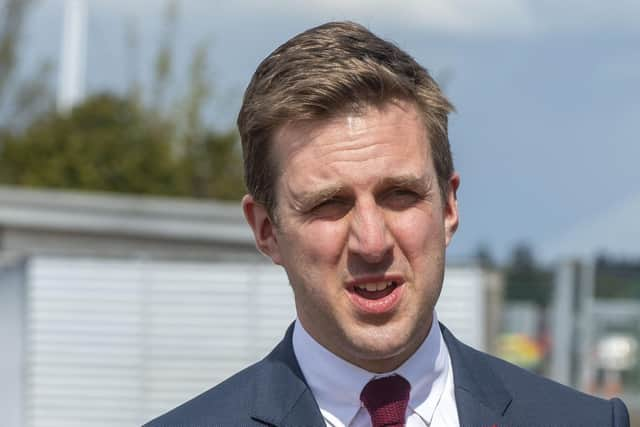
“It is simply wrong that businesses are being penalised by this government.
“Scottish businesses are fed up with paying more and getting less in return.”
A Scottish Government spokesperson said: “The Scottish Government is working closely with businesses to drive economic growth and prosperity in our towns, cities and communities and provide support through a competitive non-domestic rates relief package worth an estimated £733 million this year. This includes the most generous small business rates relief in the UK.
“However, we are doing all of this without the full economic powers needed to fully address the issues facing Scotland’s economy. We need decisive action from the UK Government, including a reversal of its damaging decision to increase employers’ national insurance contributions which is severely hampering business confidence, investment, growth and jobs.”
Meanwhile, a separate report has revealed profit alerts among UK retailers more than doubled in the second quarter as consumers reined in their spending and firms faced soaring wage costs.
The latest report from EY-Parthenon also showed that overall profit warnings among UK-listed firms jumped by a fifth year-on-year in the second quarter – with a record proportion citing policy changes and geopolitical uncertainty as the leading factor.
The data showed that seven UK-listed retailers, including supermarkets, cut profit guidance between April and June.
Britain’s retail sector has come under significant pressure since last autumn’s Budget move to hike National Insurance Contributions (NICs) and the minimum wage, both taking effect in April.
But EY said the high street was also facing tough consumer spending challenges, with shoppers cutting back and focusing on value.
EY partner Silvia Rindone said the spike in retail warnings “highlights both softening consumer demand and the deeper structural headwinds facing the sector”.
“Retailers we speak to tell us that falling sales are currently indicative of a longer-term shift, with consumers becoming more value-focused and less brand-local, which leaves cost-pressured retailers in a bind,” she said.
Tariff woes sparked by US President Donald Trump waging a trade war also featured heavily in the report, contributing to a rise in the number of alerts more widely across corporate plc.
The report found that the number of profit warnings issued by UK-listed companies rose by 20 per cent to 59 in the second quarter compared with 49 a year ago.
The top factor was policy change and geopolitical uncertainty, cited in nearly half (46 per cent) of all warnings – up from 4 per cent a year earlier and the highest since the study was launched more than 25 years ago.
Comments
Want to join the conversation? Please or to comment on this article.